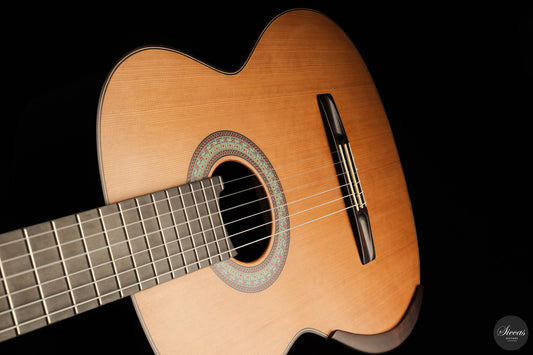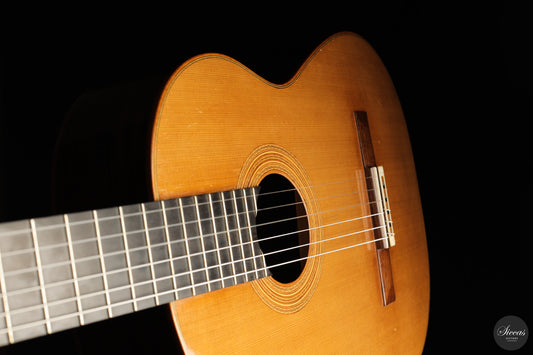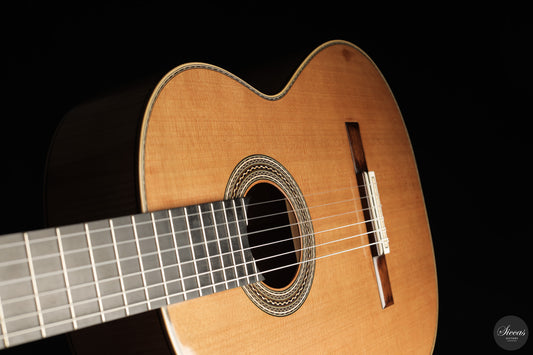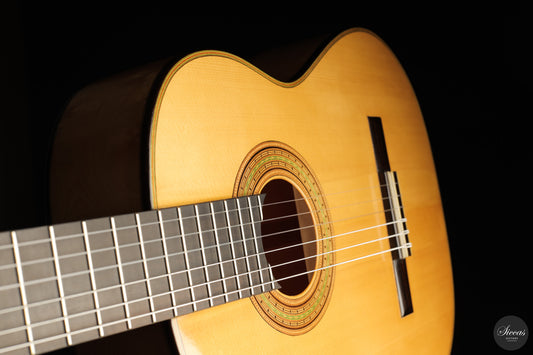

José Luis Romanillos – Scholar, Luthier, Julian Bream's Maker
José Luis Romanillos was born in Madrid in 1932. He emigrated to England in the 1950s, established a workshop, and spent the following decades building classical guitars of the kind that rarely reach the open market. His name is inseparable from two things: the instruments he made for Julian Bream, and the book he wrote on Antonio de Torres — a study that remains the definitive scholarly text on the man who shaped the modern classical guitar.
From Madrid to England: The Early Career
Romanillos arrived in England during a period when the classical guitar was gaining serious concert traction in the English-speaking world. Andrés Segovia had established the instrument's credentials internationally; in Britain, Julian Bream was doing the same. The demand for instruments capable of sustaining concert-level performance was real, and there were very few makers positioned to meet it.
Romanillos trained within the Spanish tradition. He absorbed the construction methods associated with Antonio de Torres — the nineteenth-century Almería luthier who defined the structural logic of the modern classical guitar — not as inherited habit but as a subject requiring investigation. He wanted to understand why Torres made the decisions he did, not simply copy them. That intellectual orientation set him apart from most of his contemporaries.
His early instruments attracted the attention of serious players. The connection with Julian Bream, when it developed, was the result of a shared seriousness about what the guitar could do and what it needed from its maker to do it.
Julian Bream and the Romanillos Partnership
Julian Bream (1933–2020) was the most consequential figure in the development of the classical guitar as a concert instrument in Britain. He expanded the repertoire aggressively — commissioning works from Benjamin Britten, Hans Werner Henze, William Walton, and others — and recorded the lute repertoire at a time when early music had not yet become a specialist field. His range, from Renaissance transcriptions to works written for him in the 1970s, placed extreme demands on the instruments he used.
Bream chose Romanillos guitars for concert performance across much of his career. The instruments needed to handle dynamic contrasts across four centuries of repertoire, project clearly in large halls, and remain consistent under the physical demands of heavy use. That Bream continued to play them over such a long period is the most direct evidence available of their quality. Endorsements can be arranged; decades of consistent professional use cannot.
The partnership also shaped Romanillos as a maker. Building for a player of Bream's specificity and ambition pushed the instruments in directions they might not have reached had they been built for a less demanding market. The feedback loop between a player who knows exactly what he needs and a maker who has the technical resources to respond to that is rare, and it shows in the instruments.
For an overview of the repertoire Bream and his contemporaries developed, see our article on famous classical guitar pieces.
Antonio de Torres, Guitar Maker: The Book
In 1987 Romanillos published Antonio de Torres, Guitar Maker — His Life and Work. The book was the result of years of direct access to surviving Torres instruments in collections across Spain, combined with archival research and the practical knowledge of a working luthier who had spent his career building in the same tradition.
Torres (1817–1892) built guitars in Almería and Seville across two distinct working periods. He introduced fan bracing under the soundboard — a system that remains standard on classical guitars today — established the scale length most makers still use, and brought a consistency and ambition of design that transformed the guitar from a domestic parlour instrument into something capable of filling a concert hall. Before Torres, the guitar's structural logic was inconsistent across regions and makers. After him, it was not.
Romanillos documented Torres instruments with the precision that only someone who builds in the same tradition can bring to the task. Measuring brace dimensions, top thickness, neck geometry, and body proportions on surviving instruments requires understanding what you are measuring and why it matters. A historian without lutherie experience can record dimensions; they cannot reliably interpret their acoustic significance. Romanillos could do both.
The book has remained in print for nearly four decades. It is used by luthiers, researchers, and conservators worldwide. No comparable study of Torres has superseded it. This is not because the subject has been exhausted — it is because the combination of technical authority and historical rigour Romanillos brought to the project is difficult to replicate.
The connection between Romanillos's scholarship and his workshop practice is direct. Understanding why Torres positioned his fan braces as he did, why the body proportions are what they are, why the top thickness tapers toward the edges — this understanding informs every decision a luthier makes. Romanillos's guitars are not copies of Torres instruments, but they are built by someone who understood Torres construction at a level few makers have ever achieved.
Construction: The Spanish Tradition in Practice
Romanillos works within what is known as the Spanish school of guitar making. The defining structural feature is the solera method: the top and neck are built as a single unified structure on a flat workboard before the back and sides are added. This produces a specific neck-body geometry — the neck angle, the break over the soundboard, the relationship between the string plane and the top — that affects the instrument's playability and response under playing tension.
Tonewoods
The tonal character of a classical guitar is determined largely before a joint is cut. The choice of top wood — spruce or cedar — shapes the instrument's dynamic response and tonal color. Spruce tops tend toward clarity and projection; cedar tops respond more easily at low playing pressures and produce a warmer immediate tone. Both are legitimate choices for concert instruments, and the right answer depends on the repertoire and the player's technique.
Back and sides are typically rosewood or cypress. Rosewood instruments tend toward warmth and sustain; cypress produces a brighter, drier sound more associated with flamenco but also used in some classical instruments. The neck is generally cedar; the fingerboard ebony. Within these parameters there is enormous variation. The specific piece of spruce — its density, its grain spacing, how it responds to tap testing — determines much of the instrument's final character. Selecting tonewood is itself a skill that takes years to develop reliably.
Fan Bracing
The soundboard bracing pattern is the central structural decision in classical guitar making. Romanillos uses the fan-bracing system that Torres established, with individual braces shaped and graduated by hand until the top vibrates at the desired frequency distribution across its surface. This is not a process that can be reduced to templates. The target is a top that responds evenly, without dead spots or over-stiff areas, across the full playing range. Achieving it requires removing material incrementally and testing constantly — the same iterative process Torres was using in the 1860s.
Finishing
Traditional Spanish guitars are finished with French polish — shellac applied by hand in many thin layers. French polish is acoustically transparent in a way that harder finishes are not; it adds almost no mass to the soundboard and does not damp the wood's vibration. It is also more fragile than modern lacquer and more labor-intensive to apply correctly. Its use is a deliberate choice that prioritizes acoustic performance over durability.
Liam Romanillos: Continuity of Craft
Liam Romanillos, son of José Luis, is an established luthier working within the same tradition. Growing up in a household where guitar making was the central professional and intellectual activity gave him an immersion in the craft that no formal training program can replicate. He has developed his own approach while maintaining the same commitments to historical understanding and tonal integrity that define his father's work.
Two generations of high-level lutherie within a single family is unusual. The knowledge of how materials behave, how instruments change over decades, how to read a piece of wood before it becomes part of a guitar — this accumulates slowly and is not easily transferred outside of sustained, close collaboration. Liam had access to that collaboration from childhood.
His instruments are built for the same market as his father's: players who understand the tradition they are buying into and who have the technique to hear the differences that separate instruments at this level. They are not production instruments optimised for retail appeal. They are hand-built objects reflecting a specific tradition and a specific maker's understanding of it.
The Torres Line: Why the Nineteenth Century Still Matters
The continuity the Romanillos family maintains with Torres is practical rather than sentimental. Torres solved the fundamental structural problems of the classical guitar in the mid-nineteenth century. The fan-bracing system he refined, the scale length he established, the body proportions he developed — these remain the most effective solutions available. Subsequent makers have introduced refinements: adjustments to bracing geometry, experiments with alternative materials, modifications to body depth and width. But the core of what Torres established is still the basis of most serious concert guitars built today.
The reason Romanillos's Torres scholarship matters to his lutherie — and to anyone trying to understand the instruments he built — is that it makes the tradition legible. A maker who knows why Torres made his decisions is positioned to make informed choices rather than follow convention blindly. The distinction between following a template and understanding its logic is the distinction between craft and mastery.
Francisco Tárrega, who was among the first major concert guitarists to work with Torres instruments, demonstrates how decisive the maker-player relationship can be. You can read more about that connection in our article on Francisco Tárrega. For the piece most closely associated with the Torres-Tárrega era, see our article on Recuerdos de la Alhambra.
The Place of Romanillos in the Twentieth-Century Luthier Tradition
The second half of the twentieth century produced a generation of exceptional guitar makers working outside Spain who absorbed the Spanish tradition and extended it. José Ramírez III in Madrid, Hermann Hauser II in Germany, David Rubio and Robert Bouchet in their respective contexts — these makers were responding to the same phenomenon: a concert repertoire that was expanding rapidly and players who needed instruments to match.
Romanillos occupies a specific position in this history. He is not primarily a maker who experimented with alternative construction methods. His contribution is the combination of exceptional craft within the established tradition and a scholarly understanding of that tradition's foundations that is without parallel. The Torres book is not a sideline to his lutherie. It is an expression of the same intelligence applied to a different medium.
For context on the players who drove demand for instruments at this level, our overview of great classical guitarists covers the figures whose careers shaped twentieth-century guitar making. Agustín Barrios, working earlier in the century, represents a different strand of the same story — see our article on Agustín Barrios.
Romanillos Guitars at Siccas
Siccas Guitars carries instruments from makers working within the tradition that José Luis Romanillos helped define and document. Our classical guitar collection includes instruments from luthiers who share the same commitment to historical understanding and tonal integrity that the Romanillos name represents.
Instruments built at this level are intended for players who have the technique to engage with what the guitar offers. They respond to the player's touch with a specificity that simpler instruments do not have — and they expose technical weaknesses as clearly as they reward control. If you are evaluating instruments at this level, you are already working within the tradition Romanillos spent his life serving.