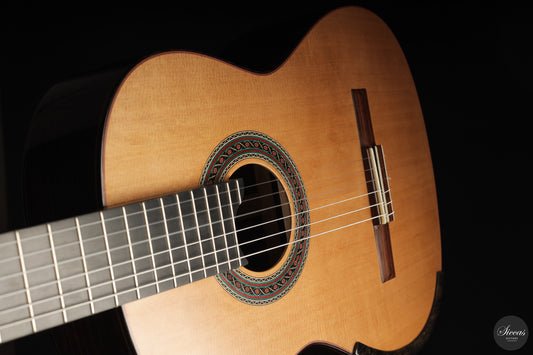
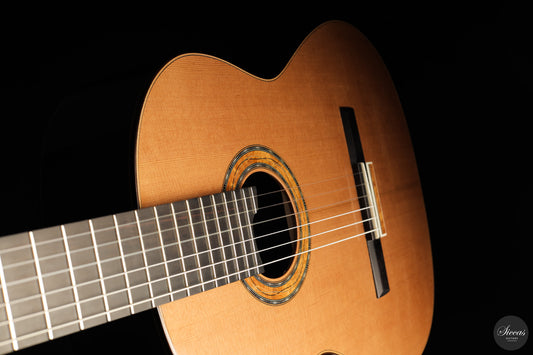
Recuerdos de la Alhambra is Francisco Tárrega's most celebrated work — a tremolo piece of such beauty that it has become one of the most performed solos in the entire classical guitar repertoire. The shimmering, unbroken melody seems to evoke the sound of the Alhambra's fountains and water channels, frozen into music. Composed in 1896 and dedicated to Concha Martínez, it distills everything that makes the classical guitar singular: intimacy, poetry, and a voice that sounds like no other instrument on earth.
Francisco Tárrega and the Alhambra
Francisco Tárrega (1852–1909) is widely regarded as the father of the modern classical guitar. He transformed the instrument's technique, expanded its repertoire, and elevated it from a parlour curiosity to a concert instrument of serious standing. By the time he visited Granada in 1896, he was already the most celebrated guitarist in Spain. The Alhambra — the fourteenth-century Moorish palace complex overlooking the city — left an impression that demanded musical expression.
The palace is a world unto itself: intricate geometric tilework, carved stucco arches, courtyard after courtyard filled with the sound of running water. The Nasrid sultans who built it between the thirteenth and fifteenth centuries understood water as architecture. The Patio de los Leones and the Patio de la Acequia are designed so that the sound of fountains fills every room. Tárrega heard this and reached for his guitar. The result — written in A minor, with its tremolo melody flowing without interruption above a singing bass — became the piece that would define his legacy and, arguably, the entire repertoire.
The dedication to Concha Martínez, a close friend and patron of Tárrega, places the work in the intimate world of late nineteenth-century Spanish musical culture, where the guitar still belonged primarily to private salons and personal relationships rather than concert halls. That intimacy is present in every bar.
The Tremolo Technique
Tremolo is the technique that gives the guitar a voice it cannot normally possess: a sustained, continuous melody. On a plucked instrument, every note decays the moment it is struck. Tremolo overcomes this by plucking the same note in rapid, evenly-spaced succession, creating the illusion of a single unbroken singing line. The right-hand pattern used in Recuerdos de la Alhambra is p-a-m-i: the thumb (p) plays the bass note, followed by the ring finger (a), middle finger (m), and index finger (i) in sequence on the treble string. This four-note cycle repeats continuously throughout almost the entire piece.
The challenge is not speed — it is evenness. Each of the three treble fingers must contribute an identical tone, identical attack, and identical timing to the cycle. If the index finger strikes harder than the ring finger, the melody stutters. If the middle finger drags, the flow breaks. The ear of a trained listener — and especially of a trained guitarist — hears every inconsistency. Achieving true evenness across all three fingers, at tempo, with musical expression, is one of the most demanding technical goals in the repertoire. It is why this piece is considered advanced despite its relatively simple harmonic language.
The bass, meanwhile, must do far more than accompany. Tárrega writes a genuine melodic line in the bass that moves independently of the tremolo above it. A skilled performance keeps both voices alive simultaneously — the tremolo floats, the bass walks, and the two create a complete musical texture from a single instrument. This is the essence of what makes Recuerdos de la Alhambra so enduringly impressive: it sounds like more than one person playing.
The Music
The piece opens directly in A minor, no introduction, the tremolo beginning immediately. The main theme is plaintive and modal, with a Moorish inflection that suits the subject perfectly. The bass line provides harmonic grounding while also carrying its own melodic interest. Structurally the piece follows a broad ABA arc: the A section in A minor, a central B section in A major, and a return to the A minor opening.
The A major section is one of the most effective moments of contrast in the solo guitar repertoire. After the minor's restless, searching quality, the parallel major arrives with a sense of openness — sunlight in a shaded courtyard. The harmonic shift is simple but the emotional effect is striking. Tárrega then returns to the minor for the closing pages, and the piece ends quietly, the tremolo fading as though the sound of the fountain has receded into the distance.
Playing It: Technical Considerations
Evenness is everything. The p-a-m-i cycle must be drilled slowly, with a metronome, before tempo is introduced. Many teachers recommend practising the three tremolo fingers alone — a-m-i without the thumb — to establish uniformity before adding the bass. Others work on pairs: a-m, then m-i, then the full sequence. Whatever the method, the goal is the same: each finger must feel like an identical contribution to the cycle, not a personality in its own right.
The tone of the tremolo must be soft enough to suggest legato, but present enough to project across the full arc of the phrase. A common mistake is to play the tremolo too loudly at the expense of the bass, producing a one-dimensional texture. The bass line must be heard as a second voice — shaped, phrased, and musical in its own right.
Right-hand position matters enormously. Most players position the right hand so that the tremolo fingers approach the string from a consistent angle, reducing variation in tone between fingers. The nail shape and length on the a, m, and i fingers should be as consistent as possible. A small difference in nail shape from one finger to another will produce a corresponding difference in tone — audible in tremolo, where the same string is struck in rapid succession by all three.
This is considered an advanced piece — a rite of passage for the serious classical guitarist. It sits naturally alongside other Tárrega works such as Capricho Árabe in a recital programme, and it benefits from an instrument with genuine projection and sustain. If you are at the stage of working on this piece, it is also the stage at which the quality of your instrument begins to matter in very tangible ways. Browse the classical guitars at Siccas to find an instrument that matches this level of repertoire.
Why This Piece Endures
Recuerdos de la Alhambra has been recorded by virtually every major classical guitarist of the twentieth and twenty-first centuries. It appears on concert programmes worldwide. It is one of the first pieces a non-guitarist will name if asked to identify classical guitar music. This ubiquity is not accidental.
The piece is immediately beautiful. It does not require a prepared audience or a knowledge of harmonic theory to move the listener. The tremolo speaks directly to something pre-verbal — the sound of water, of bells, of a voice sustained beyond its natural length. At the same time, it rewards deep listening: the interplay of voices, the architecture of the ABA form, the single moment of major-key light in an otherwise minor world. It is a piece that gives something new every time it is heard.
For guitarists, it is also a mirror. Tárrega wrote it at the height of his powers, and it shows. Every bar is precisely calibrated. There is no padding, no passage that exists merely to fill time. The player who learns it honestly — without shortcuts in the tremolo, without ignoring the bass — comes away a better musician.
To understand the broader context of Tárrega's contribution to the repertoire, the full Tárrega guide is the essential starting point. For an overview of the repertoire this piece belongs to, see the famous classical guitar pieces page. And for those working toward this level of playing, the guide to learning classical guitar offers a realistic roadmap.