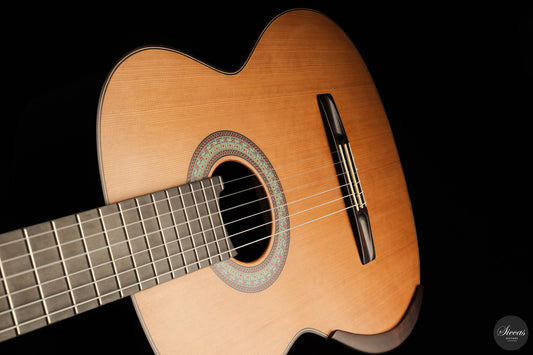
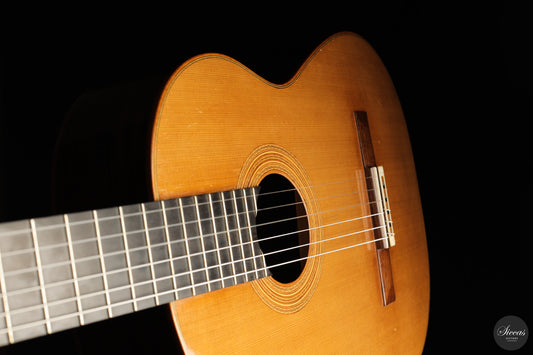
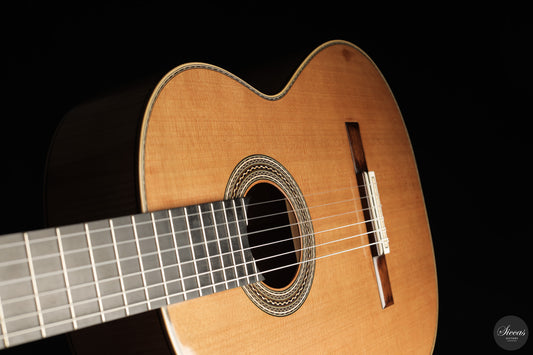
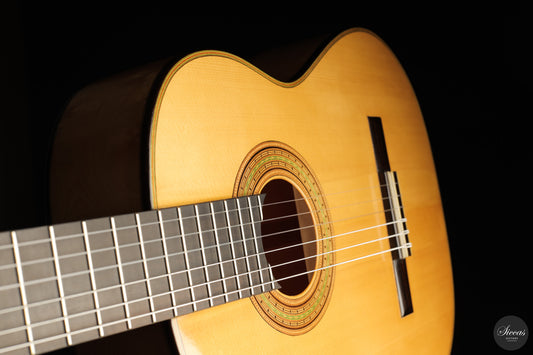
José Simón Ramírez de Galarreta y Pernías was born in 1885 in Madrid, the son of José Ramírez I, the founder of one of the most storied lutherie dynasties in the history of the classical guitar. From childhood he grew up surrounded by the craft, learning the art of guitar making directly from his father in the family workshop. Yet his early life would take a remarkable detour before he returned to carry the family legacy forward.
A Young Guitarist Departs for South America
In addition to his skills as a luthier, José Ramírez II was a capable guitarist. At the age of twenty he received an offer to join a concert ensemble on a two-year tour through South America — an opportunity that was difficult for any young musician to refuse. Persuading his father to allow him to go was itself a challenge, but the relatively short time frame made it seem manageable. Two years did not seem too long.
However, the tour was extended far beyond its original scope, and those two years stretched into nearly twenty. After the ensemble dissolved, José chose to remain in Buenos Aires rather than return to Spain. There he built a new life, meeting a Spanish woman named Blanca, who would become his wife. Together they had two sons: José — who would go on to become José Ramírez III — and Alfredo.
The Return to Madrid and the Family Workshop
In 1923 José Ramírez II received word that his father had died. The news prompted him to return to Madrid with his family, closing the chapter of his South American years. Two years after his return, in 1925, he formally took over the family guitar workshop, then located at Calle Concepción Jerónima No. 2 in the heart of Madrid.
At that time the operation was already a functioning business with several skilled individuals. The ground floor shop was managed by Jesús Martínez. On the upper floor, the workshop employed Alfonso Benito and Antonio Gómez as officers, while Marcelo Barbero — who would later become a celebrated luthier in his own right — served as an apprentice. Manuel Rodríguez, known by the nickname "Marqui," worked as the varnisher. This team formed the skilled core that José Ramírez II would lead and shape during his long tenure as master luthier.
Recognition, War, and the Scarcity of Materials
The years under his leadership brought both international recognition and severe hardship. José Ramírez II was awarded the Gold Medal at the Ibero-American Exhibition in Seville, a prestigious honour that confirmed the reputation of the Ramírez workshop at an international level. The Ramírez name, already respected within Spain, was now recognised far beyond its borders.
But the Spanish Civil War, which broke out in 1936, created enormous difficulties for the workshop. The conflict disrupted trade, supply chains, and daily life across the country. For a luthier, the scarcity of tonewoods and quality materials was a crippling problem. The shortage did not end with the war — it persisted for years afterward, shaping every decision made in the workshop and placing limits on what could be built and how.
This ongoing material scarcity became the central source of tension between José Ramírez II and his son José Ramírez III as the younger man came of age as a craftsman and began working alongside his father. José III was eager to experiment and innovate, but the shortage of quality tonewoods made any experimentation a costly luxury in the eyes of his father. The disagreements between them reflected a broader generational tension: the discipline of wartime survival versus the ambition of a new era.
The Legacy of the Second Generation
José Ramírez II led the family workshop until his death in 1957, having guided it through some of the most turbulent decades in Spanish history. Under his stewardship, the Ramírez workshop maintained its standards during the extreme hardships of civil war and post-war scarcity — no small achievement. He trained the craftsmen who would become central figures in Spanish lutherie, and he raised the son who would transform the Ramírez name into a globally dominant force in classical guitar making.
His place in the history of the instrument is often overshadowed by the towering reputations of his father and his son, but José Ramírez II represents an essential link in the chain. Without his decision to return to Madrid, without his steady hand during the difficult years, the Ramírez dynasty might well have faded after the first generation. Instead, he ensured its survival and passed on both the workshop and the tradition to José Ramírez III, who would go on to build instruments for some of the greatest classical guitarists of the twentieth century.
To understand the full scope of the Ramírez contribution to the classical guitar, it helps to appreciate what these instruments represent: not just fine lutherie, but a continuous lineage of craft knowledge passed from father to son across generations. The guitars that carry the Ramírez name today are the heirs to a tradition that José Ramírez II kept alive during its most precarious years.
If you are interested in exploring instruments from this storied lineage, our curated collection of José Ramírez guitars brings together exceptional examples from different periods. You can also explore the broader context of classical guitar history in our history of the classical guitar, or discover how the great players who performed on Ramírez instruments shaped the repertoire in our overview of great classical guitarists. For a deeper look at the pieces most closely associated with the Spanish guitar tradition, our articles on Recuerdos de la Alhambra and Francisco Tárrega offer essential context.