
The latest concert video released by Siccas Guitars features an online recital by René Izquierdo, recorded during the International Guitar Festival Iserlohn. The concert presents a carefully shaped program that reflects Izquierdo's musical background, his connection to Latin American repertoire, and his clear, structured approach to classical guitar interpretation.
René Izquierdo: Classical Guitarist and Educator
René Izquierdo is widely regarded as one of the most respected classical guitarists of his generation. Born in Cuba, he has built an active international concert career spanning many years. His playing combines technical security with rhythmic clarity and a strong sense of musical narrative. He currently serves as a professor at the Wisconsin Conservatory of Music, where he teaches classical guitar at the highest level.
His repertoire moves naturally between European classical works and music rooted in Cuban and Spanish traditions — a combination that is also reflected in this concert program. At the International Guitar Festival Iserlohn, Izquierdo performed a complete solo recital, captured in a focused setting that allows his musical language to remain transparent and direct. The result is a video document of considerable artistic value for anyone interested in great classical guitarists and their interpretive approaches.
The Instrument: Siccas Luthiers Legacy Model
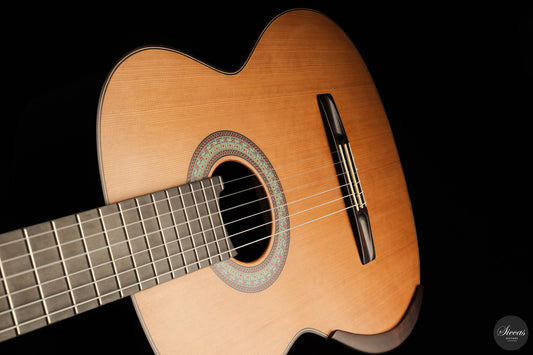
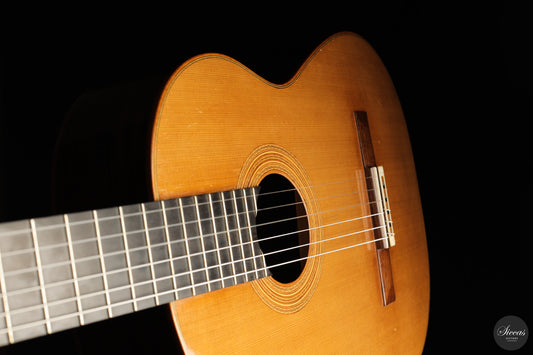
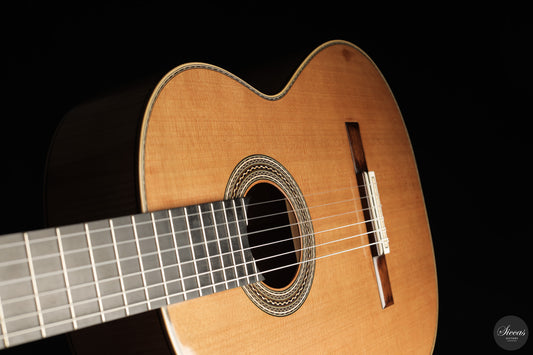
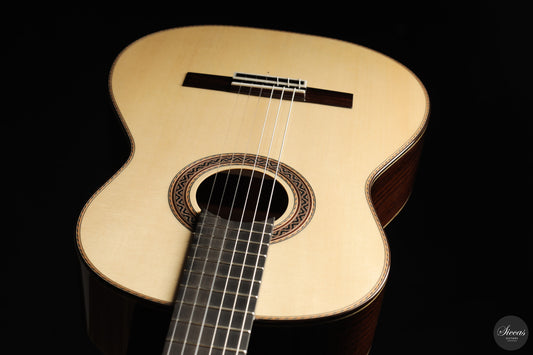
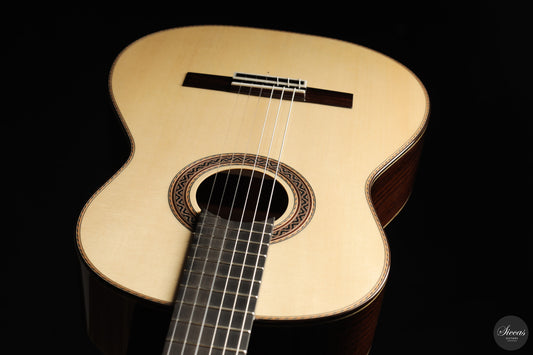
For this concert, René Izquierdo performs exclusively on the Siccas Luthiers "Legacy" model. The guitar supports a clear separation of voices, controlled projection, and a balanced response across registers. Throughout the program, the instrument provides a stable foundation for both baroque articulation and rhythmically driven modern repertoire. You can explore our range of classical guitars and double top guitars to find instruments built with the same level of craftsmanship.
The Concert Program
Domenico Scarlatti: Sonata K 208
The concert opens with Sonata K 208 by Domenico Scarlatti. Originally written for keyboard, the sonata translates naturally to the guitar through its idiomatic figurations and clear harmonic structure. Izquierdo's interpretation emphasizes rhythmic stability and articulation, allowing the form of the piece to unfold with clarity. The opening choice places the recital firmly in a European baroque tradition before the program shifts toward Spanish and Latin American territory.
Regino Sainz de la Maza: Petenera and Rondeña
The program continues with Petenera and Rondeña by Regino Sainz de la Maza. Both pieces draw on Spanish dance traditions and flamenco-influenced rhythms. The music requires precise control of articulation and accentuation — elements that Izquierdo shapes with restraint and focus. Listeners familiar with the broader Spanish guitar repertoire will recognize the stylistic kinship with pieces such as Capricho Árabe and other works rooted in Andalusian musical language.
Federico Moreno Torroba: Madroños
Madroños by Federico Moreno Torroba adds a lyrical dimension to the program. The piece balances melodic flow with subtle rhythmic motion and highlights the guitar's singing qualities. Izquierdo's phrasing maintains continuity while allowing the melodic lines to breathe. Torroba was one of the most significant composers for the classical guitar in the twentieth century, and Madroños is among his most frequently performed character pieces.
Eduardo Martín: Mirándote and Son del Burrio
Two works by Eduardo Martín frame the later part of the concert. Mirándote introduces a reflective atmosphere shaped by gentle rhythmic patterns and harmonic color. Later, Son del Burrio brings the program to a more rhythmically active close, drawing on Cuban popular music influences and requiring a strong sense of pulse and timing. Eduardo Martín is one of the foremost Cuban composer-guitarists of his generation, and these two pieces give the recital a distinctly Caribbean character.
Sindo Garay: Perla Marina (arr. Rey Guerra)
With Perla Marina by Sindo Garay, arranged by Rey Guerra, the program turns toward the Cuban song tradition known as the trova. The arrangement preserves the vocal character of the original melody while adapting it naturally to the guitar. Sindo Garay (1867–1968) is considered one of the founding figures of the Cuban trova, and this piece carries a strong sense of that historical and cultural weight.
José Antonio Ñico Rojas: Guajira a mi Madre
The concert also includes Guajira a mi Madre by José Antonio Ñico Rojas, a piece rooted in Cuban musical language and personal expression. The guajira is a traditional Cuban song form closely linked to rural life and lyrical sentiment. In Izquierdo's hands, the piece becomes a quiet and personal moment within an otherwise varied program.
A Concert Shaped by Rhythm and Tradition
The overall program reflects René Izquierdo's connection to both European and Latin American repertoire. Rather than presenting stylistic contrasts for their own sake, the pieces are linked through rhythm, dance influence, and clear formal structure. The concert demonstrates how these traditions coexist naturally on the classical guitar — something also evident in the work of composers such as Agustín Barrios Mangoré and Heitor Villa-Lobos, whose music similarly bridges European and Latin American musical worlds.
For those exploring the depth and range of the classical guitar repertoire, this concert offers a well-structured overview of stylistic variety within a single recital. It is also an excellent entry point for anyone curious about famous classical guitar pieces drawn from Spanish and Latin American traditions.
Recorded for Siccas Guitars
This concert video documents René Izquierdo's performance during the International Guitar Festival Iserlohn in collaboration with Siccas Guitars. Recorded as an online concert, it offers listeners the opportunity to experience a complete recital shaped by consistency, rhythmic focus, and musical clarity — performed on a Siccas Luthiers Legacy guitar. The collaboration reflects Siccas Guitars' ongoing commitment to documenting significant artistic performances and making them accessible to a global audience.