
Spanish Romance – Who Really Wrote This Guitar Classic?
Nobody knows who wrote Spanish Romance. That is not a gap in the historical record waiting to be filled — it is the settled scholarly position. The piece circulated anonymously in the late 19th century, appeared in print under several names, and no manuscript has ever surfaced that ties it conclusively to a single composer. Generations of guitarists have played it, recorded it, and taught it without resolving the question, and none of the attributions that have been proposed holds up under scrutiny.
That anonymity has not diminished the piece. Spanish Romance — also known as Romanza — is probably the most-played classical guitar piece in existence. It appears in recitals, on film soundtracks, in YouTube tutorials, in the hands of beginners and professionals alike. Its opening bars are among the most instantly recognizable sounds the guitar produces.
The Authorship Question
Three names come up repeatedly in discussions of who wrote Spanish Romance: Francisco Tárrega, a composer named Rubira (sometimes given the first name Antonio or Eduardo, depending on the source), and Daniel Fortea. None of these attributions is supported by primary evidence.
Tárrega is the most famous name associated with the piece, and the attribution persists in popular culture, on sheet music covers, and in streaming metadata. Tárrega scholarship, however, does not include Romanza in his authenticated catalogue. His known works are documented through manuscripts, correspondence, and contemporary accounts. Romanza appears in none of that material.
The Rubira attribution appears in some 19th-century Spanish publications, but the composer in question has no verified biography, no other known works, and no documentary trail. It may be a pseudonym, a misattribution copied from an earlier source, or a publisher's invention — the record does not say.
Fortea was a student of Tárrega and a significant figure in early 20th-century Spanish guitar culture. Some editions of Romanza carry his name as arranger rather than composer, which may be the source of the confusion. Arrangement credits and composer credits were not always clearly distinguished in salon-music publishing of that period.
The current consensus among musicologists is to classify Romanza as anonymous or traditional. That classification is not a placeholder — it reflects the genuine state of the evidence.
What the Piece Is
Spanish Romance is a solo guitar piece in E minor. It has two sections. The first, in E minor, sets a lyrical melody in the upper voice against a repeating arpeggio pattern in the lower voices. The second shifts to E major, producing a contrast in color and mood that has made the piece useful to generations of film composers and arrangers looking for a single gesture that moves from shadow to light.
The right-hand arpeggio pattern runs p-i-m-a across the strings, with the thumb sustaining a bass note while the fingers carry the melody. This places the piece in the technical territory occupied by Recuerdos de la Alhambra and similar 19th-century Spanish salon works — pieces built around continuous arpeggiation rather than block chords or single-line melody.
The key of E minor suits the guitar's natural resonance. The open strings E, B, and G all ring freely in the tonic chord, giving the piece a fullness that a transposed version would not achieve. This is one reason the piece sounds so characteristic on the instrument and why it does not transfer as naturally to other contexts.
The 19th-Century Salon Tradition
To understand where Spanish Romance comes from, it helps to understand the context in which it circulated. 19th-century Spain had a flourishing domestic music culture built around the guitar. Wealthy households kept instruments; publishers in Madrid and Barcelona produced large quantities of sheet music for amateur players. The music was functional and social — written to be played at home, at gatherings, for personal entertainment.
Much of this music was anonymous by design or by accident. Composers working in the salon tradition often did not attach their names to short pieces. Publishers compiled collections, editors added and removed attributions, and pieces passed between print runs under different names. The authorship of any individual piece in this tradition is often irrecoverable.
Spanish Romance fits this context precisely. Its structure is simple enough for competent amateurs, its emotional register is immediately accessible, and it requires no concert technique to be satisfying. It was the kind of piece that would have been copied out by hand, passed between students, and printed in collections without careful record-keeping.
Francisco Tárrega himself was active in exactly this period and this culture. He is known to have arranged and adapted existing pieces as well as composing original works. Whether he had any role in the creation or transmission of Romanza — as composer, arranger, or simply as a performer who played it — cannot be established from the evidence that survives.
How the Piece Is Structured
The minor section opens on an E minor chord with the melody in the first finger, played on the high E string. The arpeggio moves through the chord in a consistent pattern, creating a steady rhythmic pulse beneath the melody. The melody itself moves in a narrow range, mostly stepwise, with occasional leaps that produce the characteristic sighing quality of the piece.
The bass line in the minor section moves through a small number of harmonies — E minor, B major, A minor, G major — in a progression that was common in Spanish salon music and appears in many other pieces of the period. There is nothing harmonically unusual about the minor section. Its effect comes from the continuous arpeggio and the placement of the melody in the upper voice.
The major section, in E major, shifts the same arpeggio texture into a brighter register. The melody here sits differently on the fingerboard, and the open strings ring more brilliantly in the major key. Many players approach this section with a different tone color — slightly more forward in the right hand, closer to the soundhole — to emphasize the contrast with what came before.
The piece ends by returning to the minor section, or in some versions simply concluding in the major. Different editions handle this differently, which is consistent with a piece that was never fixed in an authoritative text.
Technical Demands
Spanish Romance sits between beginner and intermediate level, but playing it well requires more than basic technique. The main challenges are consistency and tone differentiation.
The arpeggio pattern must stay even throughout. Any variation in the timing or weight of the repeated strokes is immediately audible because there is no other texture to mask it. Students learning the piece often discover that their right hand is less regular than they thought.
Separating the melody from the accompaniment is the deeper technical challenge. Both are produced by the same hand. The first finger, which carries the melody, must produce a louder, fuller tone than the other fingers, which carry the accompaniment. This requires independent finger control that takes time to develop. Players who skip this step produce a version where melody and accompaniment blend into a single texture, and the piece loses its character.
Left-hand legato matters in the minor section, where several melody notes are connected by slurs rather than replucked. Clean slurs require accurate placement and consistent left-hand pressure. Sloppy slurs in this passage are audible.
Dynamic shaping across the two sections is a matter of interpretation rather than technique, but it requires conscious attention. The minor-to-major transition is the emotional center of the piece, and how a player handles that transition — whether they build toward it, arrive at it quietly, or mark it with a sudden change — determines much of the piece's character in performance.
Notable Recordings
Narciso Yepes recorded Spanish Romance for the 1952 French film Jeux Interdits, and that recording is the reason many people first encountered the piece. Yepes played on a 10-string guitar in later years, but his early recordings were on the standard six-string instrument. The film's use of the piece established it in popular culture in a way that concert recordings alone would not have.
John Williams has recorded it multiple times across different periods of his career. His approach is clean and precise, with the melody clearly differentiated from the accompaniment and the major section handled with restraint.
Pepe Romero brings a warmer, more expressive approach to the piece. His recordings tend to have more dynamic variation and a slightly freer tempo in the major section.
Ana Vidovic and David Russell have both recorded it in recent decades. Russell's version is notable for its tone quality — he produces a particularly singing upper register that serves the melody well.
Listening to these recordings side by side is useful for any player working on the piece. The differences between them are not large, but they make clear how much interpretive space exists within what looks like a simple structure.
Spanish Romance in Context
Spanish Romance belongs to a group of pieces that defined the 19th-century guitar's expressive range and are still central to the instrument's repertoire. Recuerdos de la Alhambra and Francisco Tárrega's body of work occupy similar territory — emotionally direct, technically accessible to advanced amateurs, and deeply identified with the sound of the classical guitar.
Andrés Segovia's advocacy for the classical guitar as a serious concert instrument in the 20th century drew heavily on this repertoire. Segovia performed and recorded pieces from the Spanish salon tradition, argued for their musical value, and built programs around them. Without that advocacy, pieces like Spanish Romance might have remained strictly domestic music.
The piece also appears regularly alongside works by Agustín Barrios and other composers who worked in the Latin American and Iberian guitar tradition. Its structural simplicity makes it a useful reference point — a piece where technique and interpretation are transparent, with nowhere to hide.
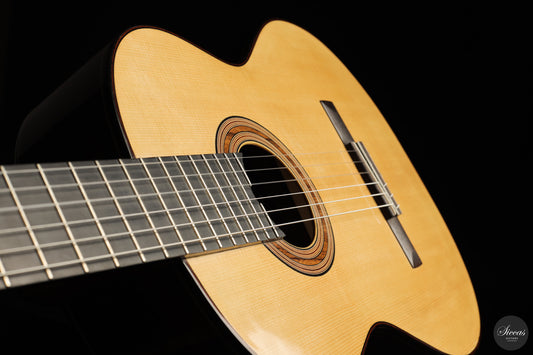
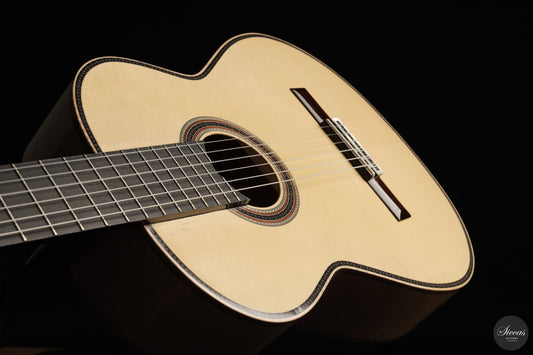
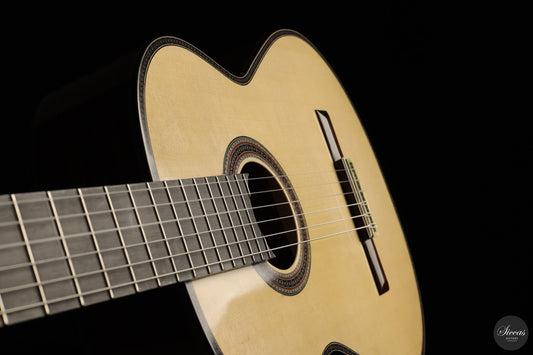
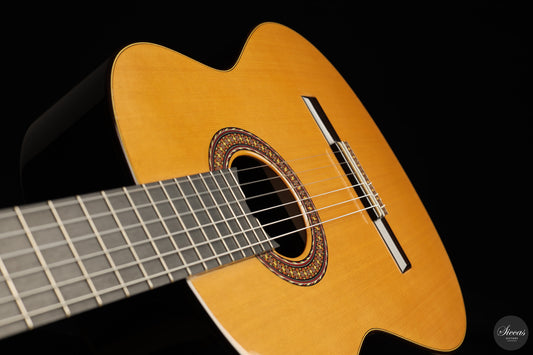
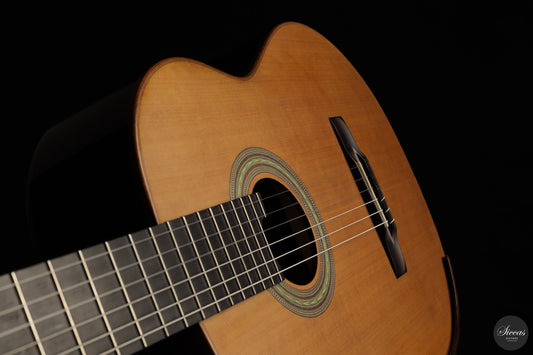
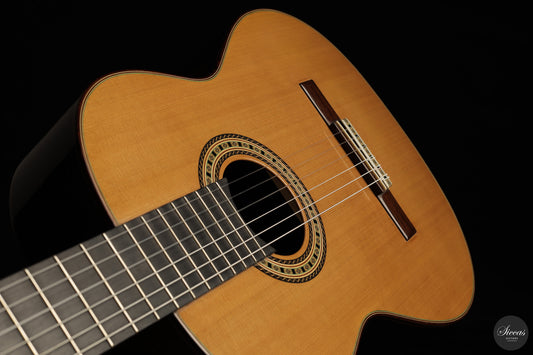
For anyone building a collection of classical guitars, Romanza is one of the pieces worth playing on every instrument you consider. It sits in the midrange of the fingerboard, uses the open strings freely, and responds clearly to differences in top material, scale length, and voicing. A cedar-top guitar with a warm, singing upper register suits the minor section particularly well. Spruce tops with more articulation in the attack can work better for players who want the arpeggio to have more presence.
Why the Anonymity Matters
Most famous pieces have authors. The anonymity of Spanish Romance is unusual enough to require explanation, and the explanation matters for how we understand the piece.
If Tárrega wrote it, it belongs to a tradition of art music with a documented lineage — a tradition that includes many of the most famous classical guitar pieces. If it emerged from the anonymous salon tradition, it is a piece of folk or vernacular music that was never anyone's personal property, that was played and adapted freely, and that reached its current form through a process no one designed or controlled.
The evidence points toward the second explanation. That makes Spanish Romance something unusual in the classical guitar world: a piece that belongs to no one and therefore belongs to everyone who plays it. The absence of an author has not made it lesser. It has made it available in a way that composed pieces are not.
Players who know this history tend to approach the piece differently. They are not interpreting someone's intention — they are participating in a tradition. That is a different relationship to the music, and for many players it is a more comfortable one.
Learning Spanish Romance
The piece is a useful early project for students who have basic right-hand arpeggio control and can navigate a few chord shapes. It is also a piece that rewards continued attention from more advanced players. The technical problems it poses — evenness, tone differentiation, dynamic shaping — do not disappear as a player advances. They become more visible.
Starting slowly with a metronome is standard advice for arpeggio pieces, and it applies here. The challenge is not learning the notes — those come quickly — but developing the consistency that makes the arpeggio disappear as a separate element and become part of the texture.
Working on the major section separately is worthwhile. Many students learn the minor section well and then treat the major section as an afterthought. The major section has its own demands: the melody sits in a different position, the harmonics of the open strings ring more prominently, and the return to the minor (if included) requires a deliberate transition.
For the great classical guitarists who have included this piece in their public repertoire, it is rarely the centerpiece of a program but often the most remembered moment. Audiences who do not follow classical guitar closely recognize it immediately. That recognition creates a particular kind of listening — more relaxed, more personal — that skilled players can use to their advantage.
The Piece in the Guitar Repertoire
Spanish Romance occupies a specific place in the classical guitar's history. It is not the most technically demanding piece in the repertoire, not the most harmonically sophisticated, not the most formally complex. Its importance comes from something else: it captures, in about three minutes of music, the sound that makes the classical guitar distinctive.
The combination of sustained bass, arpeggio middle voices, and singing melody in the upper register is uniquely idiomatic to the instrument. No other instrument reproduces it exactly. This is why the piece appears so often in films and advertising when a director or producer wants to signal classical guitar specifically — not guitar generally, but the classical instrument with its particular combination of warmth, articulation, and range.
The piece has survived for well over a century without an identified author, without a definitive text, and without the advocacy of a famous performer attached to it at its origin. It survives because it works — because it does what it does with the guitar better than almost anything else written for the instrument. That is the only explanation required.