
What Is a Classical Guitar?
The classical guitar is a nylon-string acoustic instrument that stands at the heart of centuries of musical tradition. With its warm, resonant tone, wide fingerboard, and elegant construction, it is the instrument of choice for classical, flamenco, and Latin music. Whether you are exploring the instrument for the first time or deepening your understanding after years of playing, this guide covers everything you need to know: history, construction, technique, how to choose your first guitar, and what makes the classical guitar unlike any other instrument in the world.
Unlike a steel-string acoustic guitar, the classical guitar uses nylon strings, has a wider nut width of approximately 52 mm, and is played almost exclusively with the fingers rather than a pick. These differences are not superficial — they shape the entire approach to playing, the repertoire you can explore, and the sound you produce. If you have ever wondered how a classical guitar differs from an acoustic guitar, the answer lies in far more than just the strings.
A Brief History of the Classical Guitar
Origins: The Renaissance and Baroque Guitar
The history of the guitar stretches back to the Renaissance period, when four- and five-course instruments were played across Europe. The Baroque guitar of the 17th and 18th centuries — with its gut strings and ornate decoration — was a popular instrument in aristocratic households. Composers such as Gaspar Sanz in Spain and Robert de Visée in France wrote extensive repertoire for it.
By the late 18th century, a sixth string was added and the instrument began to resemble the modern guitar in its basic layout. Figures like Fernando Sor and Mauro Giuliani — now considered foundational composers of the classical guitar repertoire — were composing and performing on instruments that were evolving rapidly in both design and capability.
Antonio de Torres and the Modern Classical Guitar
The most significant transformation in the history of the classical guitar came in the mid-19th century through the work of Spanish luthier Antonio de Torres Jurado (1817–1892). Torres introduced the fan bracing system inside the soundboard, which distributes tension across the top and dramatically increases projection and tonal clarity. He also standardised the scale length at approximately 650 mm and established the proportions and dimensions that remain the blueprint for classical guitars to this day.
Without Torres, there would be no modern classical guitar. His innovations were so fundamental that virtually every classical guitar built today — from student instruments to hand-crafted concert guitars worth tens of thousands of euros — follows his structural principles.
Andrés Segovia and the 20th-Century Renaissance
In the early 20th century, the classical guitar was still considered a salon instrument, rarely heard in concert halls. It was Andrés Segovia (1893–1987) who transformed its status. Through extraordinary technique, charisma, and relentless advocacy, Segovia convinced composers such as Manuel Ponce, Heitor Villa-Lobos, and Federico Moreno Torroba to write for the guitar. He also developed the modern right-hand technique using the flesh and nail of the fingertip, which remains the dominant approach in classical guitar playing today.
Segovia's legacy is visible in every contemporary guitarist. The great classical guitarists who followed — from Julian Bream and John Williams to Ana Vidovic and Thibaut Garcia — all built on the foundation he established.
Construction: How a Classical Guitar Is Built
The Soundboard (Top)
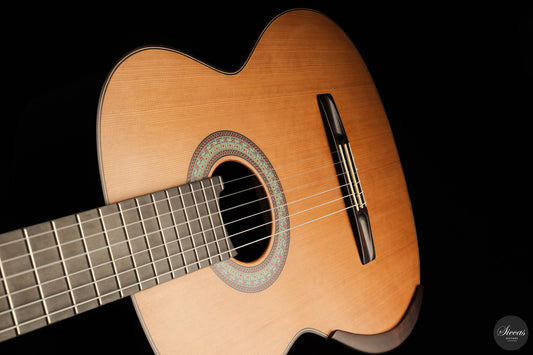
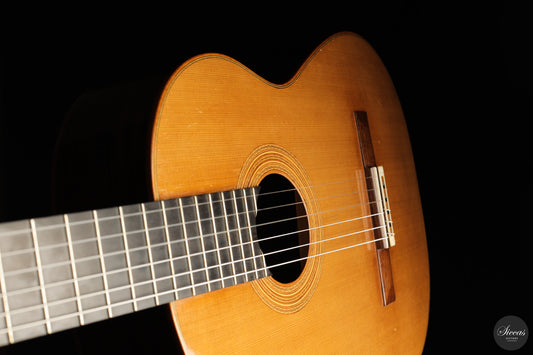
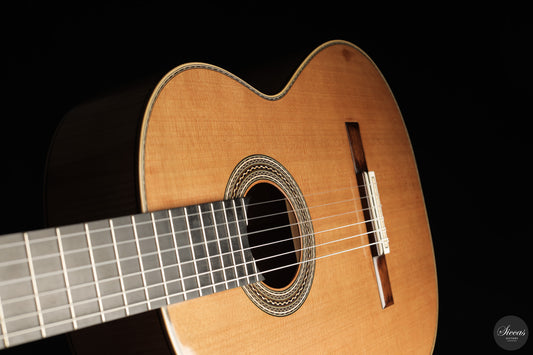
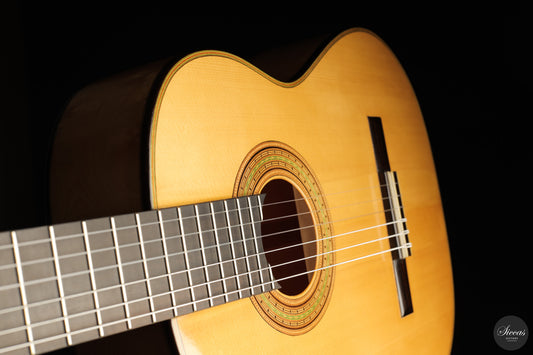
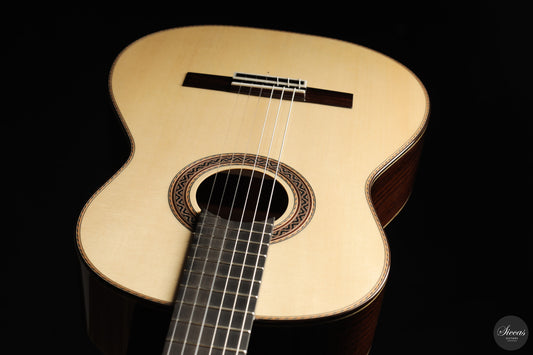
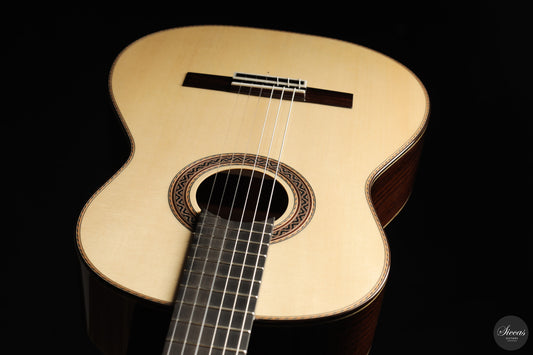
The soundboard is the most acoustically important part of a classical guitar. It amplifies string vibration and gives the guitar its voice. The two most common tonewoods for classical guitar tops are spruce and cedar, and each produces a distinct character. Comparing spruce and cedar classical guitars shows that spruce tends to offer a brighter, more articulate response with a wide dynamic range, while cedar is warmer and more immediately responsive — often preferred by players who favour fingerstyle and expressive playing.
High-quality instruments use solid tops rather than laminated wood. A solid spruce or cedar top resonates more freely and improves with age as the wood opens up over years of playing.
The Back and Sides
Traditional classical guitars use rosewood for the back and sides, particularly Indian rosewood or the increasingly rare Brazilian rosewood. Rosewood contributes a rich, complex midrange and supports the projection of the instrument. Cypress is the traditional choice for flamenco guitars, producing a drier, more percussive tone. Other tonewoods used by luthiers include maple, mahogany, and a range of exotic hardwoods.
Fan Bracing
Inside the soundboard, a pattern of thin wooden struts — the fan bracing developed by Torres — holds the top in shape while allowing it to vibrate freely. The angle, number, and thickness of the braces directly affect the tone, projection, and response of the instrument. Master luthiers spend years learning to tune the top and bracing system so that the guitar responds evenly across all registers.
The Neck, Nut, and Scale Length
The classical guitar neck is wider than that of a steel-string acoustic, with a nut width of approximately 52 mm. This extra width gives the left hand room to place fingers cleanly on individual strings without inadvertently muting adjacent ones — essential for the complex counterpoint in classical repertoire. The scale length of 650 mm determines string tension and influences tone. Some guitars, designed for players with smaller hands, use a shorter scale of 630 or 640 mm.
The Tuning Machines
Classical guitars traditionally use slotted headstocks with friction or geared tuning machines. The rollers are positioned horizontally and the strings pass through holes in the roller, which is a design that provides stability and precise tuning.
Double Top and Advanced Construction
Over the past few decades, innovative luthiers have developed new construction techniques that push the limits of what a classical guitar can do. The most significant of these is the double top guitar. In a double top instrument, the soundboard consists of two thin layers of wood — typically cedar or spruce — separated by a core of Nomex honeycomb material. This construction produces a soundboard that is both extremely light and highly rigid, resulting in extraordinary projection and sensitivity. Double top guitars are among the most sought-after instruments by professional concert guitarists.
Watch the video below to hear the tonal differences between different types of classical guitars side by side:
Nylon Strings: Why They Matter
The shift from gut strings to nylon strings in the mid-20th century — largely championed by Andrés Segovia in collaboration with string makers — transformed the consistency and reliability of the instrument. Nylon strings are gentler on the fingertips than steel strings, which makes them suitable for players of all ages including young beginners. They produce a rounder, warmer tone that suits the subtleties of classical and flamenco repertoire.
Classical guitar strings are divided into three treble strings (the first, second, and third) made of clear or rectified nylon, and three bass strings (the fourth, fifth, and sixth) that are nylon cores wound with metal — typically silver-plated copper. The tension, gauge, and material of the strings have a significant effect on playability and tone, and players often experiment to find the combination that suits their guitar and style best.
Classical Guitar Technique
Posture and Position
Classical guitar technique begins with posture. The traditional position involves resting the guitar on the left leg (for right-handed players), raised by a footstool, so that the neck angles upward and the body of the guitar sits close to the torso. An alternative used by many modern players involves a support cushion or guitar support attached to the left leg, which eliminates the need to raise the foot and reduces strain on the lower back and hip.
The spine should remain upright and the shoulders relaxed. Tension in the upper body travels down through the arms and into the hands, affecting both tone and technique. Good posture is not merely cosmetic — it is a prerequisite for fluid, injury-free playing.
Left-Hand Technique
The left hand frets the strings. The thumb rests behind the neck, roughly opposite the middle finger, and acts as a counterbalance to the pressure applied by the fingers. The fingers approach the frets from above, pressing the strings close to the fret wire to minimise buzzing while using as little pressure as necessary. Efficient left-hand technique is about economy: unnecessary tension slows down passage work and leads to injury over time.
Stretches, position shifts, and barré chords are among the technical challenges that require dedicated practice. The barré — pressing one finger across all six strings at a single fret — demands both strength and precision.
Right-Hand Technique: Fingerstyle Playing
In classical guitar, the right hand does not use a pick. Instead, the strings are plucked with the tips of the fingers, using a combination of the flesh and the nail. The conventional naming for right-hand fingers follows the Spanish abbreviations: p (pulgar — thumb), i (índice — index), m (medio — middle), and a (anular — ring finger). The little finger (meñique) is occasionally used in advanced technique.
The thumb typically plays the three bass strings (fourth, fifth, and sixth), while i, m, and a play the three treble strings. The angle of the hand, the shape of the nails, and the precise point of contact between nail and string all contribute to tone production. Players invest considerable time in maintaining their nails — the right nail profile is a genuinely personal and technical matter.
Tremolo
Tremolo is one of the most distinctive techniques in classical guitar. A single melody note is played in rapid succession by the fingers a, m, and i while the thumb provides a bass accompaniment on the lower strings. The goal is to create the illusion of a sustained, singing melody. Francisco Tárrega's Recuerdos de la Alhambra is the defining example of the tremolo technique and remains one of the most recognisable famous classical guitar pieces.
Arpeggios and Scale Passages
Arpeggios — broken chords played string by string — are fundamental to classical guitar texture. They appear in virtually every period of repertoire, from Baroque lute transcriptions to 20th-century concert works. Scales, played with strict alternation of i and m fingers, develop speed and evenness across the fingerboard.
Slurs: Hammer-Ons and Pull-Offs
Slurs are legato connections between notes produced entirely by the left hand. A hammer-on involves bringing a finger down firmly onto a fret to sound a note without the right hand plucking. A pull-off involves pulling a finger off a fret to sound the lower note beneath. Both techniques are integral to fluid, expressive playing.
Classical Guitar Repertoire
The classical guitar has an extensive and rich repertoire spanning several centuries. From Renaissance lute music transcribed for guitar to original concert works of the 20th century, the breadth of available material is enormous.
Baroque and Renaissance
Much early guitar repertoire draws on lute and vihuela music. Johann Sebastian Bach's lute suites, particularly the Chaconne from Partita No. 2 in D minor, are among the most performed and technically demanding works in the guitar canon. Works by Sylvius Leopold Weiss and Robert de Visée are also regularly performed.
Classical and Romantic Period
Fernando Sor, Mauro Giuliani, Dionisio Aguado, and Matteo Carcassi wrote extensively for the guitar in the early 19th century, producing études, sonatas, and fantasies that remain essential study material. Francisco Tárrega (1852–1909) brought the Romantic tradition fully to the guitar, composing works of great lyrical beauty including Recuerdos de la Alhambra, Capricho Árabe, and numerous preludes and mazurkas.
20th Century
The 20th century saw an explosion of original guitar composition, much of it prompted by Segovia's advocacy. Heitor Villa-Lobos wrote his twelve études and five preludes as gifts to the instrument. Manuel Ponce's Sonata Romántica and Sonatina Meridional are beloved concert works. Leo Brouwer, Joaquín Rodrigo (whose Concierto de Aranjuez for guitar and orchestra became one of the most performed concertos of the 20th century), and Benjamin Britten all contributed important works.
If you are looking for an accessible starting point, the easiest classical guitar pieces for beginners include works that sound beautiful from the very beginning and build technique naturally.
Flamenco vs. Classical Guitar
Flamenco and classical guitars are closely related but serve different musical traditions and are built accordingly. A flamenco guitar is typically lighter, with cypress back and sides (in the traditional blanca style) or rosewood/maple (in the negra style), a lower action, and a percussive character suited to the rhythmic demands of cante jondo and baile. Classical guitars are built for projection, sustain, and tonal complexity. Players choose between them based on the music they intend to play.
The flamenco guitars in the Siccas collection represent the finest makers working in the Spanish tradition today.
How Long Does It Take to Learn Classical Guitar?
Classical guitar has a reputation for being technically demanding — and it is. The combination of independent finger movement, left-hand precision, and right-hand nail technique means that progress is gradual and requires consistent, focused practice. That said, satisfying music is accessible from the very first weeks.
A committed beginner practising 30 to 45 minutes daily can expect to play simple pieces within a few months and more complex repertoire within one to two years. Advanced concert technique takes many years of dedicated study. The question of how long it takes to learn classical guitar depends greatly on prior musical experience, the quality of instruction, and the consistency of practice.
How to Choose a Classical Guitar
Starter and Student Guitars
A good starter instrument does not need to be expensive, but it must be properly set up. A guitar with high action — strings that sit far above the fretboard — is unnecessarily hard to play and discourages beginners from continuing. When choosing a first guitar, look for a solid top if the budget allows, a comfortable neck width, and a setup that makes it easy to press the strings cleanly.
Intermediate and Advanced Instruments
As technique develops, the limitations of an entry-level instrument become more apparent. An intermediate guitar typically features a solid top, solid back and sides, hand-fitted bracing, and improved finishing details. Advanced and professional instruments are made entirely by hand by individual luthiers and may take months or years to complete.
Spruce or Cedar?
Choosing between a spruce and cedar top is one of the first decisions a player faces when buying a new guitar. Spruce responds well to a strong attack and rewards players who have developed a confident right-hand technique. Cedar responds immediately to lighter touch, which can make it more forgiving for players still developing their sound. The best approach is to play both and listen with your own ears. You can explore the full range of spruce-top guitars and cedar-top guitars in the Siccas collection.
Luthier-Made vs. Factory Instruments
Factory guitars are produced efficiently and at a price point that makes them accessible. Luthier-made instruments — built by a single craftsperson using hand tools, carefully selected tonewoods, and individual attention to every aspect of construction — offer a level of responsiveness, tone, and longevity that factory production cannot match. Among the most respected production luthiers with instruments in the Siccas collection is Altamira Guitars, whose instruments represent exceptional quality at their price point.
Restringing Your Classical Guitar
Classical guitar strings do not last forever. Nylon strings lose brightness and intonation over time — typically after several weeks of regular playing. Knowing how to restring a classical guitar is an essential skill for any player. The tying method used for nylon strings at the bridge differs from the pin-bridge system on steel-string acoustics, but with practice it becomes a quick and satisfying part of instrument maintenance.
Explore the Siccas Guitars Collection
Siccas Guitars has been supplying classical and flamenco guitars to students, amateurs, and professional concert artists for decades. The collection spans student instruments, hand-made luthier guitars, double top concert instruments, and flamenco guitars — all carefully selected and set up before delivery.
Browsing the full classical guitars collection is the best starting point whether you are buying your first instrument or upgrading to a concert-level guitar. Each listing includes detailed photographs, tonal descriptions, and video demonstrations so you can hear the instrument before you buy.
The classical guitar is one of the most rewarding instruments a person can choose to learn. Its repertoire is vast, its technique is deep, and its sound — when produced well — is unlike anything else in music. Whether you are drawn to the introspective beauty of Bach, the passion of Tárrega, or the contemporary concert works of Leo Brouwer, the classical guitar offers a lifetime of musical discovery.