The First Noel is one of the oldest and most widely sung Christmas carols in the English-speaking world — a medieval-inflected melody of quiet grandeur that has been sung in churches, homes, and concert halls for centuries. On classical guitar its dignified simplicity is deeply satisfying. This guide covers the carol's history, its musical character, how to approach an arrangement on nylon strings, and practical technique notes for players of all levels.
History of The First Noel
The First Noel is a traditional English carol whose precise origins remain a matter of scholarly debate, though the earliest references to its text and melody point toward the thirteenth century. The word "noël" is Old French for Christmas, derived ultimately from the Latin natalis, meaning "of birth" — a reminder that this carol's roots reach into a period when English and French culture were intertwined following the Norman Conquest.
The carol was first published in its current recognisable form in 1823, appearing in William Sandys' landmark anthology Christmas Carols Ancient and Modern. A second important publication followed in 1833 in Davies Gilbert's collection Some Ancient Christmas Carols. These two Victorian-era publications did much to cement the carol's place in the English Christmas repertoire at a time when the revival of traditional Christmas customs — championed later in the century by figures such as Charles Dickens — was gathering momentum. The Sandys and Gilbert publications drew on oral tradition that had been maintained in West Country communities in England, suggesting the carol had a living folk presence well before it was committed to print.
The text recounts the nativity narrative as seen through the eyes of shepherds who observe a star in the sky and follow it to Bethlehem. The refrain — Noel, Noel, Noel, Noel / Born is the King of Israel — is one of the most immediately recognisable phrases in the entire Christmas carol tradition. The strophic structure (a series of verses each followed by the same refrain) is characteristic of medieval carol form, reinforcing the sense that this melody carries genuine antiquity.
Musical character and modal quality
What distinguishes The First Noel from more harmonically modern carols such as O Holy Night or Hark! The Herald Angels Sing is its archaic, modal quality. The melody moves in a way that feels rooted in an older harmonic world — one where the Mixolydian or Dorian modes were as natural as the major scale. This modal flavour is especially audible in the way certain phrases settle, avoiding the pull toward a strong dominant-to-tonic resolution that would be expected in later tonal music.
The traditional harmonisation includes a characteristic three-note descending figure in the refrain that has become one of the most recognisable harmonic moments in Christmas music. Over the centuries this harmonisation was refined through choral, organ, and congregational performance into the version most singers and players recognise today. The long phrases, unhurried pacing, and the dignity of the melody all contribute to a carol that rewards expressive, considered performance rather than simply being played through at tempo.
In terms of key and register, The First Noel is most often performed in D major or E major when arranged for classical guitar, both of which make good use of open strings and the guitar's natural resonance. The melody sits comfortably in the upper register of the instrument, leaving the bass and inner voices free to provide harmonic support without crowding the melodic line.
The First Noel on classical guitar
The carol's slow, stately character suits the classical guitar exceptionally well. The instrument's natural sustain and the warmth of nylon strings give the melody a singing quality that matches the carol's contemplative mood. Unlike faster or more technically demanding repertoire, The First Noel invites the player to focus entirely on tone production, phrasing, and dynamics — skills that define the difference between a technically correct performance and a genuinely musical one.
The phrase structure is spacious and unhurried, giving the player room to shape each line. The modal quality of the melody — which can feel ancient and even slightly mysterious — emerges naturally when the guitarist avoids overly modern voicings and lets the simple harmonic movement speak for itself. This is one of the pieces where less is genuinely more: a clean single-line melody over simple bass notes can be more effective than a densely harmonised arrangement.
For players building a seasonal repertoire, The First Noel sits naturally alongside other carol arrangements and early music. Its character connects it to the broader tradition of medieval and Renaissance music that guitarists encounter in works by Francisco Tárrega and earlier lute repertoire that the classical guitar has inherited. The piece is also an excellent introduction to playing melodically on the guitar — to sustaining a phrase, controlling dynamics, and thinking about the voice leading between melody and accompaniment.
Tutorial by Karlijn Langendijk
The tutorial featured on the Siccas Guitars YouTube channel is performed and taught by Karlijn Langendijk, a classical guitarist known for her clear pedagogical approach and expressive playing. The video guides players through the arrangement step by step, addressing fingering choices, right-hand technique, and musical phrasing. Whether you are approaching the piece for the first time or refining an existing arrangement, the tutorial offers practical guidance grounded in solid classical technique.
Langendijk's approach to the piece emphasises the importance of voicing — ensuring the melody sings clearly above the accompanying harmony — and the use of dynamics to give the performance natural shape. Her tutorial is suitable for players at the beginner-to-intermediate level and provides a reliable starting point for building an expressive classical guitar arrangement of the carol.
How to approach the piece: technique notes
Tempo and character
Stately and dignified — this carol should sound ancient, not hurried. A slow tempo allows each phrase to carry weight and gives the listener time to absorb the melody before the refrain arrives. Rushing the tempo strips the piece of its character. Think of the performance as an act of narration: each verse tells part of the story, and the refrain provides the moment of communal affirmation.
The refrain descent
The characteristic three-note descending figure in the refrain is the harmonic and emotional heart of the carol. Let it ring clearly. Avoid blurring adjacent notes by lifting fingers carefully and ensuring the bass notes sustain beneath the descending melodic line. This figure should sound inevitable — as though it has been sung the same way for a very long time, because it has.
Dynamics and voicing
A slightly fuller dynamic for the chorus and a more intimate tone for the verses gives the performance natural shape without requiring elaborate technique. The melody should consistently project above the harmony. On classical guitar this means using the flesh and nail of the index, middle, and ring fingers to draw the melody out with slightly more weight than the accompanying voices. The thumb provides the bass, which should be warm and supportive without overpowering the upper register.
Sustain and resonance
Let notes ring for their full value wherever the harmony allows. Classical guitar's natural resonance is one of its greatest assets in this repertoire, and cutting notes short wastes it. Conversely, be aware of moments where a sustained bass note may clash with a harmonic change — careful left-hand damping keeps the texture clean.
Fingering choices
Consistent fingering is particularly important in a piece like this where the melody recurs in multiple verses. Establishing a single reliable fingering for the melody from the outset prevents inconsistency between verses and makes the performance feel settled. If an arrangement includes position shifts, practise them in isolation before adding them to the full phrase.
Difficulty and repertoire context
The First Noel is generally rated beginner to intermediate on classical guitar, depending on the arrangement. A simple single-line melody with basic bass accompaniment is accessible to players in their first year of study. Fuller harmonised arrangements — with inner voices, position shifts, and more complex left-hand chords — require more developed technique and sit comfortably in intermediate repertoire alongside pieces such as simple études and early-intermediate Romantic transcriptions.
As a seasonal piece it is particularly valuable in a concert or recital context: audiences respond to familiar melodies played with care and expressiveness, and The First Noel offers precisely that opportunity. Its modest technical demands mean that the player's attention can be directed almost entirely toward musical expression rather than technical survival.
For further exploration of the classical guitar repertoire, including pieces by Agustín Barrios, J.S. Bach, and many others, visit our full guide to famous classical guitar pieces. You can also explore the work of some of the great classical guitarists who have shaped how this repertoire is performed and understood.
Choosing a guitar for seasonal repertoire
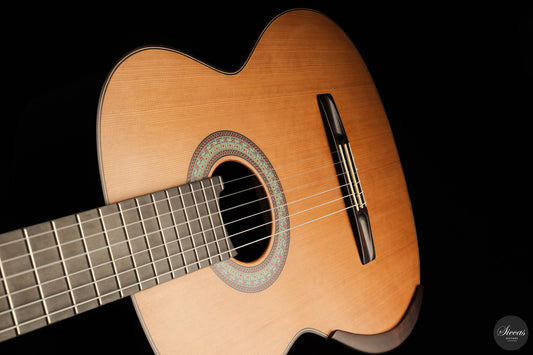
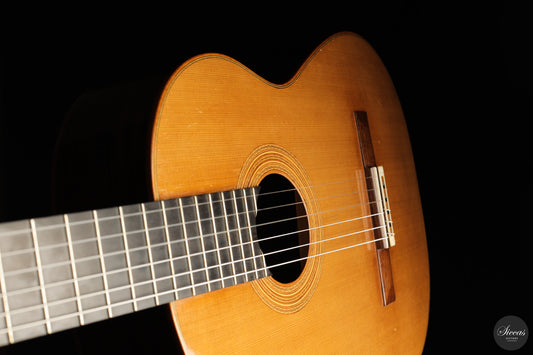
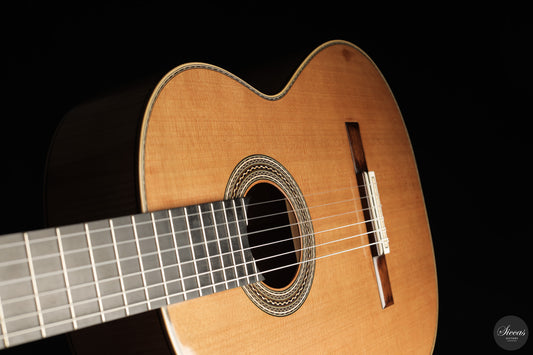
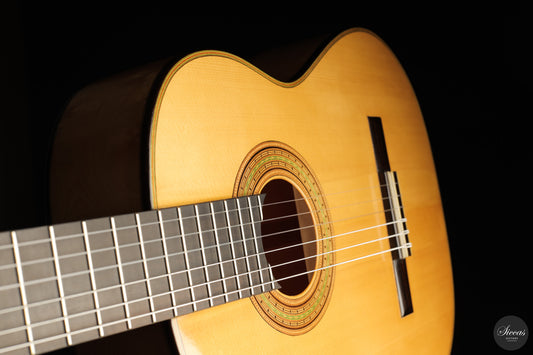
Carol arrangements and seasonal classical guitar repertoire generally benefit from a guitar with a warm, singing tone in the upper register and a bass that supports without overwhelming. A cedar-top instrument tends to offer warmth and responsiveness at lower dynamic levels, which suits the intimate character of pieces like The First Noel. Spruce-top guitars provide more projection and clarity, which is equally valid in a performance setting where the piece needs to carry across a room.
Scale length and string tension also play a role: a comfortable left-hand stretch is important for the chord voicings in harmonised arrangements, and a guitar that responds well at lower tensions will be easier to play expressively at slower tempos. Browse our collection of classical guitars to find an instrument suited to your playing and repertoire.