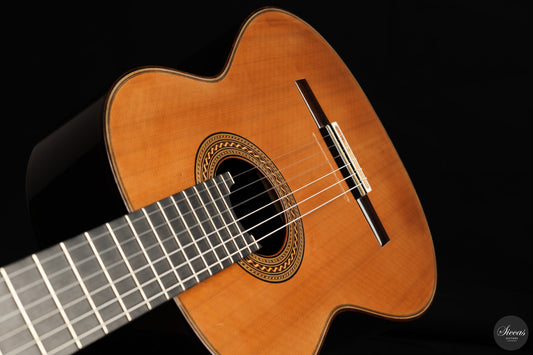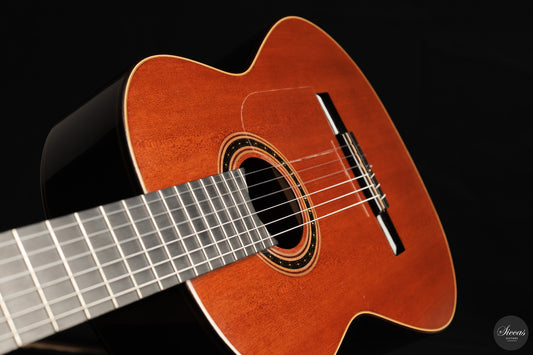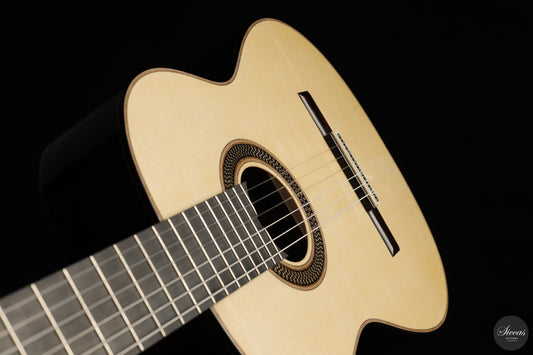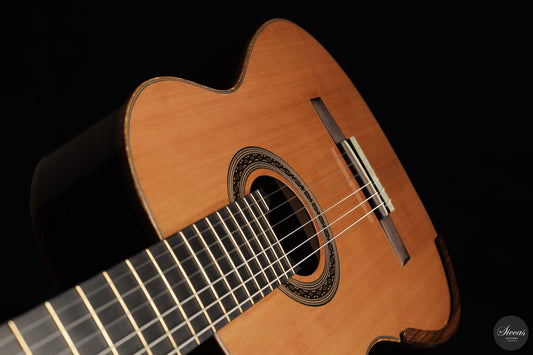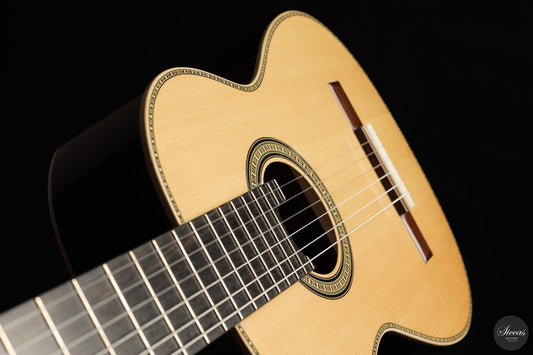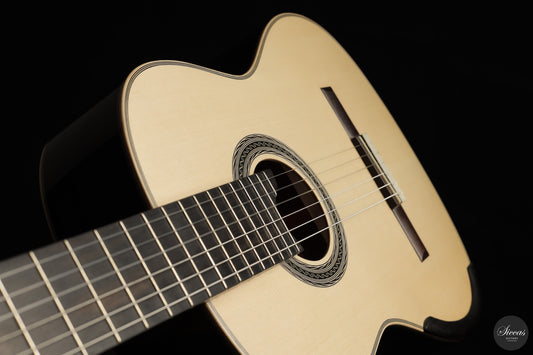

The brand Hanika was long known among folk musicians for its strong value for money. Today Hanika guitars are also highly regarded in classical music. They continue to offer an excellent price-performance ratio, deliver refined sound qualities and are manufactured with great care. Their powerful tone results from their voluminous body design. The selected tonewood used by Hanika matures for several years in the company’s own storage facilities before being further processed in the fully air-conditioned workshop. The choice of wood, its structure and tonal response are assessed manually.
The history of the Hanika family begins on 25 May 1932 in Schönbach. After the expulsion of the German musical instrument makers from the Egerland region, the family settled in the Bubenreuth area in 1946 following a short stay in Hesse. From 1947 to 1949 Helmut Hanika learned violin making from his grandfather Anton Mayer. The grandfather opened a small workshop in Baiersdorf where he produced violins. These instruments, especially the small violins, became popular souvenirs among the American occupation forces. At that time, American soldiers also brought new musical styles to Germany. Helmut Hanika developed a strong interest in jazz and in related instruments such as drums and guitars.
After completing his training, Helmut increasingly shifted his focus from violins to various types of guitars and soon sold the first instruments, including mandolins, to the company Framus in Bubenreuth. He expanded his knowledge through study and collaboration with colleagues. On 1 June 1953, after reaching adulthood, Helmut Hanika registered his own business and founded the company bearing his name.
Until 1964, drum guitars and various other guitar types were produced under the name “SOLI”. Shops such as Otto Gläsel and the major instrument manufacturer Willy Hödl sold these instruments, placing their own labels inside. In the same year Armin Hanika was born. From October 1965 onwards, Helmut concentrated on building classical concert guitars, now sold as “Helmut Hanika Konzertgitarren”. Distribution was handled for many years by Hans Norman in Wiesbaden, later Arnold Stölzel.
In October 1966 Helmut Hanika received his master craftsman title in plucked instrument making in Nuremberg. The name Hanika soon became associated with the production of high-quality classical guitars. After the end of the mass-production era in guitar building, Helmut chose the right path by focusing entirely on exclusive concert guitars, which made him internationally renowned. His son Armin began his apprenticeship in the family workshop.
From 1986 onwards Armin Hanika developed his own series inspired by Spanish guitar models with a slimmer silhouette, which continued to grow in the following years. In December 1987 he became the youngest master craftsman in plucked instrument making in Nuremberg. Taking over the business as the second generation, he followed the same philosophy as his father and built high-quality master guitars known for their exceptional sound. The company name was eventually changed to “Armin Hanika Gitarrenbau”.
Hanika continues to produce instruments with excellent value in all price categories. The brand’s success is reflected in rising sales figures and a steadily growing community of enthusiastic players.
Quality and innovation
Hanika guitars are characterised by exceptionally consistent craftsmanship and tonal stability. Production takes place in Beiersdorf using modern technology combined with traditional expertise. A distinctive aspect of Hanika is the commitment to ongoing development. The company offers lattice and double-top models as well as a wide variety of tonewoods upon request. Prices range from around 1000 euros to more than 10,000 euros.
Hanika and Siccas Guitars
For more than five years Hanika and Siccas Guitars have worked closely together. Siccas Guitars became one of the earliest Hanika Premium Shops. Custom Shop instruments can also be ordered through Siccas Guitars. The full range of Hanika models is available in the online store, where they can be ordered directly. Customers are welcome to contact the Siccas team by phone or email with any questions about Hanika guitars.