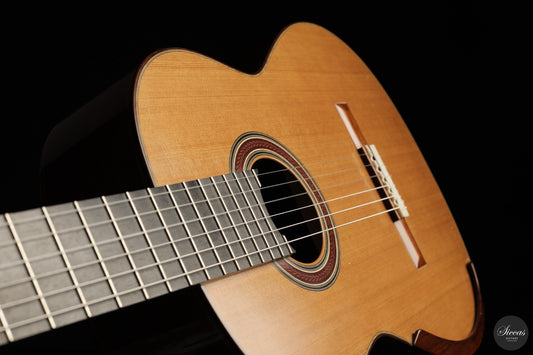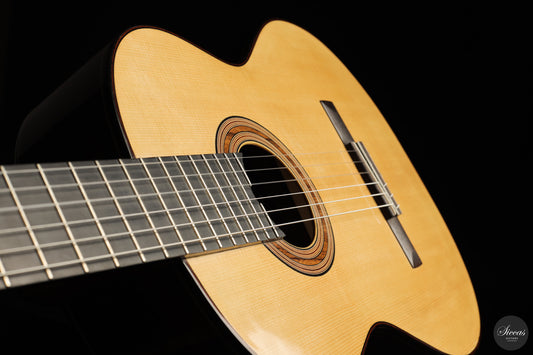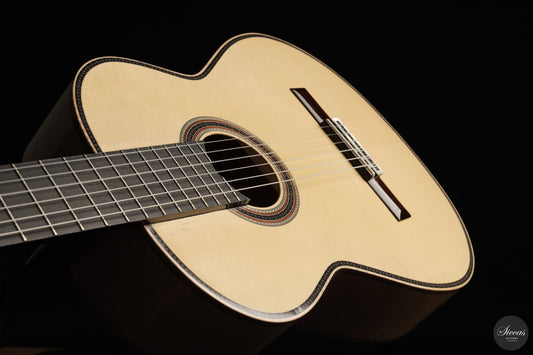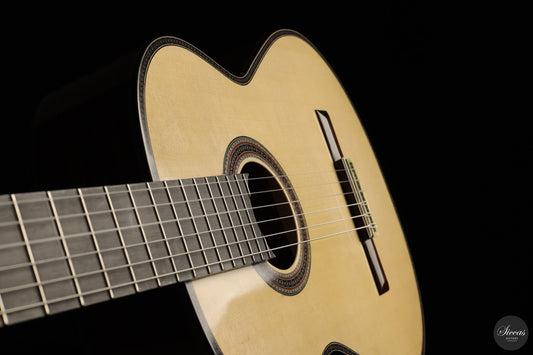

Recuerdos de la Alhambra — "Memories of the Alhambra" — is Francisco Tárrega's most famous composition, and one of the defining pieces of the entire classical guitar repertoire. It was written in 1896 following a visit to Granada's great Moorish palace, and it uses the tremolo technique to create a sound the guitar can rarely achieve: a sustained, continuous melodic line that seems to float above the world.
The Alhambra
The Alhambra is a medieval palace and fortress complex on a hilltop above Granada, built primarily in the fourteenth century during the Nasrid sultanate. It is the pinnacle of Moorish architecture in Europe: intricate geometric tilework, carved plasterwork that seems to dissolve in light, and everywhere the sound of water running through channels, fountains, and reflecting pools. Tárrega visited under the patronage of a friend in 1896, and whatever he experienced there came back as this piece — a musical memory in which the shimmering, continuous sound of water becomes the tremolo.
The Tremolo
On the classical guitar, tremolo is a technique in which a single melody note is plucked in rapid succession by the ring (a), middle (m), and index (i) fingers of the right hand, while the thumb plays a slower-moving bass line simultaneously. When executed fluently, the individual plucks merge into a continuous singing tone — the guitar achieving a sustained voice it cannot normally produce. The piece is in A minor, with a central section in A major that provides luminous contrast before the minor returns. Tárrega dedicated it to Concha Martínez.
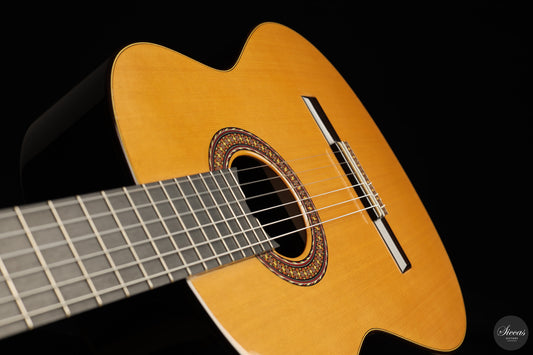
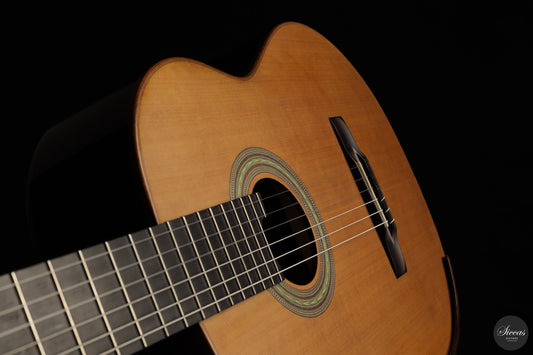
Performed at Siccas Guitars
How to Play Recuerdos de la Alhambra – Step-by-Step Guide
Learning Recuerdos de la Alhambra is one of the most rewarding challenges in the classical guitar repertoire. The piece sits at an advanced level — not because of complex harmony or unusual left-hand stretches, but because the right-hand tremolo demands a level of evenness and control that only comes from deliberate, patient practice. The following guide breaks down the technique from first principles.
Understanding the p-a-m-i Pattern
The tremolo pattern in Recuerdos de la Alhambra follows a four-note sequence: thumb (p), ring (a), middle (m), index (i). The thumb plays a bass note on a lower string, then the three fingers repeat the same melodic string three times in quick succession. In standard notation, each full tremolo cycle produces four sixteenth notes — one bass note and three melody notes — and these cycles repeat continuously throughout the piece.
The role of each finger within that cycle is not symmetrical. The a finger (ring) initiates each melodic group and tends to carry the strongest attack; it effectively leads the melody. If a is weak or hesitant, the melodic line loses its singing quality immediately. Many players who struggle with tremolo have invested their attention in m and i without first securing a reliable a.
The Role of the Thumb
The thumb is not a passive accompanist. In Recuerdos de la Alhambra, the bass line carries harmonic information that defines the mood of each phrase. The thumb must project clearly without overpowering the melody — a balance that requires its own independent practice. When working on the tremolo in isolation, it is tempting to ignore the bass; doing so produces a habit that is hard to correct later. From the first practice session, play the full p-a-m-i pattern, not just a-m-i.
How to Practice the Tremolo
The most effective entry point is the open string. Set the left hand aside entirely and play p-a-m-i on two open strings — bass on the sixth or fifth string, melody on the first or second. Listen only to evenness. All three melody plucks should sound identical in volume, tone, and timing. Most beginners produce a pattern that is louder on a and quieter on i, or that has a slight gap before a re-enters after the thumb. Both problems are addressed the same way: reduce speed until they disappear, then rebuild gradually.
A useful practice routine for the tremolo proceeds in stages:
- Stage 1 — Isolation. Play p-a-m-i on open strings at a tempo where every note sounds equal. This may be extremely slow at first — slower than feels musical. That is correct. The nervous system needs clean repetitions, not fast ones.
- Stage 2 — Add the left hand. Choose a simple chord — A minor in first position works well because it is the home key of the piece. Hold the chord and play the tremolo pattern. Listen for any change in evenness caused by left-hand tension.
- Stage 3 — Practice the opening phrase in small segments. Take the first four bars. Play them at half tempo. Once clean, move to three-quarter tempo. Do not attempt full tempo until the phrase is fluent at three-quarter speed.
- Stage 4 — Long, slow practice sessions over many weeks. The tremolo is a motor skill. It consolidates between sessions as much as during them. Short daily practice (20–30 minutes focused on tremolo) over several months produces better results than intensive weekend sessions.
Common Mistakes
Several errors appear so regularly in students learning this piece that they are worth naming explicitly.
Uneven tremolo. This is the most common issue. The melody sounds bumpy or mechanical rather than flowing. The cause is almost always that one finger — usually i, sometimes m — contributes less force than the others. The fix is to isolate the weak finger in simple exercises away from the piece and train it to match the stronger fingers, rather than trying to compensate by pushing harder overall.
Rushing. The natural tendency when the tremolo begins to flow is to accelerate. Rushing destroys the sense of a sustained melody line and makes the bass notes appear to arrive late. Use a metronome during practice phases. When you remove the metronome, the tempo discipline that was built in remains.
Physical tension. Tremolo requires a relaxed, free right hand. Players who grip, lock the wrist, or raise the forearm create tension that blocks the fine motor control the technique depends on. If the hand becomes uncomfortable during practice, stop. Rest. Return with a softer, more open hand position. Tension practiced repeatedly becomes a habit; a relaxed approach practiced repeatedly also becomes a habit.
Neglecting tone quality. Speed is not the goal; tone is. The most admired performances of Recuerdos de la Alhambra are memorable because of their singing, sustained melody — not their tempo. Practice slowly enough that you can place each pluck cleanly on the string and release it with a full, round sound. This is what separates a tremolo that convinces from one that merely impresses.
How Long Does It Take to Learn?
There is no single answer that applies to every player, but a realistic range for an intermediate guitarist with consistent daily practice is six months to two years before the tremolo sounds genuinely musical throughout the whole piece. Many players can read through the notes and produce a recognizable version within a few weeks; producing a performance in which the melody truly sings, the bass is balanced, and the tone remains even from the first bar to the last is a much longer project. That longer project is worth pursuing.
The piece does not reward impatience. Every hour spent practicing the tremolo slowly and correctly is banked and cannot be lost. Every hour spent practicing it fast and unevenly builds habits that will take additional time to undo. The investment in slow, clean work at the beginning is always repaid.
The Key of A Minor and the Structure of the Piece
Recuerdos de la Alhambra is in A minor. The opening section establishes the tremolo on the first string over a harmonic bass that moves through familiar Andalusian progressions — patterns rooted in the same musical world as flamenco, reflecting the Moorish cultural heritage of Granada itself. A central section in A major introduces a contrasting, more luminous character, as if the memory brightens for a moment before returning to the minor. The return of the opening material completes the arch, and the piece ends as quietly as it began.
The left hand, by the standards of advanced classical repertoire, is not the primary challenge. Most of the chord shapes and position shifts are within the reach of an intermediate player. What requires advanced skill is sustaining the tremolo cleanly across those shapes and shifts — keeping the right hand relaxed and even while the left hand changes.
Playing it
The tremolo must sound like an unbroken line, never mechanical. Evenness — all four fingers contributing with consistent tone and speed — is the lifelong challenge. The piece rewards patient, relaxed practice more than effortful speed. Advanced level.
See the full Tárrega guide, more about Recuerdos de la Alhambra, and other great classical guitar pieces. Explore the full range of classical guitars at Siccas Guitars, or discover more from the great classical guitarists.