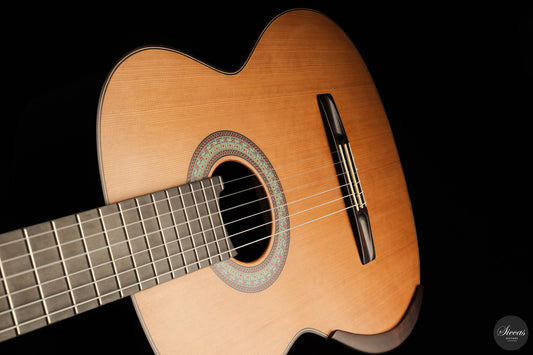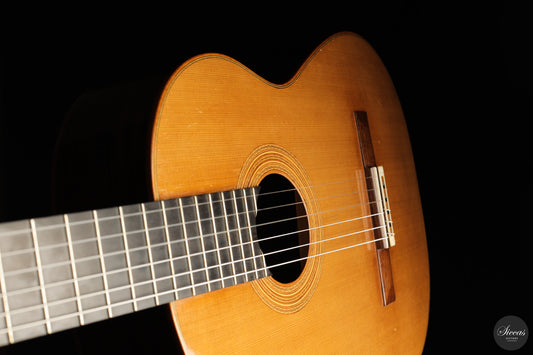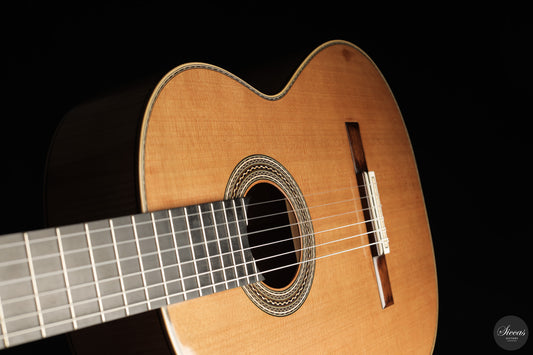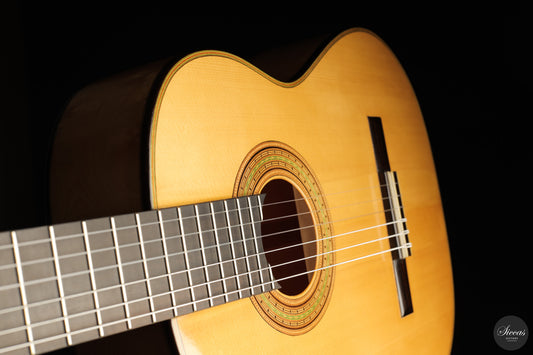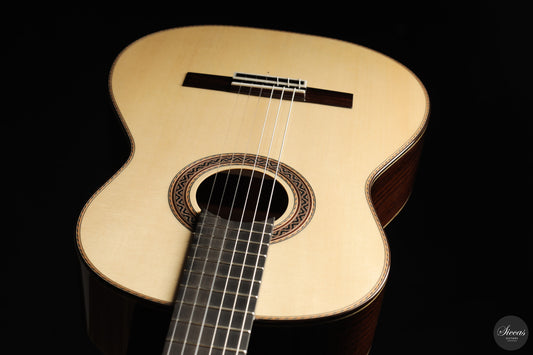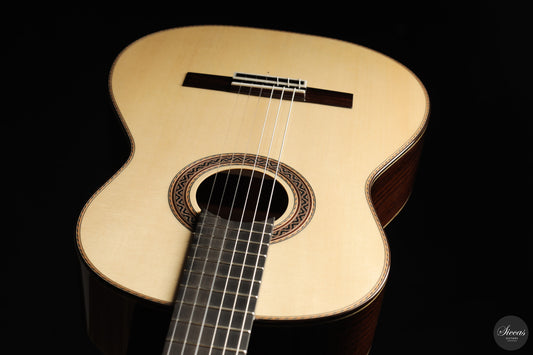

Occasionally, it happens that several outstanding antique guitars from the same guitarreria surface at the same time. This was recently the case with two remarkable instruments built in the Simplicio workshop at Paseo San Juan 110 in Barcelona. Together, they offer valuable insight into the ideas and reflections that ultimately shaped their construction.
Francisco Simplicio No. 299 / 1931
This guitar appears to be the only known instrument by Francisco Simplicio built with bird's-eye maple, leaving the wood in its natural, light color. A metal tornavoz surrounds the soundhole. Internally, the top bracing reveals a unique feature: the two V-shaped struts are not fully glued to the soundboard but are sculpted like arches, similar to bridge structures. This was a completely new approach in Simplicio guitars.
In a surviving letter to the customer Georg Bader from Berlin, Francisco Simplicio explains that he aimed to give the guitar a clear, bright voice. This intention accounts for the lighter bracing of the top. The tonal effect of the tornavoz was highly appreciated by prominent virtuosos such as Miguel Llobet and Emilio Pujol, who frequently performed on tornavoz guitars by Antonio de Torres.
A Flamenco Commission
This raises the question of why Simplicio opted for a brilliant, bright sound instead of the deep, dark and warm character for which his guitars were renowned. The instrument was made for Matilde Cuervas (1887–1956), a highly respected flamenco guitarist from Seville. Her preferred instruments included a relatively simple Torres guitar (No. 115 / 1888) made of mahogany and a cypress Torres guitar from 1860. These lightweight, direct-sounding instruments were ideally suited for Andalusian folk music and flamenco.
Simplicio sought to incorporate flamenco characteristics into this guitar. However, cypress guitars, common in Castilian and Andalusian workshops, almost never left the Simplicio workshop. Instead, Francisco Simplicio chose the rare, brilliant-sounding and precious bird's-eye maple, an expensive imported wood. This material choice is one reason this instrument stands apart from virtually every other classical guitar produced in the Barcelona workshop.
An Instrument That Almost Vanished
As Matilde Cuervas and Emilio Pujol were living in Paris in mid-1931, she was unable to collect the instrument. Simplicio therefore sold the guitar and intended to build her another similar one. The instrument ultimately passed via the Berlin guitarist Kurt Gudian to his student Georg Bader, who was delighted by the exceptional clarity and brilliance of the guitar.
The sudden death of Francisco Simplicio on January 14, 1932 prevented the construction of a second instrument of this type. As a result, the bird's-eye maple guitar, No. 299 from 1931, remains unique — a one-of-a-kind document of a master builder pushing the boundaries of his craft in response to a specific artistic request.
Miguel Simplicio No. 339 / 1932
This guitar features back and sides made of straight-grained, high-quality mahogany. It is fitted with a metal tornavoz and, like the 1931 maple guitar, has a sculpted headplate and decorative inlays around the soundhole and bindings. The original bridge was destroyed by poor repairs long ago and has since been replaced with a new bridge in the Simplicio style. Apart from a short, well-repaired crack, the guitar is in very good condition and delivers the characteristic deep, warm Simplicio sound at its finest.
The Simplicio Label Explained
The label requires some explanation. When Francisco Simplicio began working with Enrique Garcia, his son Miguel was already involved. Father and son thus entered the profession together. In a 1933 interview, Miguel Simplicio stated that he built guitars in the tradition of what he had learned from his father and their shared master, Enrique Garcia.
After Garcia's death in 1922, several unfinished instruments remained in the workshop. From 1923 onward, Francisco Simplicio began his own numbering system, initially using the Garcia label with handwritten additions. From around 1925, he used his own label, which Miguel continued to use until the closure of the Paseo San Juan workshop in 1938.
The last guitar personally signed by Francisco Simplicio is No. 336 from 1931. After his death, Miguel continued the numbering for the jointly built instruments. It is likely that No. 342 / 1932 represents the final result of their shared work. Understanding this labeling history is essential for scholars and collectors seeking to attribute individual instruments correctly — much as provenance matters with instruments by other great Spanish makers studied on pages such as our overview of great classical guitarists.
The Simplicio Legacy in Context
Francisco Simplicio (1874–1932) occupies a singular position in the history of Spanish guitar making. Trained under Enrique Garcia — himself a pupil of the renowned Antonio de Torres — Simplicio absorbed a tradition of meticulous craftsmanship while developing his own voice as a builder. His instruments are distinguished by exceptional tonal depth, fine woodworking detail, and a responsiveness that appealed equally to concert virtuosos and advanced amateurs.
Compared with the instruments of contemporaries such as José Ramírez or later masters like Ignacio Fleta, Simplicio guitars occupy a special niche: they are Spanish in tradition and intimately connected to the pre-war Barcelona school, yet often show a degree of individual experimentation — as the bird's-eye maple instrument of 1931 so vividly demonstrates. For those interested in the broader sweep of Spanish guitar history, our article on Francisco Tárrega provides essential context for the repertoire these instruments were built to serve.
Tonewoods and Climate: A Deliberate Choice
The worldwide distribution of Simplicio guitars reveals an intriguing pattern. Many instruments supplied to Central Europe were deliberately built using mahogany, while Brazilian rosewood appears to have been used only upon special request. Simplicio clearly considered climatic conditions and selected robust, stable tonewoods for drier regions. This is a degree of client-oriented thinking rarely documented in surviving correspondence from luthiers of his era.
The bird's-eye maple guitar fits perfectly into this philosophy: visually light, flamenco-inspired in character, and resistant to continental climate influences. Those curious about how tonewood choices shape an instrument's voice will find our guide on spruce vs. cedar a useful companion read — the same principles of resonance, stiffness, and tonal color that govern modern choices were clearly understood by master builders like Simplicio a century ago.
Why These Two Guitars Matter
Seeing these two instruments together — No. 299 in bird's-eye maple from 1931 and No. 339 in mahogany from 1932 — offers a rare comparative window. Both share the signature Simplicio tornavoz, sculpted headplate, and fine inlay work. Yet they represent opposite ends of the tonal spectrum the workshop could produce: one bright and flamenco-inflected, the other deep and classically warm.
For collectors and musicians interested in vintage Spanish guitars, few opportunities arise to study such direct contrasts within a single maker's output. These instruments are not merely historical artifacts — they remain fully playable, living voices from one of the most creative periods in guitar-making history.
Karlstein, May 2022
Siegfried "Hogi" Hogenmüller