
Introduction: Choosing the right classical guitar can feel overwhelming, especially with the wide variety of options available. Whether you're a beginner, an intermediate player, or a seasoned guitarist, finding the perfect classical guitar involves considering factors like budget, tonewoods, scale length, bracing style, and personal playing goals. This guide will help you understand what to look for in a classical guitar, so you can make an informed choice and find an instrument that suits your playing level, musical ambitions, and sound preferences.
Define Your Skill Level and Purpose
Your playing experience and goals are the foundation for choosing the right classical guitar. Beginners often prioritize comfort and affordability, while advanced players look for superior tone, responsiveness, and craftsmanship.
For Beginners: If you're just starting out, look for a guitar with good playability and solid construction at an accessible price. Entry-level instruments are designed to be forgiving and comfortable, helping you build technique without fighting the instrument. Read more about getting started in our guide on how long it takes to learn classical guitar.
For Intermediate Players: Intermediate players benefit from investing in a guitar with higher-quality tonewoods and refined craftsmanship. The step up in build quality translates directly into a richer, more nuanced sound and better dynamic response — qualities that become increasingly important as your technique develops.
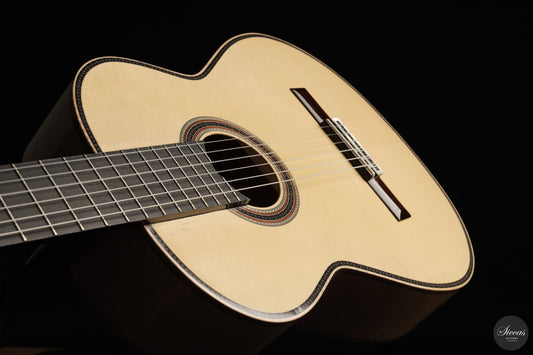
For Advanced Players and Professionals: Professional-level instruments are typically handcrafted by individual luthiers, built with premium tonewoods, and voiced to deliver exceptional projection, tonal complexity, and responsiveness. These instruments reward refined technique and are built to the demands of concert-level performance. Explore our full range at Siccas Guitars – Classical Guitars.
Top Wood: Cedar vs. Spruce
The choice of top wood is one of the most significant decisions you will make when selecting a classical guitar. The soundboard — the top of the guitar — is responsible for the majority of the instrument's acoustic character. The two dominant choices are cedar and spruce, and each has a distinct tonal identity.
Cedar Tops
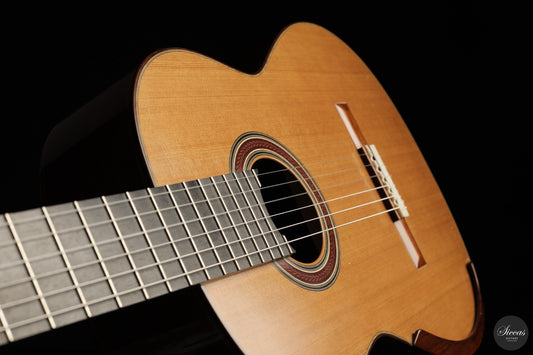
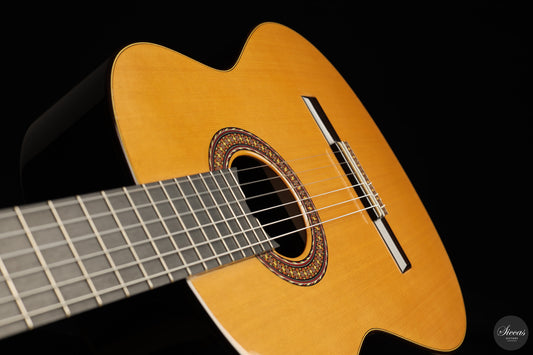
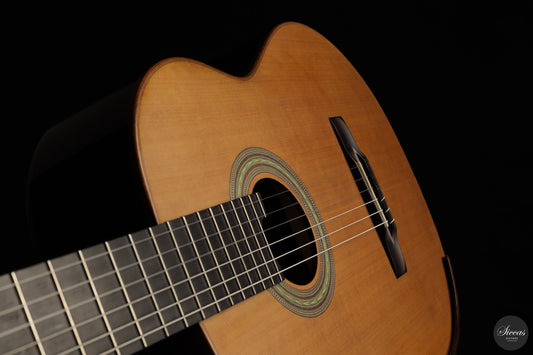
Cedar produces a warm, immediate, and expressive tone. It responds easily at lower playing forces, which makes it particularly appealing for players who favour a softer touch or an intimate, nuanced style. Cedar tends to sound "open" right away — it does not require the same extended break-in period that spruce sometimes needs. Many players exploring Romantic-era repertoire or early music find cedar to be an excellent match.
Spruce Tops
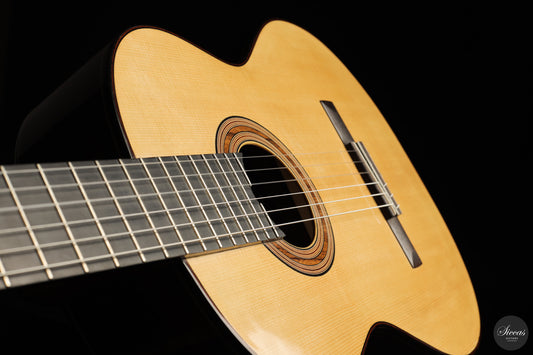
Spruce delivers a brighter, more projecting sound with a pronounced dynamic range. It rewards assertive playing and tends to open up further over years of use, becoming progressively richer and more complex. Spruce is the traditional choice for instruments intended for concert performance, where volume and clarity across a large space are priorities. Our dedicated spruce vs. cedar tone comparison explores the differences in greater depth.
Tip: If you are drawn to expressive, lyrical playing and a warm palette, cedar is likely your wood. If you want clarity, brightness, and long-term dynamic ceiling, spruce is the stronger choice. Ideally, try both side by side before deciding.
Bracing: Traditional Fan, Lattice, and Double-Top
The internal bracing of the guitar top shapes how the soundboard vibrates and therefore how the guitar projects and responds. Three bracing architectures are common in classical guitars at Siccas Guitars.
Traditional Fan Bracing
Fan bracing is the classical standard, developed and refined over centuries of Spanish luthiery. A series of radiating braces fan out beneath the soundboard, providing structural support while allowing the top to vibrate freely. The result is a warm, balanced, organically voiced instrument that is versatile across repertoire. The vast majority of classical guitars — from student models to fine handmade instruments — use fan bracing in some form.
Lattice Bracing
Lattice bracing, developed in Australia in the 1980s, replaces the traditional fan with a grid of carbon fibre or wooden cross-members. This dramatically stiffens the top while reducing its mass, allowing for extraordinary projection and treble brilliance. Lattice guitars tend to have a modern, powerful sound with exceptional volume. They are particularly popular with players who perform without amplification in larger venues.
Double-Top Construction
Double-top guitars use a soundboard composed of two thin layers of wood with a core of Nomex honeycomb or similar material sandwiched between them. This construction combines low mass with high stiffness — similar in principle to lattice bracing, but with a tonal character that many players find more familiar and rounded than pure carbon lattice instruments. The result is a guitar with outstanding projection and sensitivity. Browse our double-top guitar collection to see current availability.
Scale Length: Standard and Short-Scale Guitars
Scale length — the vibrating length of the string from nut to saddle — has a direct impact on playability and tone. The standard classical guitar scale length is 650 mm, which produces full, resonant tone and is appropriate for most adult players.
Short-scale instruments, typically 630 mm, reduce the overall string tension and bring the frets slightly closer together. This can be a significant advantage for players with smaller hands, or for those transitioning from shorter-scale instruments. The tonal trade-off is generally minor — many fine concert instruments are built to 630 mm — and for the right player, the improvement in comfort and left-hand facility more than compensates.
Tip: If you regularly find full-size necks uncomfortable, try a short-scale instrument before assuming the problem lies with your technique. The physical fit of the instrument matters.
Tonewoods for Back and Sides
While the top wood dominates the guitar's tonal identity, the back and sides contribute to the overall sonic character, particularly in terms of sustain, resonance, and tonal colour.
- Rosewood: The most traditional choice for concert instruments. Rosewood delivers a deep, complex bass response, rich mid-range, and excellent sustain. It is the reference material against which other back-and-side woods are often measured.
- Cypress: The classic choice for flamenco guitars, cypress produces a drier, more percussive sound with excellent attack. It is also commonly found on traditional Spanish-style classical instruments. Explore our flamenco guitar collection for cypress-bodied instruments.
- Maple: Produces a bright, articulate sound with a focused midrange. Used by some contemporary luthiers seeking a different tonal palette from rosewood.
- Mahogany: Warm, balanced, and clear — often found on well-built mid-range instruments. It tends to produce a more forward, direct sound than rosewood.
Playability and Action
"Action" refers to the distance between the strings and the fretboard. It is a critical factor in how comfortable and effortful the guitar is to play. Low action makes pressing the strings easier, which is particularly valuable for beginners, but action set too low will cause string buzz. Higher action allows for more volume and cleaner articulation at higher dynamics, but demands greater finger strength.
A well-set-up classical guitar should have action that is neither fighting you nor buzzing. If you are buying online, check whether the instrument has been set up before shipping. At Siccas Guitars, instruments are professionally checked before dispatch.
Acoustic vs. Acoustic-Electric Models
Most classical guitars sold at the concert level are purely acoustic instruments, optimised for unamplified performance. However, acoustic-electric models with integrated pickup systems exist and are practical for players who regularly perform in amplified settings — teaching studios, small venues, or recording environments where microphone placement is impractical.
If you choose an acoustic-electric model, pay attention to the quality of the preamp system. A poor pickup implementation can flatten the dynamic range and strip out the tonal complexity that makes a good classical guitar worth owning. For home practice and small recitals, a traditional acoustic instrument is almost always the better choice.
Understanding Classical Guitar Repertoire and Matching Your Instrument
The repertoire you intend to play can help guide your instrument choice. Baroque and Renaissance music, often performed on smaller-bodied instruments with a focused, clear tone, can suit a shorter-scale guitar with a cedar top. Large Romantic works — pieces by Francisco Tárrega, Agustín Barrios, or Heitor Villa-Lobos — often benefit from the projection and tonal complexity of a spruce-topped concert instrument. If you are learning the standard repertoire and are unsure where to start, our guide to famous classical guitar pieces may help you identify what excites you most.
Comparing Classical Guitars in Action
Listening to instruments being played side by side is one of the most direct ways to understand tonal differences. The video below from our Weekly Guitar Meeting series demonstrates how different classical guitars compare in a real playing context:
Budget Levels: What to Expect at Each Price Point
Classical guitars are available across a very wide price spectrum, and understanding what your budget buys is essential to making a satisfying choice.
Entry-Level
Entry-level instruments are mass-produced or factory-assembled, typically featuring laminate tops. They are functional tools for building basic technique and are the appropriate starting point for absolute beginners who are not yet certain of their long-term commitment to the instrument.
Mid-Range
At the mid-range level, solid wood tops become standard. The improvement in tonal quality and resonance over laminate instruments is immediately audible, and the guitars begin to reward the developing technique of a serious student. This is where many players find instruments they are happy to use for years.
Professional and Handmade Instruments
Professional instruments are hand-built by individual luthiers, often to order, using premium tonewoods carefully selected for their acoustic properties. Every detail — bracing geometry, voicing, finish — is attended to by a single maker who understands how each choice affects the final result. These instruments have the responsiveness, projection, and tonal complexity required at the concert level. Browse makers such as José Ramírez in our catalogue.
Essential Accessories
Once you have chosen your guitar, a small set of accessories will complete your setup:
- Case or gig bag: A hard case offers the best protection for transport and storage. A quality gig bag is a practical lighter-weight alternative for short journeys.
- Tuner: Accurate tuning is essential from the very first session. A clip-on chromatic tuner or a dedicated app works well for classical guitar.
- Footstool or guitar support: Classical technique requires the guitar to be held in a specific position. A footstool is the traditional solution; modern supports such as the Ergoplay or Gitano attach to the body of the guitar and avoid the postural strain of a raised foot.
- Extra strings: Nylon strings need regular replacement — typically every one to three months for active players. Keep a spare set to hand.
Conclusion: Find the Classical Guitar That Is Right for You
Choosing a classical guitar is a deeply personal decision, shaped by your playing level, physical build, tonal preferences, and the music you love. By working through the key decision factors — top wood (cedar vs. spruce), bracing architecture (traditional fan, lattice, or double-top), scale length (650 mm vs. 630 mm), and budget — you can systematically narrow your options to instruments that genuinely suit you.
Take the time to try instruments in person where possible, listen carefully to recordings, and do not hesitate to consult with specialists. The right classical guitar will feel like a natural extension of your musical voice — and it will reward you every time you pick it up.
Explore our full selection of handpicked classical guitars from the world's leading luthiers at Siccas Guitars. For further reading, our guide on acoustic vs. classical guitar explains the fundamental differences between the two instrument families.