


Dieter Hopf
-
Luthier: Dieter Hopf
-
Luthier: Dieter Hopf
-
Luthier: Dieter Hopf
-
Luthier: Dieter Hopf
-
Luthier: Dieter Hopf
-

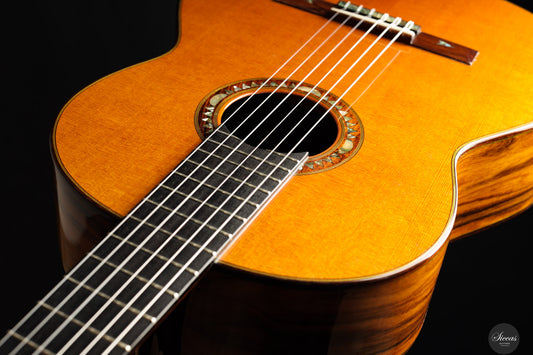 SoldSoldLuthier: Dieter Hopf






Frequently Asked Questions About Classical Guitars
How do I choose the right classical guitar for my level?
Choosing the right classical guitar depends on your playing level, musical goals, and budget. Beginners benefit from studio-model guitars from renowned workshops, while advanced players and professionals often choose a handmade master guitar. We are happy to advise you personally and can send detailed sound samples and videos on request.
What is the difference between a master guitar and a studio guitar?
Master guitars are built entirely by hand in the workshop of a single luthier, using only high-quality, well-aged tonewoods. Studio guitars are made in small series, often under the supervision of the master luthier, and offer excellent value for students and ambitious amateur players.
Can I try a classical guitar at home for 14 days?
Yes — every guitar you purchase from us comes with a 14-day home approval period. This complimentary trial applies worldwide to all orders, whether you are in Germany, Europe, the USA, Asia or anywhere else. We ship your instrument fully insured in a high-quality case so you can play it under your own acoustic conditions. If the guitar is not the right one for you, simply send it back and receive a full refund of the purchase price.
Can I try a classical guitar before purchasing?
Absolutely. You are warmly invited to visit our showroom in Karlsruhe, Germany, and test the instruments at your leisure. We are happy to schedule a personal appointment. If a visit is not possible, we send detailed videos and sound samples, and offer extensive consultation by phone or video call.
What payment methods and financing options do you offer?
We accept bank transfer, PayPal, major credit cards, and Klarna. For high-value instruments, we offer individual installment plans on request. Please contact us directly — we will find a suitable solution for every budget.
How do I properly care for my classical guitar?
A classical guitar requires constant humidity between 45 and 55 percent. Store the instrument in its case with a humidifier, avoid direct sunlight and large temperature fluctuations. Change the strings regularly and clean the guitar with a soft microfiber cloth.
You may also be interested Dieter Hopf
Dieter Hopf – Guitar Maker
Hopf Guitar Craftsmanship: Over 350 Years of Musical History
Since the 17th century, the Hopf name has been synonymous with excellence and tradition in guitar and instrument making. In the world of musical instruments, especially guitars and violins, the Hopf brand holds a significant position.
Origins in the 17th and 18th Centuries
The Hopf family’s musical heritage began in the regions of Klingenthal and Markneukirchen, often referred to as the center of German musical instrument manufacturing. Caspar Hopf (1655–1716), the first documented violin maker of the family, laid the foundation for a history marked by artisanal skill and craftsmanship. Under his guidance and that of his successor, Caspar Hopf II, the family became one of the key contributors to German instrument making.
Transition into the 20th Century
For generations, Hopf masters passed their craft to their descendants. Their instruments – guitars, violins, and strings – were celebrated worldwide for their quality and craftsmanship. Following the political changes after World War II, the family relocated to Taunusstein-Wehen and continued building their reputation as leading instrument makers.
Modern Legacy
Dieter J. Hopf continues the family tradition, combining innovation with classical construction. His developments, such as the Free Swinging Top System (F.V.T.S.) and the rosette bridge design, set new standards in guitar building. The partnership between Dieter J. and Gertrud Hopf expanded their portfolio with the acquisition of Carl Hellweg Deutschland, further strengthening their market position.
A Global Presence
Hopf instruments now have admirers around the world. From classical concert strings to modern electric guitar strings, Hopf products cater to musicians across all genres and skill levels.
Classical Guitars by Dieter Hopf
The Artist Membrane: Developed in collaboration with Manuel Adalid. The top features a refined central area and uses a grid bracing reinforced with carbon fiber. A semi-concert model designed to project large volume—ideal for players wanting a lattice guitar at an accessible price.
The Progresso: The only double-top cedar/Nomex/cedar guitar by Dieter Hopf. It remains traditional in tonal character but offers extra power thanks to the Nomex core.
The Portentosa Grande Furioso: The lattice version of the famous traditional Portentosa. The thin top uses grid bracing, resulting in power combined with classic elegance. It is the result of experimentation rather than an attempt to imitate Australian designs.
The Portentosa Evolucion: Likely the most advanced guitar by Dieter Hopf. A lattice instrument with a classical character and exceptional power.