






Paul Hildebrandt - 2024 No. 13
Details
Details
Overview
Overview


Video overview


More details about the guitar
About the luthier
Paul Hildebrandt, originally from Rostock, Germany, discovered his passion for crafting, tinkering, and innovating at a young age. His childhood fascination with wood and numerous DIY projects naturally evolved into a love for musical instruments. Starting with the cello in elementary school and later transitioning to the guitar during his teenage years, Paul’s interest in music deepened. His first encounter with a violin maker sparked a lifelong fascination with the art of instrument making, inspiring him to pursue this craft professionally. In 2021, Paul excelled at the Klingenthal Musical Instrument Making School by passing the journeyman’s examination for plucked instrument makers and subsequently won first place as the top graduate at the national crafts competition, Leistungswettbewerb des deutschen Handwerks. Currently, he is furthering his expertise by studying musical instrument making in Markneukirchen, a town with a rich history in this field.About the guitar
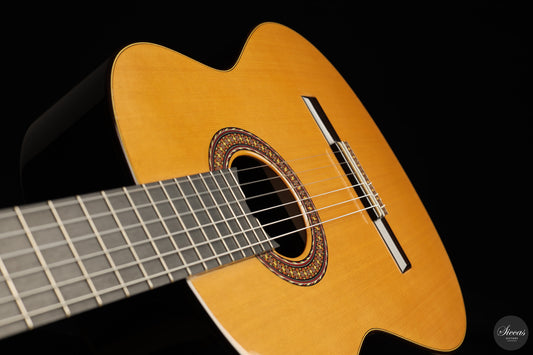
Guitar No. 13, the sister instrument to No. 14, shares a nearly identical aesthetic with its counterpart, beautifully crafted to mirror each other in every visible aspect. The true distinction lies beneath the surface, where luthier Paul has varied the thickness of the top, an experimental touch designed to subtly influence the acoustic properties of each guitar. This meticulous attention to detail is part of a broader commitment to achieving the highest level of craftsmanship, with every element finely tuned to perfection. For those interested in the specifics of these variations, an interview with Paul provides a deeper insight into his innovative approach, highlighting the subtle yet impactful differences between these two exceptional instruments.Both guitars stand out as masterpieces of lutherie, boasting clean and precise acoustic qualities that make them suitable for a wide range of musical styles. The clarity of sound produced by these instruments is particularly remarkable, facilitating the performance of complex polyphonic works with ease. This clarity ensures that every note is articulated distinctly, supporting musicians in their expression of intricate musical passages. Whether used in a solo performance or within an ensemble, guitars No. 13 and No. 14 offer musicians the ability to convey their musical vision with precision, making them not just tools, but true partners in the artistic process.

While this one is sold, these are ready for you
-
Classical Guitars
The classical guitar, with its soft nylon strings and characteristic timbre, has become a symbol of chamber music, Spanish tradition, and concert repertoire. Its modern form was shaped by Antonio de Torres in the 19th century, setting the standard for the body, fan bracing, and the 65-centimeter scale length that are still used today. Instruments in this category open up a rich palette from the refined Romantic miniatures of Tárrega to the majestic concertos of Rodrigo. Here you will find guitars that preserve historical continuity and at the same time inspire new interpretations.Look all products of the collection -
Jialan Chen - 2026 Coclea Thucea "Fibonacci"
Price: 9.990 €Unit price per Tax free (0% DE)Luthier: Jialan ChenConstruction Type: Traditional -
Lucio Antonio Carbone - 2026
Price: 8.400 €Unit price per Tax free (0% DE)Luthier: Lucio Antonio CarboneConstruction Type: Traditional -
Solveig & Andreas Kirschner - 2016 Studio
Price: 4.990 €Unit price per Tax free (0% DE)Luthier: Andreas KirschnerConstruction Type: Traditional -
Richard Jacob Weissgerber - 1944 Biedermeier 35.1/3
Price: 4.990 €Unit price per Tax free (0% DE)Luthier: Richard Jacob WeissgerberConstruction Type: Traditional -
Richard Jacob Weissgerber - 1936 Torres Damen 33.3/0
Price: 2.790 €Unit price per Tax free (0% DE)ReservedLuthier: Richard Jacob WeissgerberConstruction Type: Traditional -

 Reserved
Zbigniew Gnatek - 2023
Price: 11.990 €Unit price per Tax free (0% DE)ReservedLuthier: Zbigniew GnatekConstruction Type: Lattice -

 Reserved
Andreas Kraus - 2025-01 Double-Top
Price: 6.990 €Unit price per Tax free (0% DE)ReservedConstruction Type: Double-Top Guitars -
Kenneth Brögger - 2025 Maple "Mosaic"
Price: 8.990 €Unit price per Tax free (0% DE)ReservedConstruction Type: Traditional -
Kenneth Brögger - 2026 Rosewood "Mosaic"
Price: 8.990 €Unit price per Tax free (0% DE)Construction Type: Traditional -
José Salinas - 2026 Cedar 64 cm
Price: 5.990 €Unit price per Tax free (0% DE)Luthier: José SalinasConstruction Type: Traditional




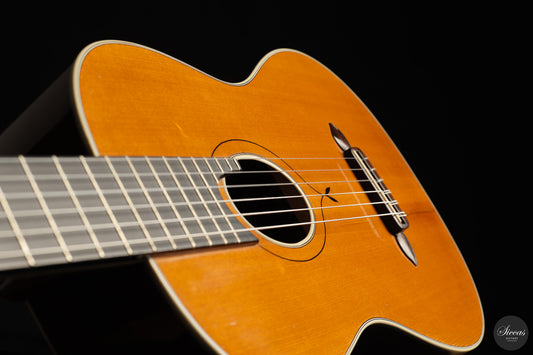

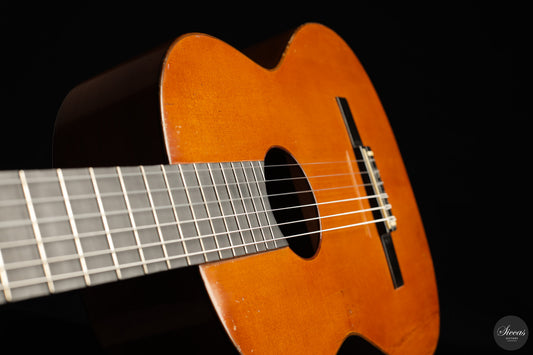


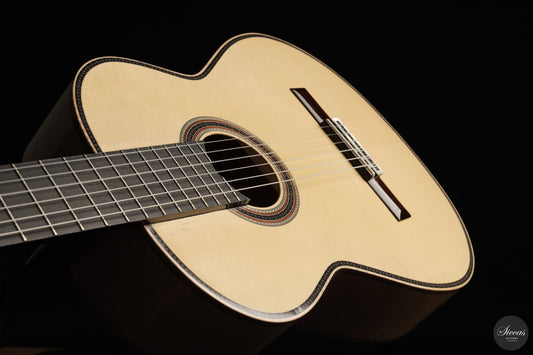

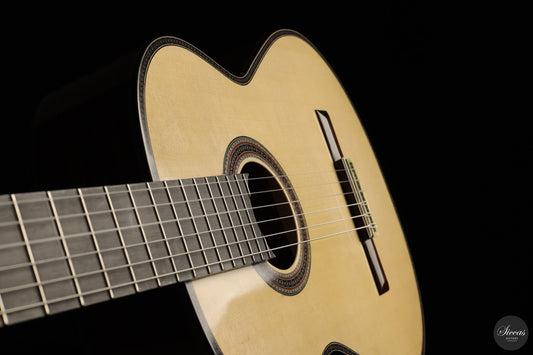



Related guitars
Frequently Asked Questions About Classical Guitars
How do I choose the right classical guitar for my level?
Choosing the right classical guitar depends on your playing level, musical goals, and budget. Beginners benefit from studio-model guitars from renowned workshops, while advanced players and professionals often choose a handmade master guitar. We are happy to advise you personally and can send detailed sound samples and videos on request.
What is the difference between a master guitar and a studio guitar?
Master guitars are built entirely by hand in the workshop of a single luthier, using only high-quality, well-aged tonewoods. Studio guitars are made in small series, often under the supervision of the master luthier, and offer excellent value for students and ambitious amateur players.
Can I try a classical guitar at home for 14 days?
Yes — every guitar you purchase from us comes with a 14-day home approval period. This complimentary trial applies worldwide to all orders, whether you are in Germany, Europe, the USA, Asia or anywhere else. We ship your instrument fully insured in a high-quality case so you can play it under your own acoustic conditions. If the guitar is not the right one for you, simply send it back and receive a full refund of the purchase price.
Can I try a classical guitar before purchasing?
Absolutely. You are warmly invited to visit our showroom in Karlsruhe, Germany, and test the instruments at your leisure. We are happy to schedule a personal appointment. If a visit is not possible, we send detailed videos and sound samples, and offer extensive consultation by phone or video call.
What payment methods and financing options do you offer?
We accept bank transfer, PayPal, major credit cards, and Klarna. For high-value instruments, we offer individual installment plans on request. Please contact us directly — we will find a suitable solution for every budget.
How do I properly care for my classical guitar?
A classical guitar requires constant humidity between 45 and 55 percent. Store the instrument in its case with a humidifier, avoid direct sunlight and large temperature fluctuations. Change the strings regularly and clean the guitar with a soft microfiber cloth.