






Santos Hernandez - 1925
Details
Details
Overview
Overview


Video overview


More details about the guitar
About the luthier
Santos Hernández was born in Madrid in 1873 and began his apprenticeship at an early age in the workshop of Valentín Viudes before continuing his training in José Ortega’s Granadinian workshop. After periods spent in several workshops and compulsory military service, he assumed Enrique García’s position at Manuel Ramírez’s workshop in 1905. His contribution to the construction of Andrés Segovia’s celebrated 1912 Manuel Ramírez guitar established his reputation as one of the most important Spanish guitar makers of his generation.
Following Manuel Ramírez’s death, Hernández continued working for his widow alongside Domingo Esteso. In 1921, he opened his own workshop, marking the beginning of an independent period that would produce some of the most sought after Spanish guitars of the early twentieth century. His work is characterised by a Torres influenced structural approach, refined craftsmanship and a tonal ideal that has remained a reference point for generations of makers.
About the guitar
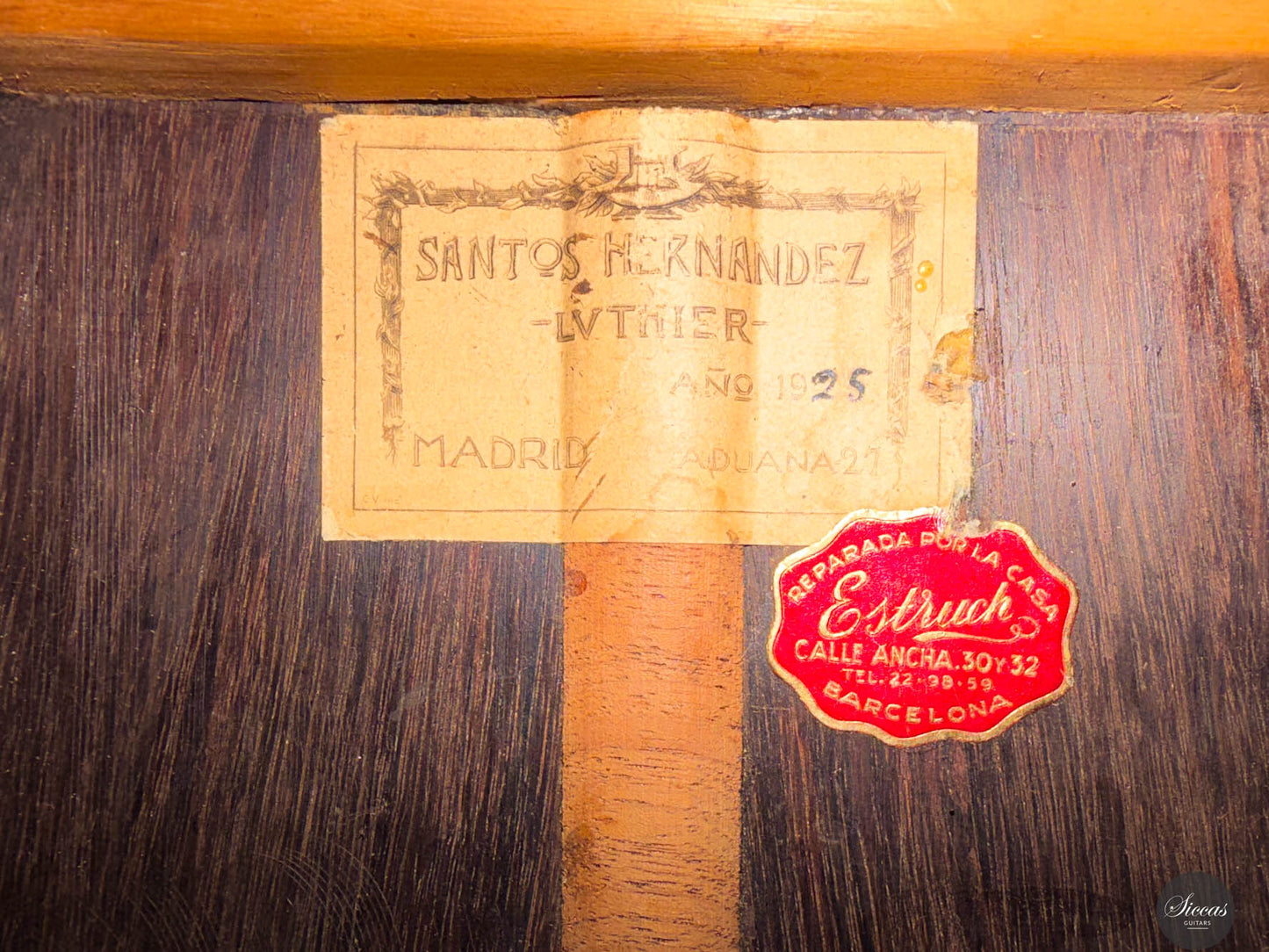
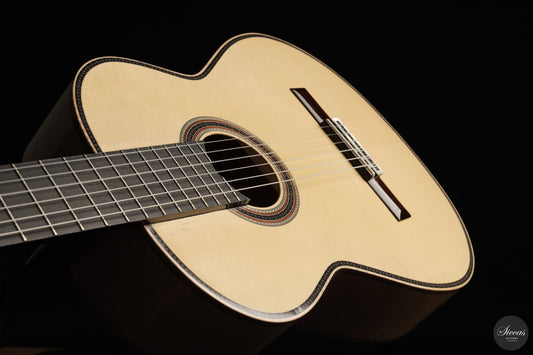
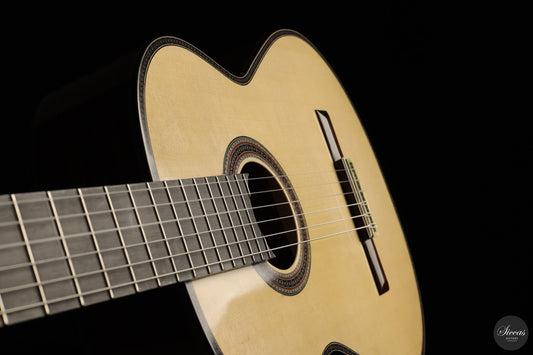
This guitar was built in 1925 and represents a mature example of Santos Hernández’s independent work. Constructed with a spruce top and Brazilian rosewood back and sides, it is exceptionally light in weight, a characteristic closely associated with Hernández’s most responsive instruments from this period.
The tonal character is distinctly vintage and immediately recognisable. The basses are not only deep but notably singing, supported by a very low body resonance that gives the instrument a sense of depth and openness. Despite this resonance, the sound remains controlled, with clear separation between notes and a focused core to each pitch. The overall colour is slightly dark and smooth rather than bright, yet never blurred.
Across the registers, the guitar offers strong balance and a refined sense of space between notes, allowing inner voices and phrasing details to emerge naturally. The response encourages expressive playing and rewards subtle articulation, making the instrument particularly compelling for players seeking an authentic early twentieth century Spanish voice.
Condition
The guitar has been professionally repaired and is structurally stable. It carries an additional internal seal reading “Reparada por Casa Estrada, Calle Ancha 30 y 32, Barcelona,” indicating historical restoration work carried out by Casa Estruch.
Several cracks are present on the top, including two running from below the bridge to the lower edge, one to the right of the rosette, cracks on both sides of the fingerboard, and a possible short crack in front of the bridge. A small crack is also present on the side near the lower bout. All cracks have been professionally repaired without the use of cleats, which is considered a positive aspect in historical restoration.
On the back, a crack runs close to the right bout from the upper to the lower section. Additionally, a section of the back has been replaced with a well matched piece of wood, with possibly a single cleat near the tip of the replaced area. The tuners are original.
The finish consists of a combination of nitrocellulose and shellac applied across the instrument.

While this one is sold, these are ready for you
-
Classical Guitars
The classical guitar, with its soft nylon strings and characteristic timbre, has become a symbol of chamber music, Spanish tradition, and concert repertoire. Its modern form was shaped by Antonio de Torres in the 19th century, setting the standard for the body, fan bracing, and the 65-centimeter scale length that are still used today. Instruments in this category open up a rich palette from the refined Romantic miniatures of Tárrega to the majestic concertos of Rodrigo. Here you will find guitars that preserve historical continuity and at the same time inspire new interpretations.Look all products of the collection -
Antonio Marin Montero - 2011 Flamenca No. 670
Price: 7.490 €Unit price per Tax free (0% DE)ReservedLuthier: Antonio Marin MonteroConstruction Type: FlamencoConstruction Type: Traditional -
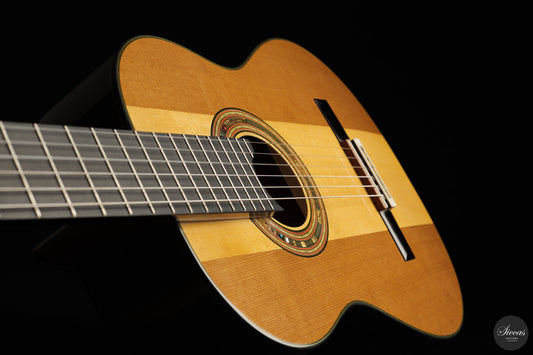
Jialan Chen - 2026 Coclea Thucea "Fibonacci"
Price: 9.990 €Unit price per Tax free (0% DE)Luthier: Jialan ChenConstruction Type: Traditional -
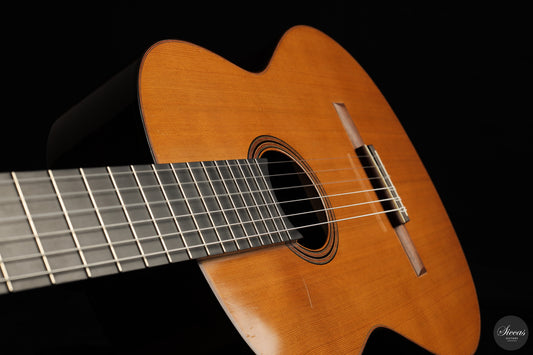
Lucio Antonio Carbone - 2026
Price: 8.400 €Unit price per Tax free (0% DE)Luthier: Lucio Antonio CarboneConstruction Type: Traditional -
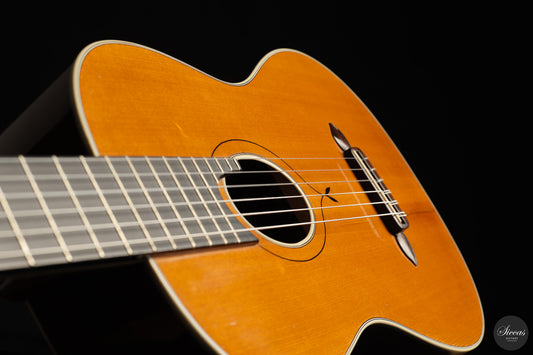
Solveig & Andreas Kirschner - 2016 Studio
Price: 4.990 €Unit price per Tax free (0% DE)Luthier: Andreas KirschnerConstruction Type: Traditional -
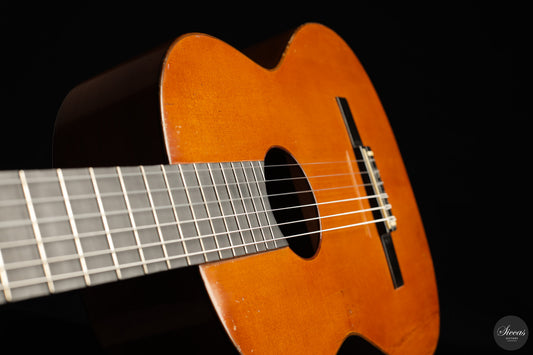
Richard Jacob Weissgerber - 1944 Biedermeier 35.1/3
Price: 4.990 €Unit price per Tax free (0% DE)Luthier: Richard Jacob WeissgerberConstruction Type: Traditional -
Richard Jacob Weissgerber - 1936 Torres Damen 33.3/0
Price: 2.790 €Unit price per Tax free (0% DE)ReservedLuthier: Richard Jacob WeissgerberConstruction Type: Traditional -

 Reserved
Zbigniew Gnatek - 2023
Price: 11.990 €Unit price per Tax free (0% DE)ReservedLuthier: Zbigniew GnatekConstruction Type: Lattice -

 Reserved
Andreas Kraus - 2025-01 Double-Top
Price: 6.990 €Unit price per Tax free (0% DE)ReservedConstruction Type: Double-Top Guitars -
Kenneth Brögger - 2025 Maple "Mosaic"
Price: 8.990 €Unit price per Tax free (0% DE)ReservedConstruction Type: Traditional -
Kenneth Brögger - 2026 Rosewood "Mosaic"
Price: 8.990 €Unit price per Tax free (0% DE)Construction Type: Traditional











Related guitars
Frequently Asked Questions About Classical Guitars
How do I choose the right classical guitar for my level?
Choosing the right classical guitar depends on your playing level, musical goals, and budget. Beginners benefit from studio-model guitars from renowned workshops, while advanced players and professionals often choose a handmade master guitar. We are happy to advise you personally and can send detailed sound samples and videos on request.
What is the difference between a master guitar and a studio guitar?
Master guitars are built entirely by hand in the workshop of a single luthier, using only high-quality, well-aged tonewoods. Studio guitars are made in small series, often under the supervision of the master luthier, and offer excellent value for students and ambitious amateur players.
Can I try a classical guitar at home for 14 days?
Yes — every guitar you purchase from us comes with a 14-day home approval period. This complimentary trial applies worldwide to all orders, whether you are in Germany, Europe, the USA, Asia or anywhere else. We ship your instrument fully insured in a high-quality case so you can play it under your own acoustic conditions. If the guitar is not the right one for you, simply send it back and receive a full refund of the purchase price.
Can I try a classical guitar before purchasing?
Absolutely. You are warmly invited to visit our showroom in Karlsruhe, Germany, and test the instruments at your leisure. We are happy to schedule a personal appointment. If a visit is not possible, we send detailed videos and sound samples, and offer extensive consultation by phone or video call.
What payment methods and financing options do you offer?
We accept bank transfer, PayPal, major credit cards, and Klarna. For high-value instruments, we offer individual installment plans on request. Please contact us directly — we will find a suitable solution for every budget.
How do I properly care for my classical guitar?
A classical guitar requires constant humidity between 45 and 55 percent. Store the instrument in its case with a humidifier, avoid direct sunlight and large temperature fluctuations. Change the strings regularly and clean the guitar with a soft microfiber cloth.