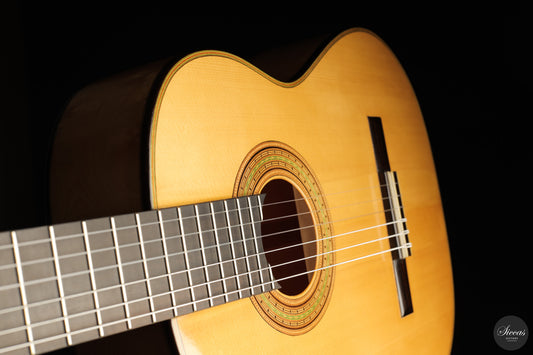
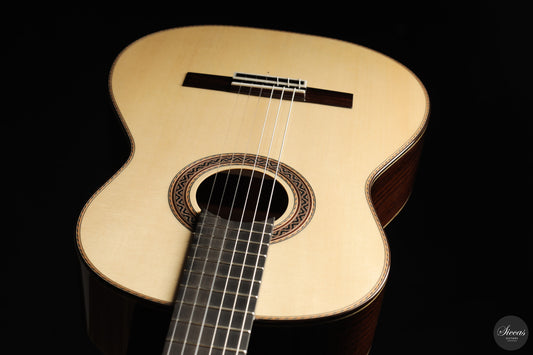
Ana Espinosa Rodriguez is one of the most compelling voices in contemporary classical guitar making — a Granada-based luthier whose instruments combine the tonal warmth of the Spanish tradition with a distinctly personal aesthetic sensibility. Born in 1960 in Tíjola, Almería, she came to guitar building not through a conventional apprenticeship but by way of art, craft, and a lifelong fascination with wood. Today, her concert instruments are sought by discerning players around the world and are carried by some of the finest guitar dealers, including Siccas Guitars.
Biography & Training
Espinosa's background is unusual for a luthier of her calibre. Her grandfather was a cabinet maker, and her early years in his workshop gave her an instinctive feel for wood, grain, and form. She went on to study geography and history at university before pursuing fine arts at the Escuela de Arte de Granada, where she trained as a weaver. This path into textile craft — demanding patience, precision, and an eye for material quality — proved quietly formative for the work that would follow.
In 1989 she married René Baarslag, a Dutch-born luthier who had arrived in Granada in 1977 drawn by flamenco culture. Baarslag had himself trained with the celebrated Granada master Antonio Marín Montero and had spent time in Normandy working alongside Robert Bouchet, one of the twentieth century's most revered guitar makers. The workshop they share — Baarslag & Espinosa, active since 1980 under René's name — became the environment in which Ana eventually found her calling as a builder.
She began her formal apprenticeship with René in 1994, and made her first guitar in 1997: a copy of an instrument by Antonio de Torres, the nineteenth-century master who effectively defined the form of the modern classical guitar. She found Torres's work so compelling that she spent the next eight years building Torres copies almost exclusively, absorbing his structural logic, his graduation principles, and the particular resonance of his fan-braced top design. This deep, extended study gave her a foundation that very few contemporary makers can claim.
Construction Philosophy
Torres's influence remains visible in everything Espinosa builds, but her mature guitars are not mere reproductions. Through years of analysis and refinement — measuring, listening, adjusting — she developed her own models that synthesise what she learned from Torres with insights drawn from playing feedback and her own evolving aesthetic. Her construction philosophy is grounded in the conviction that an exceptional guitar must be beautiful as an object before it is even played: the design of her instruments carries a sensual attention to line and proportion that reflects her background in fine arts.
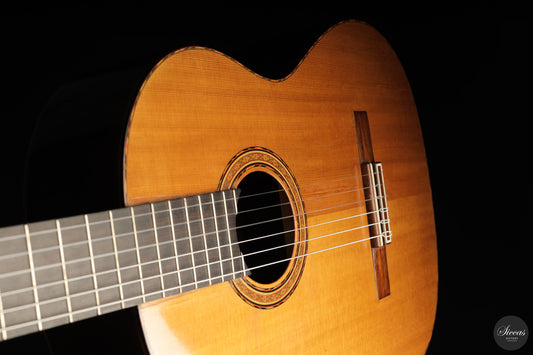
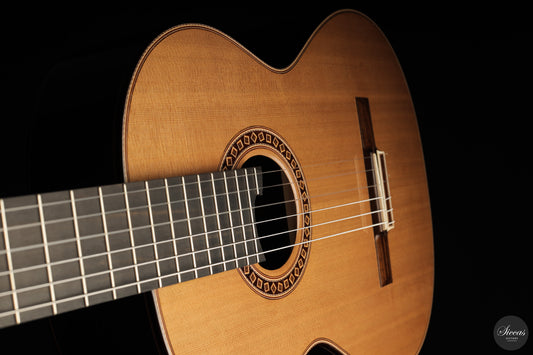
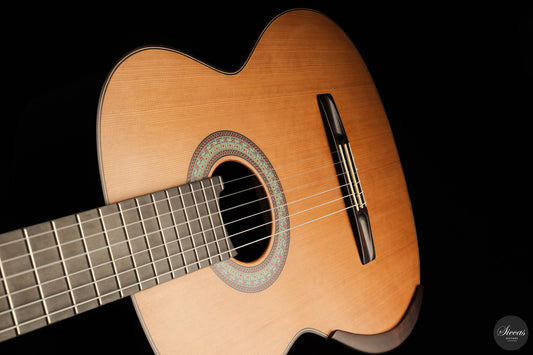
She builds with fan bracing in the Spanish tradition, favouring tops in either cedar or German spruce, paired with back and sides in Indian rosewood, cocobolo, or ziricote depending on the model. Each instrument is finished in traditional French polish, a labour-intensive process that preserves the natural resonance of the wood and gives the surface a depth no synthetic lacquer can replicate. Scale lengths vary across her range — from the standard 650 mm down to 640 mm for players who prefer a more compact geometry — and nut widths and string spacing are adjusted to individual specifications on request. The result is an instrument that feels tailored as much as it is built.
Her concert guitars are particularly noted for their projection and clarity in the upper registers, combined with a warm, rounded bass that is characteristic of the Granada school. Players who have worked with her instruments describe an ease of response — a guitar that seems to amplify intention rather than resist it.
Signature Models
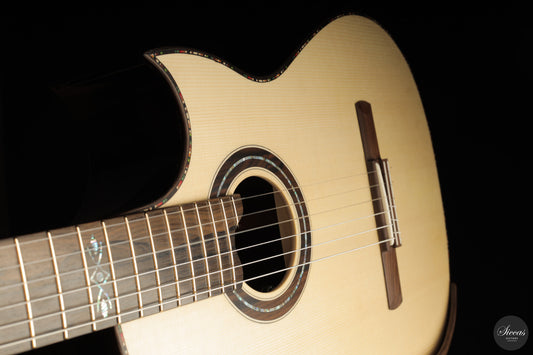
Espinosa currently offers two principal classical models alongside a flamenco instrument. Her standard concert model uses a 650 mm scale with cedar or spruce top and Indian rosewood back and sides, delivering the broad dynamic range and tonal balance demanded by the concert stage. A raised-fingerboard variant is available for players who favour the slightly different angle of attack and sustain characteristics that a raised neck provides.
Among her most distinctive recent work are instruments featuring cocobolo back and sides — a dense, oily tropical hardwood prized for its clarity and sustain. Her 2024 Cocobolo Special, stocked by Siccas Guitars, exemplifies this direction: a cedar top over cocobolo body producing a voice that is simultaneously articulate and deeply resonant, with a visual grain in the back and sides that makes each instrument a unique object. A 2025 model with a 640 mm scale length further extends her exploration of compact, responsive instruments suited to smaller hands or to players seeking a more intimate feel.
Her flamenco guitars follow the lighter construction and lower action of the blanca tradition, built for attack and immediacy rather than the sustained projection of the concert model.
Notable Players & Legacy
Espinosa is part of a wider tradition of Granada lutherie that stretches back generations, connecting practitioners like herself to the lineage of makers that includes Antonio Marín Montero — her husband's teacher — and figures such as José Luis Romanillos, who themselves carried the craft outward from Spain to the wider world. Her instruments have been acquired by professional guitarists across Europe and beyond, and her guitars appear in the inventories of respected dealers who work primarily at the concert level.
What makes Espinosa's position in that tradition particularly meaningful is the path she took to arrive at it. She did not set out to be a luthier; she found guitar building through curiosity and connection, and built her craft methodically, without shortcuts. The eight years she spent on Torres copies alone speaks to a seriousness of purpose that is rare. The workshop she shares with René Baarslag has also produced a third generation of makers: their son Julio Baarslag Espinosa now builds instruments of his own, carrying the family's accumulated knowledge forward.
For players seeking an instrument rooted in the deepest traditions of Spanish making — one that speaks with warmth, responds with generosity, and rewards careful listening — the guitars of Ana Espinosa Rodriguez represent a quiet but unmistakable achievement. Understanding what distinguishes instruments at this level is part of how concert guitarists develop their ear and their relationship with their instrument.
Browse available Ana Espinosa guitars → in the Siccas Guitars collection.