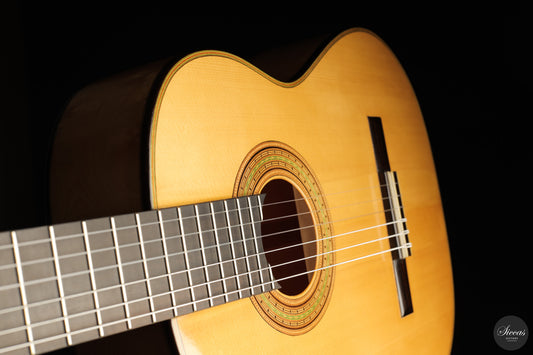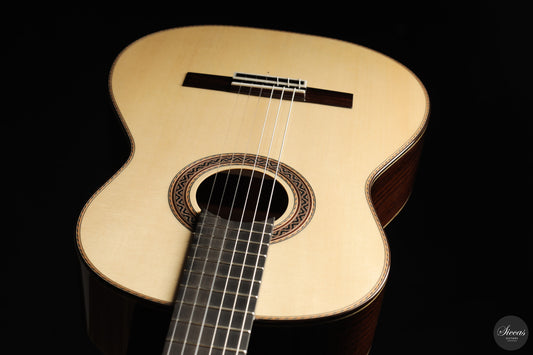

Angelo Vailati – Italian Luthier with a Spanish Soul
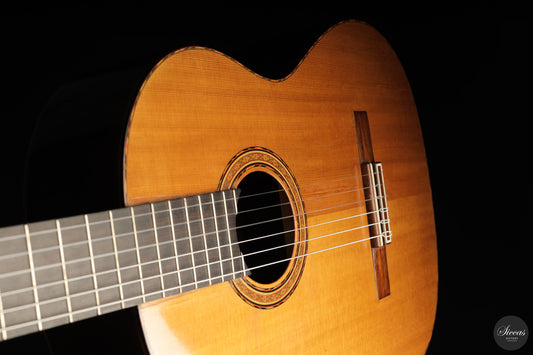
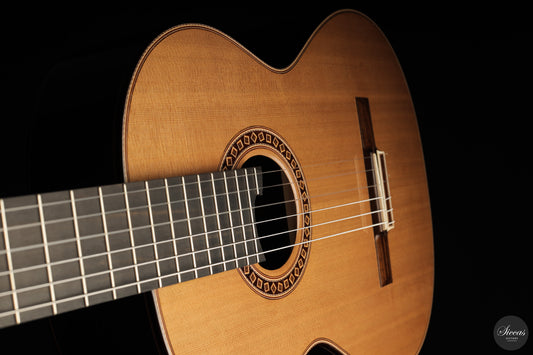
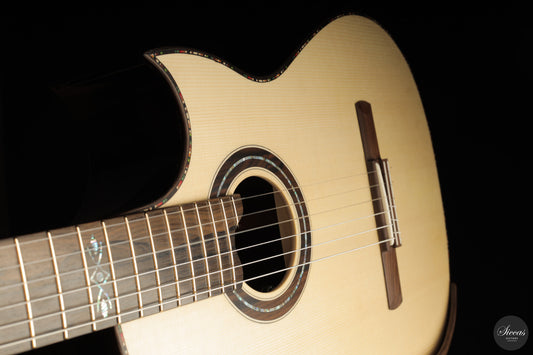
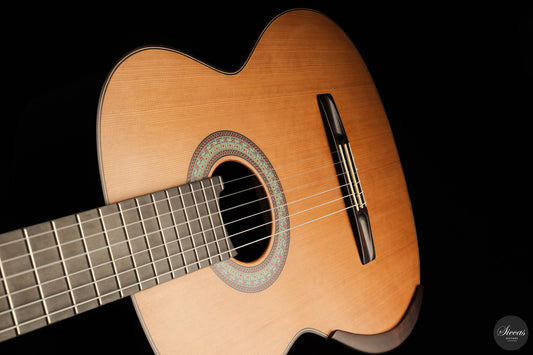
Among the most compelling voices in contemporary Italian guitar making, Angelo Vailati has quietly built a reputation that reaches far beyond the borders of his native Lombardy. Born in 1977 in Treviglio, in the Bergamo province of northern Italy, Vailati combines the meticulous refinement long associated with Italian craftsmanship with a deep reverence for the Spanish classical tradition — producing instruments that feel both historically rooted and unmistakably alive in the hands of modern concert performers.
From Treviglio to Bologna – A Maker's Formation
Vailati's relationship with the guitar began in adolescence. At sixteen, he acquired his first instrument and, driven purely by curiosity, spent that same summer attempting to build one from scratch — a formative experiment that revealed both the difficulty and the fascination of the craft. That early impulse to understand a guitar from the inside out would become the animating principle of his entire career.
His formal training began at the Civica Scuola di Liuteria in Milan, one of Italy's most respected institutions for string instrument making, where he graduated with top marks. After completing his diploma, Vailati sought out working experience under seasoned hands. In 2005 he undertook post-diploma training in the Bologna workshop of Italian luthier Enrico Bottelli, deepening his understanding of construction methodology and the subtle interplay between material and tone.
The following years took him increasingly towards Spain, the historical heartland of the classical guitar. In the summer of 2006, he traveled to Sigüenza to attend the prestigious guitar-making course led by José Luis Romanillos, one of the defining masters of the twentieth century. Two years later, in 2008, Vailati spent time in Granada working alongside Italian luthier Daniele Chiesa — absorbing the living legacy of Andalusian guitar craft in the very city where Antonio de Torres had helped shape the modern instrument nearly two centuries before. He launched his professional workshop in Bologna in 2002, entering the international market in earnest by 2012.
Craft Philosophy and Construction Approach
Vailati works exclusively in classical guitars, and each instrument is built entirely by hand from first cut to final varnish. He selects only the finest tonewoods, insisting that the integrity of the raw material is inseparable from the quality of the finished instrument. His construction philosophy draws directly from the canonical Spanish masters — Antonio de Torres, Enrique Garcia, Manuel Ramírez, Santos Hernández, and Domingo Esteso — not as a programme of reproduction, but as a living dialogue with the tradition. Where his predecessors developed principles of resonance, balance, and playability through generations of practice, Vailati absorbs those principles and applies them through his own Italian sensibility.
The sonic ideal he pursues is one of transparency, elegance, and what he describes as "incredible manageability" — a guitar that responds to the finest gradations of touch without imposing its own character on the music. This places him in a lineage of makers who have understood the classical guitar not as a loud instrument seeking projection at all costs, but as a nuanced, malleable medium for expression. Collectors and players consistently note the tonal balance across registers and the clarity with which his instruments handle contrapuntal textures. For players interested in understanding how these competing construction philosophies shape sound, the broader discussion of fan-braced, double top and lattice guitars offers helpful context.
A New Generation of Italian Makers
Vailati's career sits within a remarkable wider flourishing of Italian classical guitar making. Italy has long possessed the institutional infrastructure — schools, restoration workshops, a deep culture of lutherie — to produce makers of the highest calibre, but the generation that came of age in the early 2000s has distinguished itself through an unusually international outlook. Like his contemporaries, Vailati sought training across borders, absorbing influences from Spain while remaining anchored in Italian precision. Other Florentine makers such as Andrea and Giovanni Tacchi represent a parallel strand of this Italian renaissance, each workshop finding its own synthesis of tradition and individual voice.
This generation is also remarkable for the seriousness with which it has engaged the historical record. Rather than simply updating the Spanish tradition, makers like Vailati have returned to primary sources — studying the surviving instruments of Torres, Garcia and Hernández — to understand why those guitars sounded the way they did and how those lessons can be translated into the demands of the concert hall today. The result is instruments that carry genuine historical intelligence rather than merely historical aesthetics. The wider story of classical guitar makers and how the craft has evolved across centuries illuminates the tradition Vailati is now contributing to.
International Recognition and the Concert Stage
Since his entry into the international market in 2012, Vailati's guitars have attracted the attention of leading dealers and performers across Europe. His instruments are carried by specialist galleries in France and Germany as well as Siccas Guitars, reflecting a reputation built steadily through the quality of the work itself rather than through competition accolades. Concert guitarists who seek instruments with warm, transparent tone and responsive action have found in Vailati a maker whose guitars suit the nuanced demands of recital repertoire — from the intimate counterpoint of Bach to the rich harmonic landscapes of twentieth-century Spanish and South American music.
His presence at the Volterra Guitar Project, an international gathering of guitar makers and performers in Tuscany, has brought his instruments into direct contact with the international concert community. Events like Volterra have become important platforms for Italian makers to place their guitars in the hands of leading players, and Vailati's participation reflects his standing within this community. The intersection of Italian craftsmanship and the broader Spanish classical lineage that shaped makers such as Daniel Friederich — who was himself deeply influenced by Iberian masters — demonstrates how the great tradition continues to branch and evolve through individual makers of genuine commitment.
Legacy and Continuity
Angelo Vailati is still in the active prime of his career, and each instrument he produces represents both a continuation of the classical Spanish school and a statement of his own artistic identity. What makes his trajectory compelling is the patience and rigour with which he has built it — returning to the sources, seeking out the masters, refusing shortcuts in material or method. In a field where reputation is measured in decades, he has already earned the trust of the international classical guitar world, and there is every reason to expect that the instruments he builds today will be played and valued long after the trees from which they were made have been forgotten.
Browse available Angelo Vailati guitars → in the Siccas Guitars collection.