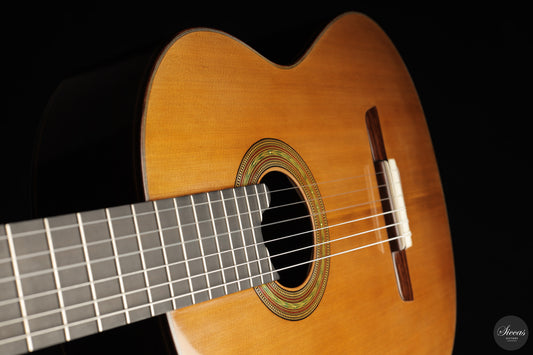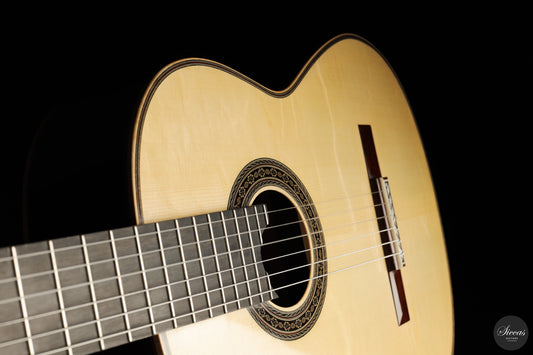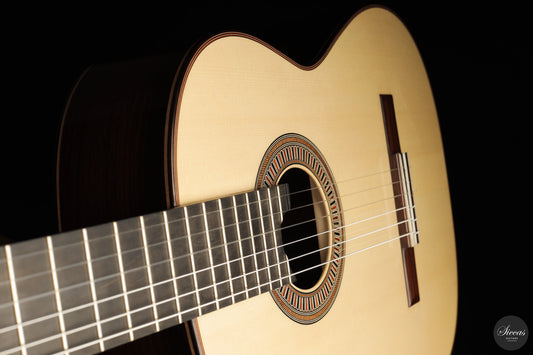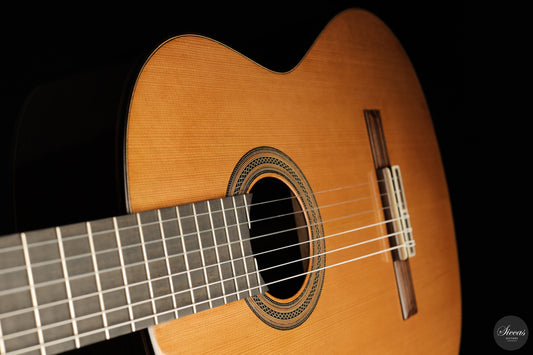

Andrea Tacchi & Giovanni Tacchi – A Florentine Guitar-Making Legacy
Few names in contemporary lutherie carry the combined weight of tradition, research, and innovation that the Tacchi family brings from Florence. Andrea Tacchi, born in 1956, has spent more than four decades building instruments that synthesize the finest threads of the French, Spanish, and Italian guitar-making traditions. His son Giovanni Tacchi, trained in the same Florentine workshop, now carries that legacy forward with his own voice — precise, historically aware, and distinctly personal.
Andrea Tacchi – From Florence to the World's Great Workshops
Andrea Tacchi grew up in a Florentine artisan family with roots in jewelry-making and woodworking. He built his first guitar at fifteen, and by 1977 was apprenticing under Ricardo Brané, an Argentine luthier who had settled in Italy and worked across guitars and lutes. Brané's early death ended the formal apprenticeship, but it had opened a path Andrea would pursue for the rest of his career: learning directly from the best makers alive.
In 1981, he traveled to Spain to visit Paulino Bernabé Sr., José Ramírez III, and Francisco and Gabriel Fleta. He later consulted twice with José Luis Romanillos in England. Most formatively, he made multiple visits to Robert Bouchet and Daniel Friederich in their Paris workshops in the early 1980s. These encounters gave Tacchi direct access to the thinking, methods, and priorities of makers who had defined the sound of the modern concert guitar. He came not as a student to be taught a system, but as a craftsman seeking to understand how each maker thought — and why.
For deeper context on these influences, see our articles on Robert Bouchet →, Daniel Friederich →, and Ignacio Fleta →.
The Coclea — Geometry as Sound Design
Andrea Tacchi's signature contribution to lutherie is the Coclea, a model he began developing in 1989. The name comes from the Latin cochlea — the inner ear — and reflects his acoustic intent: an instrument that responds with the sensitivity and immediacy of hearing itself. The design principle behind the Coclea is geometric. Tacchi conceived both the top and back as portions of spheres of different radii, calculated to optimize vibrational behavior across the soundboard. This is not decorative arch — it is structural and acoustic design, informed by research into 19th-century instrument forms and the mathematical relationships that define how wood responds to vibration.
The Coclea became available in both spruce and cedar top versions. In 1997, Tacchi began developing a further variant, the Coclea Thucea, which combines thuja plicata (western red cedar) and picea excelsa (spruce) across the soundboard — an approach later extended in the Coclea Fibonacci, named for its geometric derivation. These are not iterations of a standard model. Each represents a distinct acoustic hypothesis, tested across years of building and player feedback.
The Omaggio Series — Dialogue with the Great Makers
Alongside his original models, Tacchi has built an extensive series of instruments paying homage to the luthiers who shaped him. His first Omaggio a Robert Bouchet, completed in 1994, was built directly from Bouchet's Cahier d'atelier — the workshop notebook Bouchet made available after his death. Tacchi also built tributes to Enrique Garcia and Francisco Simplicio, and in 1998 was invited to exhibit his Bouchet replica in Tokyo at a celebration of the centenary of Bouchet's birth.
These are not replicas for collectors. They are a craftsman's method of understanding — the most direct way to enter the thinking of another maker and test it in wood and string. Tacchi's Omaggio instruments are played, recorded, and used in concert by serious musicians.
Two of his instruments are held in the permanent collection of the Conservatorio Luigi Cherubini in Florence. His guitars have been played by guitarists including Filomena Moretti, Flavio Cucchi, Carlo Marchione, Antigoni Goni, and Marcelo Kayath. At the 1985 Concours International des Facteurs de Guitare in Castres — organized by Robert Vidal for Radio France — Tacchi won first prize for aesthetic qualities and second prize for acoustic qualities.
For an overview of Italian lutherie and how the Tacchi family fits within it, see Italica — A Guitar Built by 20 Italian Master Luthiers → and our guide to Classical Guitar Makers →.
Giovanni Tacchi – The Next Generation
Giovanni Tacchi grew up in the Florentine workshop, surrounded by tools, wood, and instruments at every stage of construction. His formation was immersive from the beginning — not a course, but a way of life. He trained under his father, absorbing the accumulated influences of Bouchet, Friederich, Fleta, and Romanillos through direct conversation and daily practice. He later traveled to Paris to examine a 2008 Daniel Friederich guitar in person, an experience that shaped his approach to voicing and construction in ways he has described as decisive.
His first major independent model, the Omaggio a Daniel Friederich, replicates Friederich's precise dimensions and construction logic: cedar top, Indian rosewood back and sides, a vintage-toned French polish finish with a rosette design mirrored in the bridge inlay. The result is a guitar that recalls the Friederich sound — broad, firm basses, glassy singing trebles — while bearing the Florentine maker's own mark in its finish and detail.
La Decima — Torres Revisited
Giovanni's La Decima model takes a different historical reference point: the construction principles of Antonio de Torres, widely considered the founder of the modern classical guitar form. Built with a European spruce soundboard, flamed maple back and sides, and a maple burl bridge, the La Decima is Torres in spirit but entirely contemporary in execution. The French polish, the careful weight management — approximately 1,300 grams — and the 650mm scale length reflect the same attention to proportion that defines his father's work.
For context on how Torres's legacy continues to shape modern instrument design, see our article Fan-Braced, Double Top & Lattice Classical Guitars →.
Two Makers, One Workshop
What distinguishes the Tacchi workshop from most family studios is continuity of intent. Andrea's decades of research — historical, geometric, acoustic — were not handed down as rules but demonstrated as method. Giovanni builds differently from his father, but from the same foundation: close study of historical instruments, deliberate material choices, and an approach to construction that treats every decision as having acoustic consequence.
Their guitars are currently among the most sought-after instruments in the European classical guitar market, and their presence on the Siccas collection has grown steadily as players discover both the depth of Andrea's catalogue and the promise of Giovanni's emerging body of work.
Browse available Andrea Tacchi guitars → and Giovanni Tacchi guitars → in the Siccas collection.