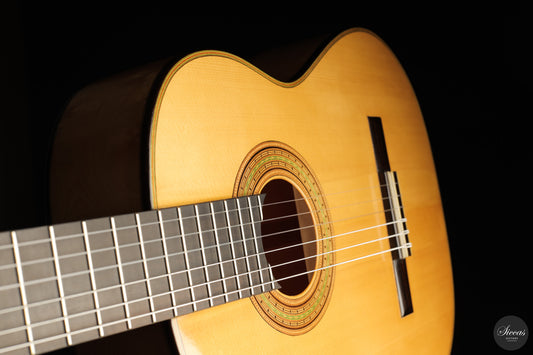
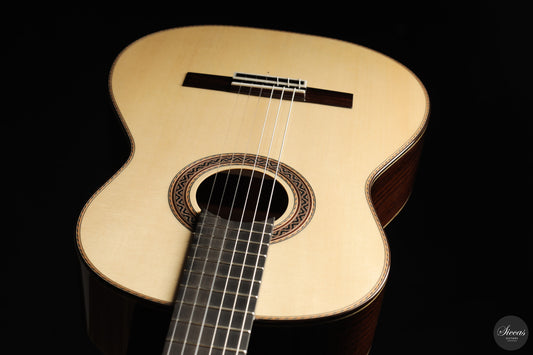
Among the classical guitar makers who emerged from the rich Catalan lutherie tradition, Antonio Picado Cardoso stands out as a craftsman who combined rigorous artisanal training, deep respect for Spanish guitar-making heritage, and a genuine gift for producing instruments that deliver concert-quality tone at an accessible level. Working from his workshop in Berga, a mountain town in the foothills north of Barcelona, Picado built guitars for decades that found their way into the hands of students, teachers, and advancing players across the world. His name became synonymous with honest craftsmanship, tonal warmth, and lasting value — qualities that continue to define the guitars produced under his legacy today.
Biography & Training
Antonio Picado's formation as a luthier began in earnest in 1968 when he joined the Taurus workshop in Barcelona. Taurus was one of the most important guitar manufacturing operations in Catalonia during that era, producing instruments both under its own name and — crucially — building study-grade guitars for the celebrated José Ramírez house in Madrid. Working within that environment gave Picado an exceptional grounding: he absorbed the structural logic of the Madrid school, learned how scale lengths, bracing geometries, and tonal woods interacted, and developed the patience and precision that large-scale artisanal production demands. He remained at Taurus until 1982, accumulating more than a decade of hands-on experience before striking out independently.
In the mid-1980s, Picado opened his own workshop in Berga. The town's relative remove from the bustle of Barcelona suited the quiet, concentrated work of lutherie. There he built a small team of skilled artisans — at the workshop's productive peak, five craftspeople worked under his direction, turning out roughly twenty instruments a month. Crucially, each guitar was assigned to a single builder throughout its construction, preserving the continuity and personal attention that distinguishes handmade instruments from factory production. The influence of José Ramírez could be heard and seen in a number of early Picado guitars: particular bracing proportions, specific neck angles, and a characteristic tonal balance that rewarded expressive playing. You can read more about the Ramírez legacy in our article on José Ramírez guitar models and history.
Construction Philosophy
At the heart of Picado's approach was a commitment to the Torres-derived fan-bracing tradition — the same fundamental architecture that has defined Spanish classical guitar construction for more than 150 years. Rather than chasing novelty, Picado refined the tried-and-true: careful graduation of the soundboard, precisely cut and fitted fan struts, and scrupulous attention to the relationship between top stiffness and flexibility. His instruments demonstrate what is possible when classical methods are executed with consistency and care. For a broader perspective on the design choices that separate Spanish lutherie styles, our guide on fan-braced, double-top and lattice guitars offers useful context.
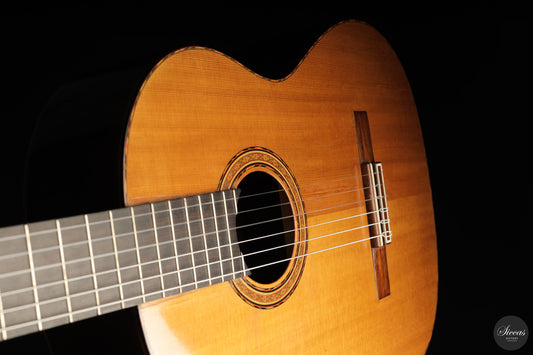
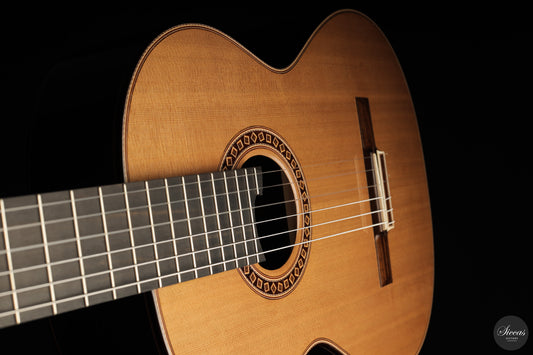
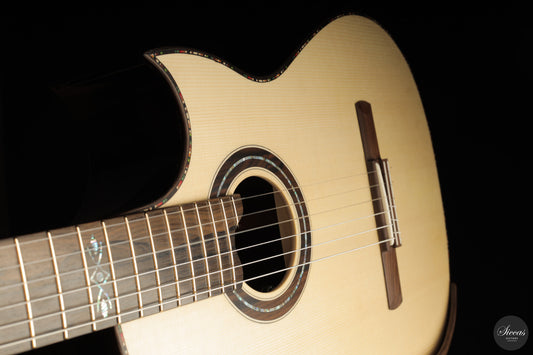
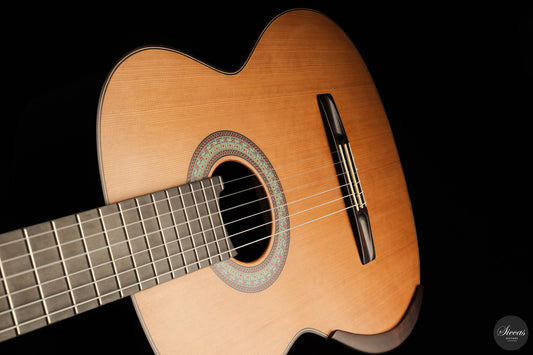
Tonal woods were selected with care across the model range. Soundboards were offered in Alpine spruce or Western red cedar, each chosen for premium-grade acoustic properties. Back and sides were typically Indian rosewood or, in higher models, Madagascan rosewood — species known for their density, resonance, and visual warmth. Necks were fashioned from Honduran cedar, a lightweight yet stable wood well-suited to the demands of a classical neck, and fingerboards were made of ebony, finished with bone nut and saddle. In certain concert-grade instruments, Picado's workshop also explored a doble tapa — a double-top reinforcement technique in which the back is braced internally with a solid cedar layer to increase stiffness and improve resonance. This technique places the Antonio Picado workshop in an interesting position within the broader story of Spanish classical guitar makers who have continuously innovated within the tradition.
Signature Models
The Antonio Picado range is organised by numbered models that correspond to increasing levels of tonal wood quality, structural refinement, and acoustic ambition. The Model 49 represents an accessible entry into the range, pairing a solid spruce or cedar top with solid Indian rosewood sides and a laminate rosewood back — a construction that delivers genuine tonal character at a practical price. The Model 53 and Model 54 step up with higher-grade cedar tops and solid Indian rosewood back and sides, offering the warmth and projection that advancing students and amateur performers need. The Model 60 introduces premium-grade spruce with solid Indian rosewood, producing instruments with greater sustain and tonal complexity. At the top of the conventional range, the Model 62 pairs choice spruce or cedar with Madagascan rosewood, a wood combination that yields a powerful, focused sound with exceptional clarity across the registers. The concert-level instruments — including models described as the Concierto DT and the Brazilian Rosewood series — represent the fullest expression of the workshop's capabilities, instruments built to meet the expectations of serious players and professionals.
Workshop Continuity & Legacy
Following Antonio Picado's retirement, the Berga workshop did not close — it continued under the leadership of Ángel Genis and Carlos Prat Sr., two colleagues who had worked alongside Picado for many years and who understood both his methods and his standards. This continuity is significant. Many lutherie traditions dissipate when a founding craftsman steps back; the Antonio Picado workshop instead preserved its accumulated knowledge and handed it forward. The guitars produced today under this tradition maintain the tonal identity, constructional rigour, and value proposition that Picado established across his career. It is a model of sustainable lutherie that echoes the workshop traditions of other great Spanish makers — a lineage that, in different ways, connects back through Taurus and Ramírez to the foundational innovations of Antonio de Torres himself. The broader context of this tradition is explored in our profile of Ignacio Fleta, another Catalan luthier whose work shaped the modern concert guitar.
Players who have sought out Antonio Picado instruments have tended to value them for reasons that are difficult to reduce to specifications: a naturalness of response, a tonal evenness across the neck, a playing comfort that allows the music to take precedence over the instrument. These are the qualities that experienced teachers recommend and that players discover for themselves once they spend time with one of these guitars. The reputation built over decades of consistent, careful work in Berga has proven durable precisely because it was earned through instruments rather than through marketing — a rarity in any craft, and a mark of genuine achievement in lutherie. For comparison with other distinguished European luthiers working within and beyond the Spanish tradition, our profiles of Daniel Friederich and Robert Bouchet offer illuminating parallels.
Browse available Antonio Picado guitars → in the Siccas Guitars collection.