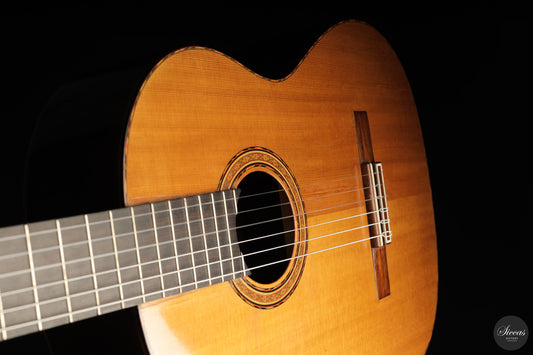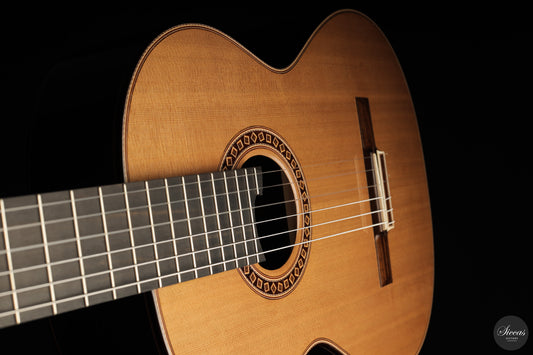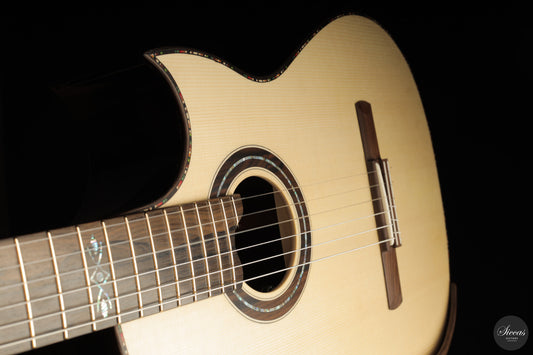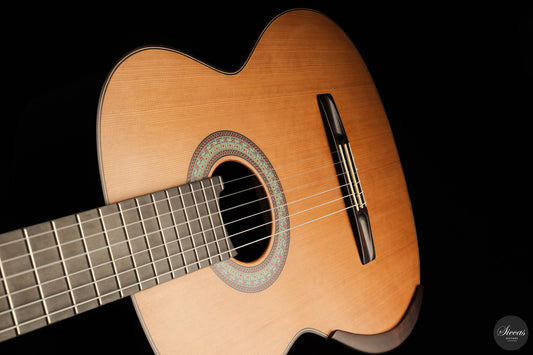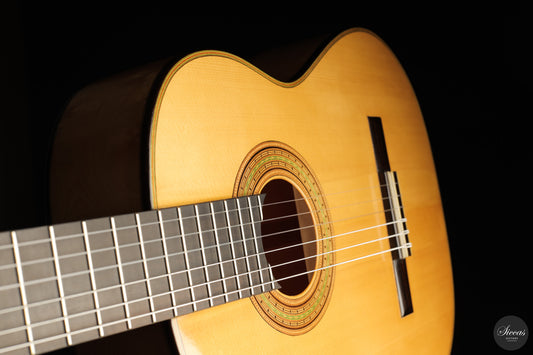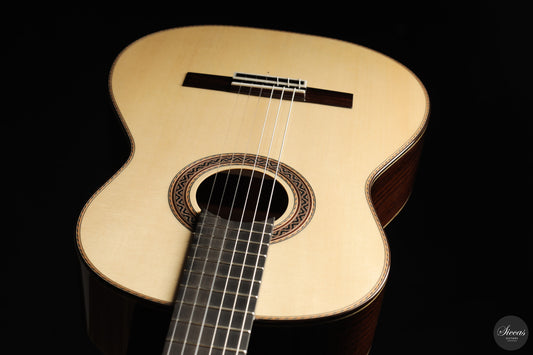

Armin Hanika – A Legacy of German Classical Guitar Making
Few luthiers embody the continuity of a craft tradition as naturally as Armin Hanika. Born into a family of instrument makers with roots stretching back to the workshops of the Egerland region of Central Europe, he learned his trade at his father's side and has spent decades refining it into something distinctly his own. Today, from his workshop in Baiersdorf, Bavaria, Hanika produces some of the most consistently admired concert guitars to come out of Germany — instruments that combine the precision of Central European craftsmanship with an expressive tonal voice that speaks directly to the needs of serious players.
From Schönbach to Baiersdorf — A Family History
The Hanika story begins not with Armin but with his father Helmut, born in 1932 in Schönbach, a small town in the Egerland region long known as one of the most fertile centers of instrument-making in Europe. After the Second World War, the family resettled in Bubenreuth, a Bavarian village that became a hub for displaced craftspeople from the Egerland, many of whom continued their trades and rebuilt a thriving instrument-making community. Helmut learned the violin maker's art from his grandfather Anton Mayer, but over time his passion shifted toward plucked string instruments and ultimately to the classical guitar. In 1953 he registered his workshop, marking the official founding of what would eventually become the Hanika brand.
Armin entered this world as an apprentice in 1980 at the age of sixteen, working alongside his father in the workshop and absorbing the rhythms and disciplines of the trade. He passed his master craftsman's examination in 1987, and in 1993 he formally took over the business from Helmut, renaming it Armin Hanika Gitarrenbau. Since 1995, the workshop has been based in Baiersdorf, where Armin and his team continue to build instruments by hand in a fully climate-controlled environment that reflects both the traditional demands of lutherie and the precision requirements of modern instrument production. Among the many classical guitar makers working in Europe today, Hanika stands out for having preserved a direct line from a nineteenth-century Central European craft tradition into the contemporary concert world.
Construction Philosophy — Tradition, Technology, and the Search for Sound
What distinguishes Hanika as a luthier is not a single method but a carefully considered layering of the old and the new. The workshop has always respected the principles of Spanish-style construction — the internal geometry, the bracing logic, the approach to body resonance — but Armin has never been doctrinaire about materials or techniques when evidence suggests that something newer genuinely improves an instrument's performance. This open-minded empiricism shows most clearly in his double-top models, which use Nomex honeycomb cores sandwiched between two thin soundboard layers to achieve a combination of lightness, stiffness, and vibrational complexity that traditional solid tops cannot always match. The result is exceptional projection and a clarity of separation between voices that makes these instruments particularly well-suited to the demands of concert performance.
Tonewoods are chosen with great care and stored in the workshop's own seasoning facilities for several years before they are worked, allowing the wood to stabilize and begin expressing the acoustic qualities it will carry in the finished instrument. European spruce and Western red cedar are the preferred top woods, each offering a different tonal character — cedar's immediate warmth and responsiveness contrasting with spruce's dynamic range and long-term development. Backs and sides are fashioned from Indian rosewood, Madagascar rosewood, or maple, depending on the model and the tonal balance Armin is seeking. A distinctive feature of the Hanika workshop is a proprietary thermal treatment process applied to certain tonewoods, which accelerates the natural aging of the wood, producing properties normally associated with decades of maturation. The workshop also uses CAD-CAM design tools and five-axis CNC technology for certain preparatory steps, not to replace hand work but to achieve a consistency of component dimensions that frees the maker to concentrate on the acoustic variables that only experience and sensitivity can resolve.
Finishing at Hanika spans a range of approaches — from traditional shellac to polyurethane and UV-cured acrylic — each chosen to suit the character of the individual instrument and to protect without unduly dampening the soundboard's ability to vibrate freely. This attention to the finishing stage as an acoustic decision, rather than merely a cosmetic one, reflects the seriousness with which Hanika approaches every aspect of construction. The double-top technology that Armin has embraced places him in the company of a wider movement among European luthiers exploring how modern engineering can serve the ancient goals of the classical guitar.
The Guitar Lines — From Studio to Master Class
The Hanika range is organized to serve players across a wide spectrum of experience and expectation. At the professional end, the 1a series represents the pinnacle of what the workshop can produce — instruments built entirely by hand, with individually selected tonewoods, meticulous voicing, and a level of finish that places them unambiguously in the concert category. The double-top variants within this line, including special custom configurations featuring cedar over yew-tree backs and sides, demonstrate Hanika's willingness to explore unusual combinations in the pursuit of a particular tonal signature. The New Century Doubletop model is among the most recent expressions of this approach, blending accumulated knowledge with fresh constructional thinking.
Alongside the top-tier instruments, Hanika offers studio and professional lines that bring the same philosophy of careful material selection and precise construction to instruments accessible to advanced students and developing professionals. This breadth of offering has made the Hanika name familiar not only to the highest tier of concert performers but to the wider community of serious players who need instruments that reward deep engagement. The Hanika Custom Shop takes the principle further still, building instruments to individual specifications and allowing players to collaborate directly with the workshop on tonewoods, body dimensions, string length, and finish. This service reflects the belief, central to Armin's practice, that the relationship between a guitar and its player should be as specific and as personal as possible.
Hanika's workshop also trains the next generation of luthiers through a formal apprenticeship programme. In Germany, the title of plucked instrument maker requires a recognized qualification earned over roughly three years of structured training. Armin has mentored apprentices who have gone on to establish their own practices, extending the influence of the Baiersdorf workshop into the broader landscape of German lutherie. This commitment to transmission — of knowledge, of standards, of a particular understanding of what a concert guitar should be — connects Hanika to a longer tradition of workshop-based education that one finds also in the careers of masters such as Daniel Friederich in France or José Luis Romanillos in Spain and England.
Legacy and Standing in the Classical Guitar World
Armin Hanika has, over more than three decades at the head of his own workshop, built a reputation that rests not on a single celebrated instrument or a famous patronage but on the sustained quality of an output that players and teachers return to consistently. His guitars are sought by conservatory students, competition entrants, and established recitalists who value instruments that are honest in their construction, reliable in their response, and rewarding in their long-term development. The Hanika sound — full in the bass, clear in the treble, with a mid-range warmth that makes chord textures sing — has become recognizable as a product of this particular workshop's accumulated knowledge.
Within the context of German lutherie, Hanika occupies a position that bridges the historical instrument-making traditions of Bubenreuth and the contemporary demands of the international concert market. The family lineage from Helmut's post-war workshop to Armin's present-day operation in Baiersdorf represents one of the most coherent generational narratives in European guitar making. As discussions continue among players and makers about the future direction of the classical guitar — about the role of double-top construction and other structural innovations, about the balance between consistency and individual character — Armin Hanika's workshop remains a reference point: a place where questions about materials and methods are taken seriously, where tradition is respected without being treated as a constraint, and where the guitar is understood above all as a tool for musical expression.
Browse available Armin Hanika guitars → in the Siccas Guitars collection.