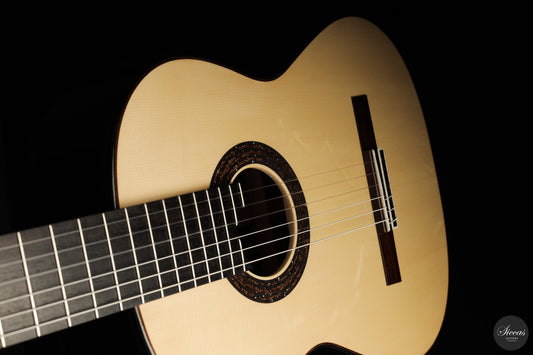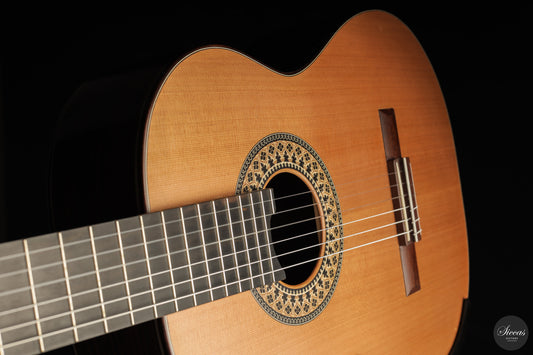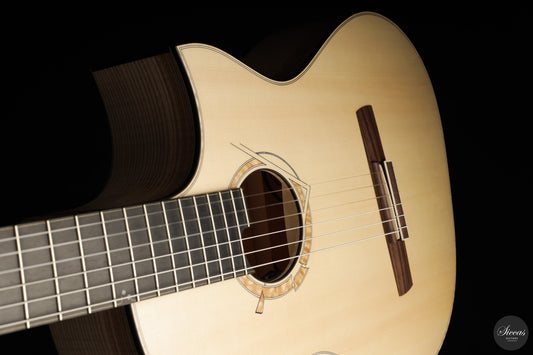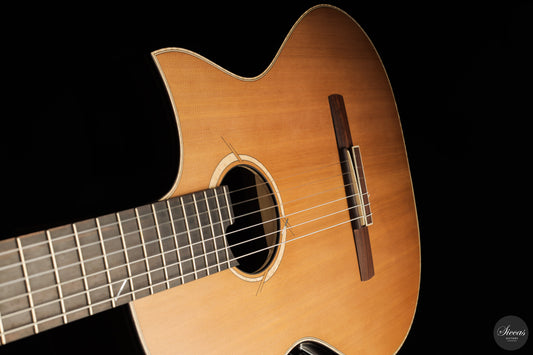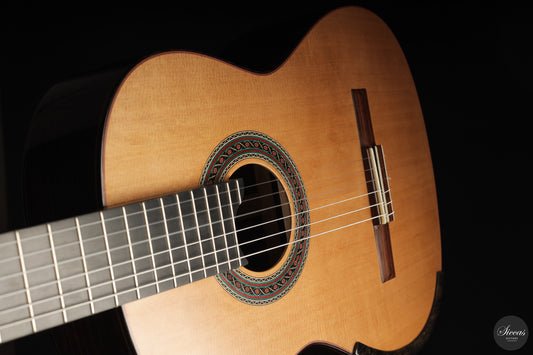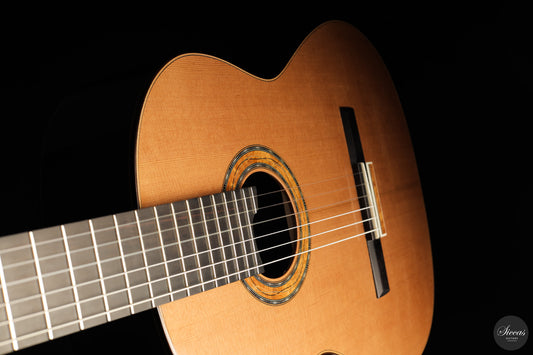

Every so often, a single idea changes an instrument forever. For the classical guitar, one such moment came at the end of the 1980s in Germany, when two luthiers — Matthias Dammann and Gernot Wagner — pioneered the double-top guitar. Their innovation gave the modern concert guitar more power and projection than had ever seemed possible, and it is now built by leading makers around the world.
What is a double top?
A traditional guitar has a soundboard carved from a single solid piece of tonewood. A double top, by contrast, is a kind of sandwich: two extremely thin layers of wood (often cedar or spruce) bonded around a light, rigid core — usually a honeycomb material called Nomex. The result is a soundboard that is at once lighter and stiffer than a solid top. Because a lighter top moves more easily, it can produce more volume, more projection and a powerful, sustaining tone — exactly what a soloist needs to fill a large hall.
Matthias Dammann — the inventor
The double top has a clear inventor: Matthias Dammann, born in 1957, who studied and later taught guitar at the music academy in Frankfurt. Inspired by the instruments of Torres, Miguel Rodríguez and Robert Ruck, Dammann built the very first double-top guitar in 1989. His earliest examples used an all-wood core; then, in 1995, he created the first double top with a Nomex core — the breakthrough that defined the modern design. His guitars are played by soloists such as Manuel Barrueco and David Russell.
Gernot Wagner — the developer
Working in the same city of Frankfurt, the luthier Gernot Wagner became, alongside Dammann, one of the key figures in developing the technology. The two builders worked together in the late 1980s to push the sound performance of concert guitars, and a few years after Dammann's Nomex breakthrough Wagner built his own first double top, helping to refine and spread the method. Between them, they turned a bold experiment into an established craft.
A place in history
Dammann is now spoken of alongside Torres and the Australian Greg Smallman as one of the truly visionary builders who took the guitar in a genuinely new direction. The double top did not replace the traditional guitar — many players still prefer the warmth and character of a fine solid top — but it gave makers a powerful new option, and luthiers such as Dieter Müller and Jim Redgate have built on their pioneering work.
FAQ
Who invented the double-top guitar?
Matthias Dammann, who built the first one in 1989 and the first with a Nomex core in 1995.
What is the advantage of a double top?
A lighter, stiffer soundboard that gives more volume, projection and sustain than a solid top.
Who else helped develop it?
Gernot Wagner, who worked alongside Dammann in Frankfurt and helped refine and spread the technique.