
Daniel Stark – A German Luthier Shaping the Modern Concert Guitar
Daniel Stark is one of contemporary lutherie's most compelling voices — a German craftsman whose instruments have found their way onto concert stages across Europe, into the hands of internationally acclaimed soloists, and onto more than 25 recorded albums. Born in 1981, Stark built his reputation through uncompromising workmanship, an instinctive grasp of acoustic principles, and a willingness to develop his own structural solutions rather than simply inherit the past. His workshop in Oldenburg, Lower Saxony, stands as proof that the great tradition of classical guitar makers is very much alive in the twenty-first century.
From Childhood Curiosity to Markneukirchen
Stark's early musical life began at the piano, but the classical guitar soon captured his imagination completely. After finishing secondary school, he sought practical grounding at the guitar-making workshop of Stephan Schlemper, a year-long apprenticeship that gave him hands-on experience in the craft before any formal training began. During this formative period he immersed himself in the life and work of Antonio de Torres, the nineteenth-century Spanish builder whose lightweight construction principles and elegant geometry laid the foundations of the modern classical guitar — an influence whose spirit remains present in everything Stark has built since.
In 2002 he enrolled at the University of Applied Sciences for Musical Instrument Making in Markneukirchen, the historic German centre of instrument craftsmanship, where he completed a four-year diploma programme in 2006. The academic training sharpened his understanding of acoustics, wood behaviour, and the physics of vibrating soundboards, equipping him with analytical tools to complement the intuitive knowledge he had gathered in the workshop.
Oldenburg and the Making of a Reputation
Stark opened his own workshop in 2006 in Friedrichsfehn, near Oldenburg, and almost immediately attracted attention far beyond Germany. Even while he was still completing his studies, internationally recognised performers began to take notice. The French concert guitarist Prof. Éric Franceries was among the first to discover Stark's instruments in 2005, followed by the Slovak virtuoso Prof. Ján Labant in 2006 — two artists whose endorsement helped spread awareness of his guitars rapidly, particularly across France. This early recognition from professional soloists gave Stark both valuable feedback and a growing network of advocates at the highest level of performance.
By 2012 the workshop had relocated to the heart of Oldenburg, near the historic Pferdemarkt, where it became a collaborative space. Guitar maker Hartmut Stührenberg joined Stark there, and in 2018 the workshop took on its first formal apprentice, Justus Förster — a sign of both the enterprise's maturity and Stark's commitment to passing the craft forward. The Oldenburg atelier today functions as a genuine workshop community, not merely a solo studio, and the collaborative atmosphere is reflected in the attentiveness and consistency of the instruments it produces.
Construction Philosophy and the Double-Top System
Stark builds his concert guitars in the Spanish tradition, with the measured geometry and tonal balance that tradition demands, but he has never been content to leave well enough alone. His most significant technical achievement is the development of a proprietary double-top system that relies exclusively on wood — no carbon-fibre or synthetic materials — constructing a lattice of spruce strips enclosed between two thin soundboards. This all-wood approach, which sets him apart from many practitioners in the fan-braced, double-top, and lattice guitar field, produces a soundboard of exceptional lightness without sacrificing structural rigidity. The result is an instrument with remarkable responsiveness across the dynamic range: pianissimo passages carry nuance and colour, while fortissimo playing opens into a full, sustained resonance that fills a concert hall.
Where makers such as Matthias Dammann and Rainer Wagner helped define the double-top concept in Germany from the 1990s onward, Stark has pursued a parallel but distinct path. His rejection of non-wood reinforcements reflects a philosophical commitment to tonal warmth and organic response, and musicians who play his instruments frequently note the naturalness of the sound — a quality that can be difficult to quantify but is immediately apparent in performance.
Signature Models: Española II and the Concert Double-Top
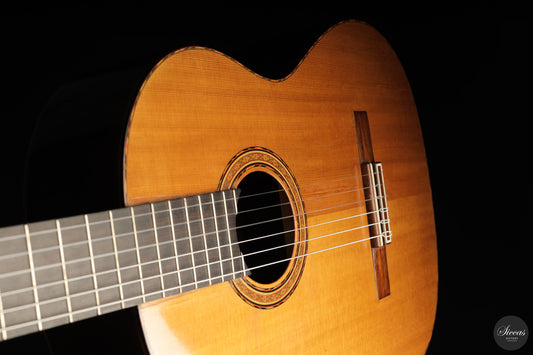
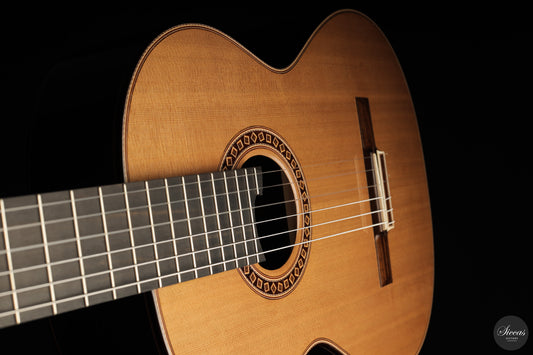
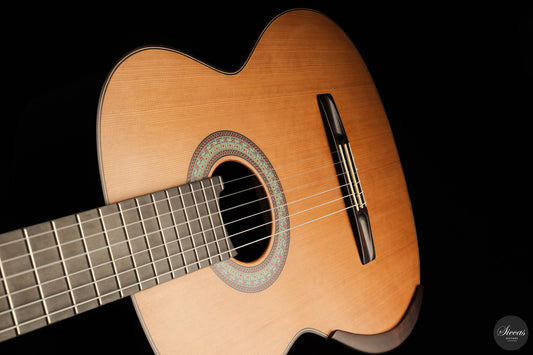
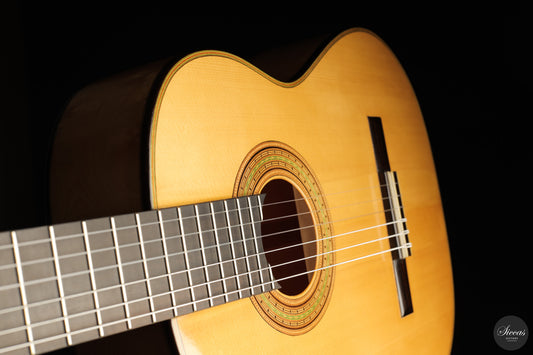
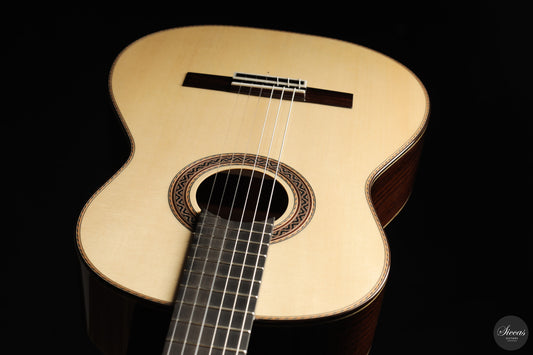
Stark's catalogue centres on two instrument families. The Española II is the more accessible model, built in the Spanish idiom with a recognisable mosaic rosette and tie-block in the style of Francisco Simplicio. Available with either a spruce or a cedar top, and typically paired with wenge back and sides for a focused, projecting tone, the Española II is aimed at advanced students and emerging professionals seeking a serious instrument without the waiting time or investment that a fully bespoke concert guitar demands. It delivers a direct, balanced voice and has proven itself in competition and recital contexts alike.
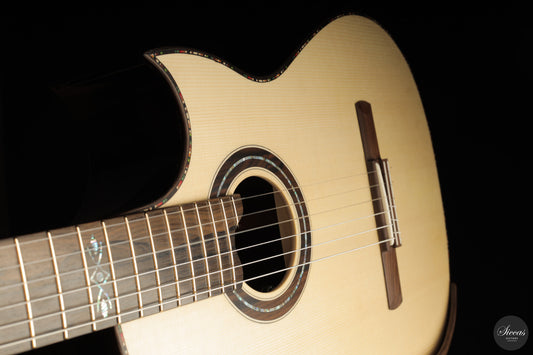
The concert double-top instruments represent the summit of Stark's craft. Each one is an individual creation, its dimensions, bracing geometry, and tonal voicing shaped in response to the specific tonewoods selected. These guitars have appeared on concert stages worldwide and on album recordings by professional soloists, a testament to their reliability and musical depth. The instruments have drawn comparisons to the finest contemporary German and European luthiers, and their presence in major guitar collections and specialist dealers across Europe confirms a standing that has grown steadily since the mid-2000s.
Legacy and Place Within Contemporary Lutherie
The trajectory of Daniel Stark's career echoes, in some ways, those of the great post-war European builders who defined the classical concert guitar as we know it today. Figures like Daniel Friederich in France and José Luis Romanillos in Spain demonstrated that the instrument's acoustic potential was far from exhausted — that careful thought, honest materials, and an understanding of the physics of vibrating wood could always yield something new and musically compelling. Stark belongs to that lineage: a builder who has absorbed historical lessons deeply enough to develop his own voice rather than simply repeat received solutions.
Two decades into his career, with a collaborative workshop in Oldenburg, an international roster of professional players, and a growing generation of instruments active in concert life, Daniel Stark stands as one of the most significant German luthiers of his generation. His double-top system, built entirely from wood, represents a genuine contribution to the field — not a novelty but a considered response to the demands of modern concert performance. For players in search of an instrument that combines tonal warmth with modern projection, his guitars offer a compelling and distinctive answer.
Browse available Daniel Stark guitars → in the Siccas Guitars collection.