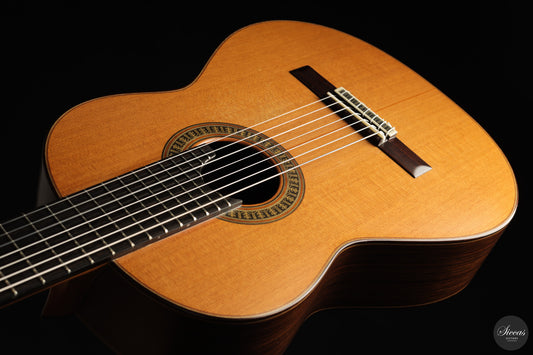
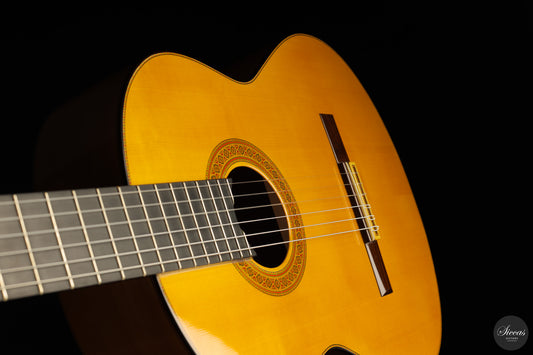
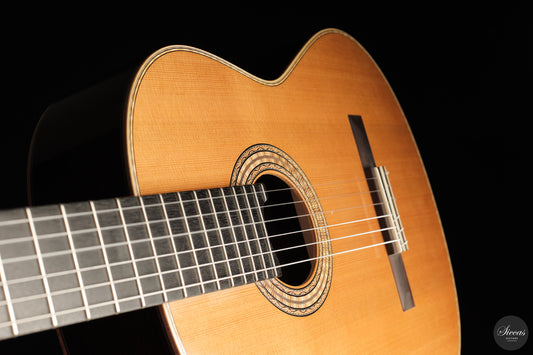
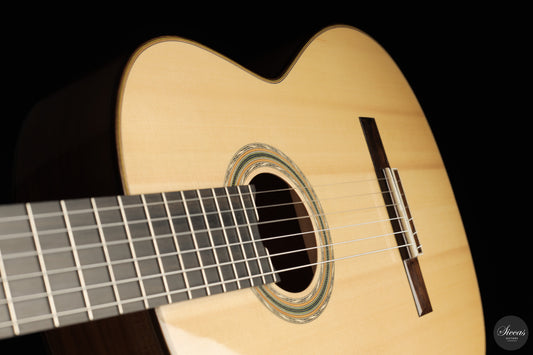
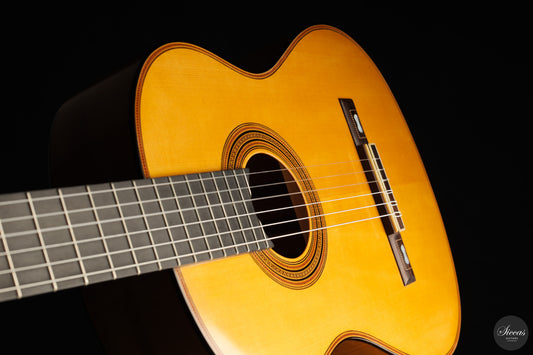
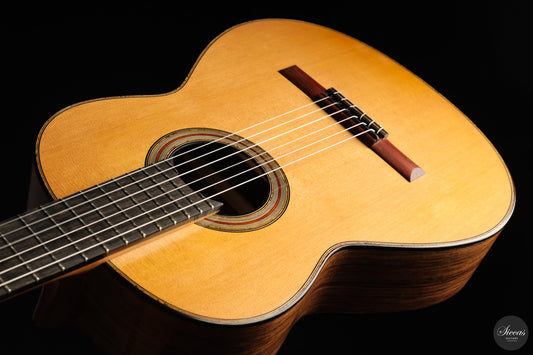
Daniele Chiesa – Italian Master Luthier in the Granada Tradition
Daniele Chiesa is one of the most admired classical guitar makers working today — an Italian craftsman who found his calling in the ancient workshops of Granada and has spent more than two decades refining instruments of exceptional tonal depth and beauty. Born in Bergamo in 1973, Chiesa has woven together the rigorous academic tradition of Cremona, the hands-on pragmatism of American workshops, and the living legacy of the Spanish school into a body of work that places him firmly among the great classical guitar makers of his generation.
From Bergamo to Cremona: A Luthier's Formation
Chiesa grew up in Bergamo, in the Lombardy region of northern Italy, where he began studying both classical and jazz guitar at the age of twelve. His path toward lutherie was almost accidental. In 1994 he moved to Cremona — the city of Stradivari, home to the internationally renowned school of instrument-making — to study musicology at the university. When he found himself unable to afford a new guitar, a friend encouraged him to build one. That first instrument changed everything. Captivated by the craft, Chiesa transferred his studies and enrolled full-time in the Cremona School of Instrument-Making, devoting forty hours a week to the workshop for five years. He graduated as a Maestro Liutaio in 1998, already carrying a growing reputation for his precision and sensitivity as a maker.
What followed graduation was a period of remarkable itinerant learning. Chiesa first travelled to Santa Cruz, California, where he worked in the workshop of Kenny Hill — a maker celebrated for his deep understanding of traditional Spanish construction. There, for the first time, Chiesa witnessed the full process of building a classical guitar in the Spanish manner, with the soundboard and sides assembled around an interior cedar solera. A year later he returned to Bergamo to collaborate with classical guitarist and guitar maker Paolo Viscardi, and then crossed back to California for a formative year in the Healdsburg workshop of Tom Ribbecke, where he broadened his scope further by constructing archtop guitars. This exposure to diverse lutherie cultures gave Chiesa an unusually wide technical foundation before he committed entirely to the classical tradition.
Granada and the Spanish School
The decisive turn came in April 2002, when Chiesa travelled to Córdoba to study under master guitar maker Francisco Santiago Marín — one of the defining figures of the Granada school. The experience was transformative. The depth of the tradition, the directness of the construction methods, and the unmistakable sonic character of Granada guitars convinced Chiesa that this was the path he needed to follow. He relocated to Granada and spent eight years immersed in its workshop culture, working alongside Antonio Marín and his nephew José Plazuelo as well as the late Rolf Eichinger — makers who together represented an unbroken lineage reaching back through the history of the Spanish classical guitar. The influence of makers like Daniel Friederich and the broader tradition that runs from Torres through Ignacio Fleta informed the aesthetic sensibility Chiesa was developing during this period.
After eight years in Granada, Chiesa and his wife relocated to the Costa del Sol in Málaga, where his workshop remains today. The move changed his address but not his methods: he continues to build in the idiom he absorbed in Granada, working entirely by hand, relying on the feel and response of the wood rather than mechanical uniformity.
Construction Philosophy and Signature Sound
Chiesa works in both spruce and cedar, tailoring each instrument to the tonal goals he sets for it. His soundboards are supported by a finely tuned five-fan bracing system, combined with a particularly light cross reinforcement beneath the bridge — a configuration that preserves the warmth and directness associated with the Granada tradition while delivering even response across the full range of the fingerboard. His approach to the neck is equally considered: he cuts the cedar neck block himself from a single piece of wood more than a metre and a half long, taking the four required sections for the heel and neck from one radially cut piece so that the grain runs consistently through the entire structure.
The resulting instruments are known for their clarity in the upper register, a singing mid-range with natural warmth, and a bass response that is full without heaviness. Chiesa has experimented over the years with synthetic materials but has found that traditional tonewoods and Granada construction principles consistently deliver the results he is seeking. His guitars sit in a continuum with the great Spanish-school instruments — thinking of makers such as José Luis Romanillos — while carrying a personal voice shaped by his unusually broad training. Chiesa also builds double-top instruments, and those familiar with the double-top guitar tradition will appreciate how he integrates its principles with Granada construction sensibilities.
Recognition and the Artists Who Play His Guitars
Over more than two decades of professional lutherie, Chiesa has built a reputation that extends well beyond Italy and Spain. His instruments are sought by professional concert artists, leading conservatory teachers, and discerning collectors worldwide. Guitar dealers and specialist shops across Europe and North America consistently describe his work as among the most tonally refined available at the concert level. His guitars have appeared in major international guitar festivals and competitions, and the demand for his instruments regularly outpaces production — a natural consequence of working alone, entirely by hand, with uncompromising attention to each individual guitar.
Chiesa has also participated in collaborative projects celebrating Italian lutherie, and his work is closely associated with a broader renaissance of Italian guitar making that connects with the tradition of makers from Florence and Tuscany who have brought fresh attention to Italy's place in the world of classical guitar construction.
A Living Tradition
What makes Daniele Chiesa's story compelling is not simply the quality of his instruments — though that quality is exceptional — but the journey that produced them. From a chance decision to build a guitar in Cremona, through workshops in California and the living streets of Granada, to a quiet studio on the Costa del Sol, every stage of that journey left its mark on the way he works and the way his guitars sound. Chiesa represents something increasingly rare: a maker who has absorbed multiple traditions deeply enough to transcend each of them and arrive at something genuinely his own. His guitars do not merely echo the past — they carry it forward, shaped by hands that understand exactly what they are doing and why.
Browse available Daniele Chiesa guitars → in the Siccas Guitars collection.