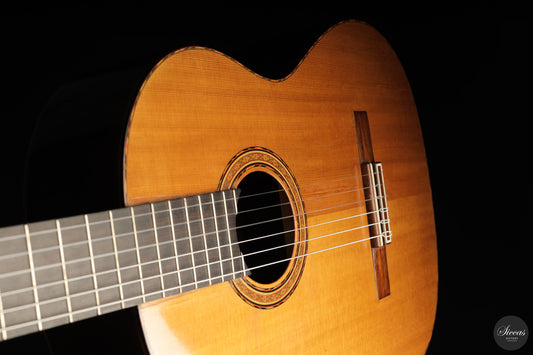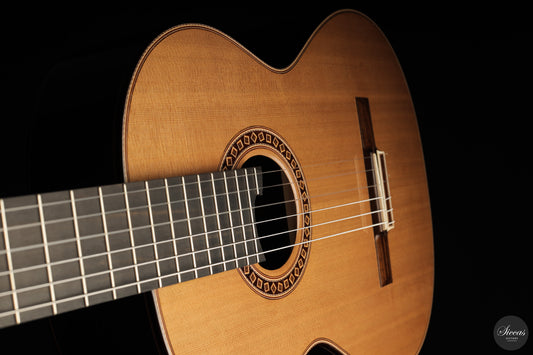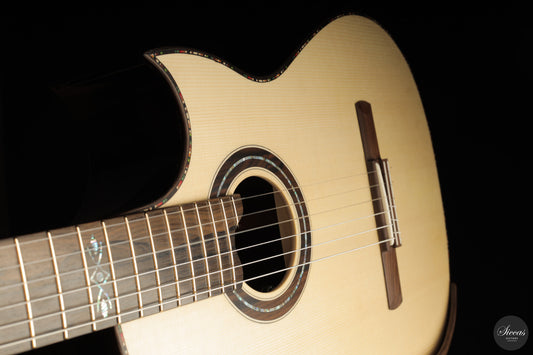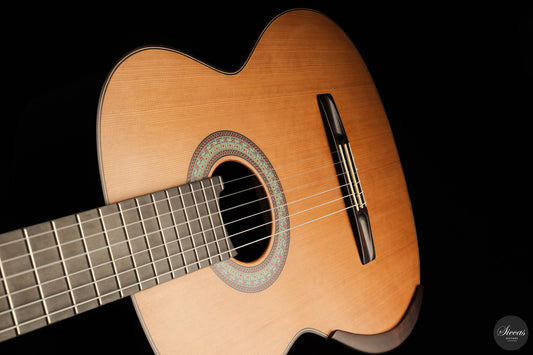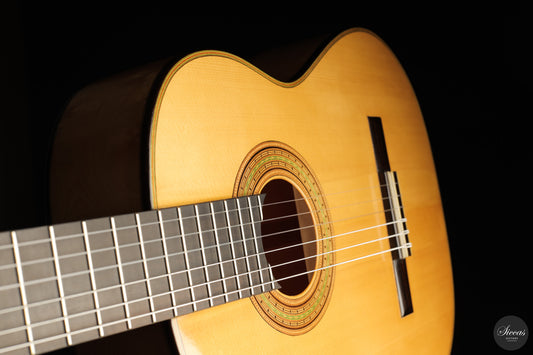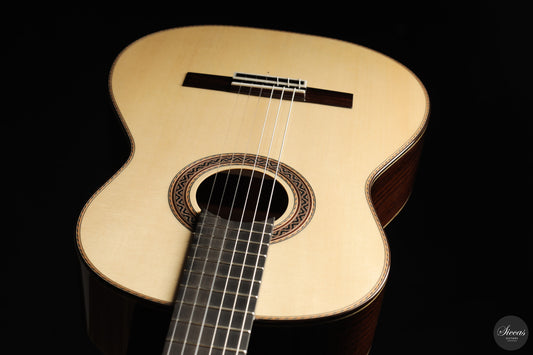

At a time when the classical guitar world looks increasingly to a handful of established names, Darío García represents something genuinely rare: a young maker from Granada, still in his early twenties, who has already attracted the attention of serious players and respected dealers worldwide. Trained exclusively by his father, rooted in the living traditions of the Granada school, and rewarded with prizes at one of the most prestigious guitar-making competitions in Spain, García is emerging as one of the most compelling voices of his generation.
Biography & Training
Darío García was born in 2002 in Granada, Spain — a city whose guitar-making lineage runs deep. From an early age he was drawn to music, entering an elementary music conservatory at the age of eight to study classical guitar. In the years that followed he broadened his musical interests to include the electric guitar and composition, but it was the workshop of his father, Antonio J. García, that would ultimately shape his path most profoundly.
Antonio J. García learned the craft of guitar making from two of Granada's most influential luthiers: Paco Santiago Marín and Rolf Eichinger. The combination of a deeply Spanish aesthetic sensibility and rigorous Northern European precision that characterises the Granada school passed directly from those masters to Antonio, and from Antonio to Darío. As a child, Darío would wander through the workshop, handling offcuts and shavings before he was old enough to understand what they were for. When he was around nine, his father built him a small-scale classical guitar based on plans by Robert Bouchet — a thoughtful gesture that planted the seed of a deeper involvement with lutherie.
Darío's formal training as a maker began at seventeen. His father has been his only teacher, guiding him through every stage of the process: from the first modest tasks of sanding components and gluing joints, through the preparation of individual parts, to the full independent construction of complete instruments. Each guitar brought greater responsibility and greater refinement. The influence of the Granada school is clearly legible in his work, but García is not content to reproduce what came before — each instrument carries a personal mark.
Construction Philosophy
García builds both classical and flamenco guitars, and his approach to each type reflects a careful balance between historical models and contemporary demands. He is committed to pairing the finest available tonewoods with exacting workmanship, and the results speak for themselves in the instruments that have reached the hands of players and collectors.
His classical concert guitars — such as the "Concierto" model — demonstrate a willingness to incorporate constructional refinements that enhance projection and tonal capacity. The use of double-sided construction, in which a thin cypress layer lines the inner surface of rosewood back and sides, is one example of how García draws on modern lutherie thinking without abandoning the warmth and directness of the Spanish tradition. Instruments built to this specification are described by players as powerful yet flexible, with excellent separation between voices and a dynamic responsiveness that rewards expressive playing. Understanding the principles behind such choices is well covered in the overview of fan-braced, double-top and lattice construction approaches.
For his historical replicas, García has shown an ability to enter into the logic of an earlier era. His version of the "La Leona" — a guitar based on the celebrated 1856 Torres instrument FE04, the first Torres guitar to incorporate a tornavoz (the internal brass cone that gives the sound its distinctive depth and projection) — is a particularly ambitious undertaking for any maker, let alone one still in his early twenties. García's recreation preserves the essential acoustic character of the original while incorporating practical modern modifications, including a fitted saddle and machined machine heads. Players who have encountered this instrument report an enormous palette of tonal colour, deep basses, singing trebles, and a natural clarity across the registers.
Signature Models
García currently works across several distinct model types, each with its own acoustic identity. The "Concierto" model is his primary concert classical guitar, built in various tonal configurations — most notably with a spruce or cedar soundboard and back and sides in Madagascar rosewood or similar tonewoods of comparable quality. Scale length typically sits at 650 mm, with a nut width of 52.5 mm, proportions well suited to the demands of the modern concert repertoire.
The "La Leona" model represents his engagement with the historical side of the instrument's development, applying the traditions explored in depth in the history of the romantic guitar to a living, playable instrument. Where his concert guitars look forward, this model looks back — yet both share the same commitment to tonal integrity and technical precision that defines his workshop.
His flamenco guitars complete a range that demonstrates real versatility. Built with spruce soundboards and cypress back and sides in the traditional Andalusian manner, these instruments carry the directness and immediacy that the flamenco repertoire demands.
Awards & Recognition
In July and August 2024, Darío García entered the seventh edition of the Antonio Marín Montero Guitar Making Competition in Granada — widely regarded as one of the most significant lutherie competitions in Spain. He was awarded Second Prize for his flamenco guitar and Third Prize for his classical guitar. For a maker in his early twenties, competing for the first time at this level, these results represent a significant endorsement from the professional community.
The Antonio Marín Montero competition takes its name from one of Granada's most celebrated luthiers, a figure whose influence on the city's guitar-making culture has been immense. To be recognised in this context places García within a lineage that stretches back through the great classical guitar makers of the twentieth century, from Granada and beyond.
Legacy
Darío García is, by any measure, at the beginning of his career. He is young, still developing his voice as a maker, and the full range of what he will produce over a lifetime of work remains to be seen. Yet the foundations are already exceptional: a thorough grounding in the Granada tradition, a rigorous apprenticeship under a skilled father, demonstrated competitive success, and an ability to work across historical and contemporary models with equal conviction.
The world of classical guitar making has always depended on the passing of knowledge from one generation to the next — from teacher to student, from father to son. Darío García's story is a vivid example of that continuity. His guitars are already finding their way into the hands of discerning players, and the trajectory points steeply upward. For those who follow the craft closely, his name is one to watch.
Browse available Darío García guitars → in the Siccas Guitars collection.