
Dieter Hopf – A Legacy Three Centuries in the Making
Few names in the world of classical guitar carry the historical weight of Hopf. Born in 1936 in Zwota in the Vogtland region of Germany, Dieter Hopf represents the latest chapter in a family instrument-making tradition stretching back to Caspar Hopf (1655–1716), the dynasty's first documented violin maker. Over more than fifty years of active building, Dieter has transformed that heritage into something unmistakably modern — developing patented construction systems, earning international recognition, and placing his instruments into the hands of celebrated concert artists across the globe.
Roots in Vogtland, Workshop in Taunusstein
The Hopf family's instrument-making roots lie in the Klingenthal and Markneukirchen area of Saxony, a region long regarded as the heartland of German musical instrument production. After the upheavals that followed World War II, the family relocated westward, and Dieter has lived in Taunusstein — a small town just west of Frankfurt — since 1949. It is there, in his workshop in Taunusstein-Wehen, that he has spent his career quietly redefining what a German classical guitar can be.
His formal training began with a two-year course in violin making in the renowned luthiery town of Mittenwald in Bavaria, a grounding that gave him a deep understanding of resonance, wood behaviour, and acoustic engineering. He subsequently specialised in guitar making and completed his master craftsman's qualification in 1968, the year he effectively took charge of the family workshop. From that point on, he devoted his energies exclusively to building high-quality solo instruments, eventually becoming one of the most respected independent luthiers in Germany. The broader story of how makers like Hopf shaped modern instrument building is explored in our overview of classical guitar makers.
Invention and Innovation: The FVTS Patent
What distinguishes Dieter Hopf from many of his contemporaries is his willingness to challenge structural convention. Around 1980, he developed and patented two significant innovations that attracted considerable attention in the lutherie world: the Free Vibrating Top System — known by its German abbreviation F.V.T.S. — and the Rosettensteg, a rosette-integrated bridge design.
The F.V.T.S. was a bold departure from orthodox classical guitar construction. Inspired in part by the mechanics of the violin, where the bridge floats freely and is held in position solely by string tension, Hopf designed a soundboard system in which the bridge was not glued to the top. The idea was to allow the soundboard to vibrate with greater freedom, theoretically unlocking more tonal projection and sustain. Guitars built with this system from the early 1980s remain collector's pieces today, sought out precisely because of their experimental character. Though Hopf eventually moved away from the F.V.T.S. approach in later years, the patents stand as evidence of a maker who was genuinely pushing the boundaries of what the classical guitar could do — something that places him in conversation with the broader world of fan-braced, double-top and lattice guitar innovation.
Guitar Models and Construction Philosophy
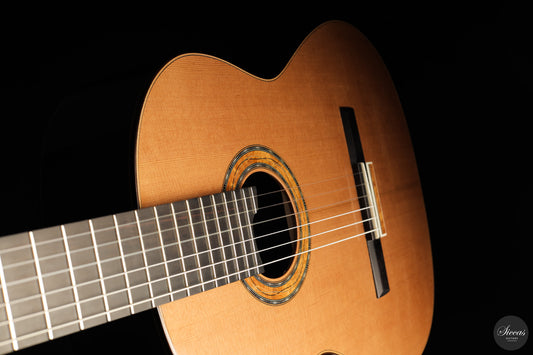
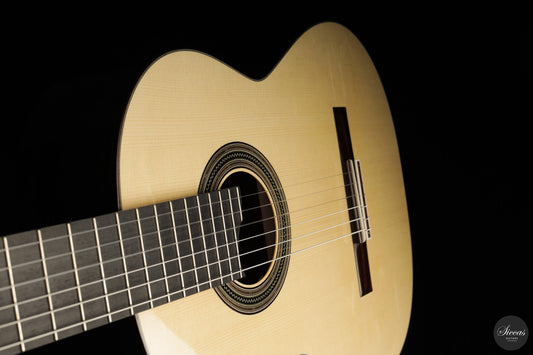
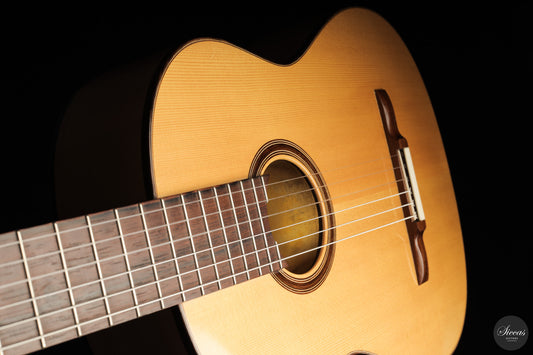
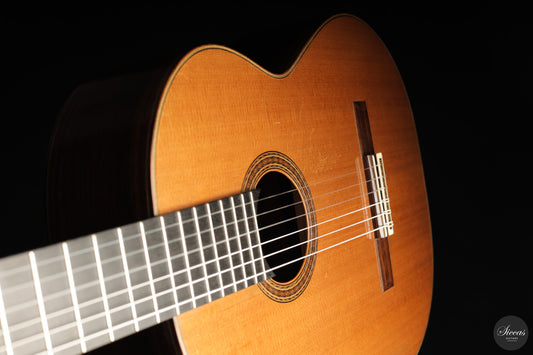
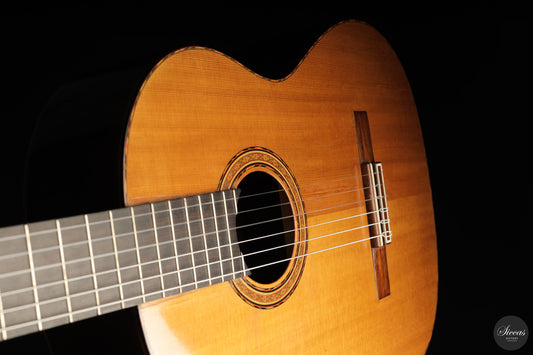
Dieter Hopf's current and recent output encompasses a range of models that reflect both his classical roots and his openness to contemporary construction methods. The Progresso, built in cedar and spruce variants, offers a warm, accessible voice suited to advancing players. The Artista Membrane occupies a higher tier of the range, featuring refined structural details and the kind of tonal complexity that serious concert performers demand. At the upper end of his catalogue sit the Portentosa Grande Furioso and the Portentosa Evolución — instruments that draw on modern building approaches including lattice and double-top techniques, which other German pioneers such as those profiled in our article on double-top guitar pioneers have also championed.
Throughout his career, Hopf has favoured tonewoods of the highest grade, with many of his earlier instruments featuring Brazilian rosewood back and sides at a time when such timber was still accessible to European workshops. His later instruments typically employ premium alternatives including Indian rosewood and maple, paired with spruce or cedar soundboards. The result, across all model tiers, is an instrument that speaks clearly in the concert hall — responsive to the touch, balanced across registers, and built to last.
Artists Who Have Chosen Hopf Guitars
The measure of any luthier's work is ultimately taken on stage, and by that measure Dieter Hopf's reputation is secure. His instruments have been chosen by internationally recognised concert artists including Alexandre Lagoya, the Franco-Greek virtuoso who was among the most celebrated recitalists of the mid-twentieth century; Baden Powell, the Brazilian guitarist whose synthesis of samba and jazz introduced classical guitar technique to entirely new audiences; Jorge Morel, the Argentine master known for his compositional and pedagogical legacy; and Michael Troster, a prominent figure in the German concert guitar world. That such a range of artists — spanning different national traditions, musical languages, and performance contexts — converged on Hopf guitars speaks to the broad expressive range his instruments offer.
The craftsmanship tradition these players drew on connects to a wider European lineage. Where French makers like Robert Bouchet or Daniel Friederich shaped the Parisian school, Hopf has been one of the central figures defining what a distinctly German approach to the concert classical guitar looks and sounds like.
A Living Heritage
Dieter Hopf's story is, in the end, a story about continuity and reinvention. A family that has been building stringed instruments since the seventeenth century did not survive three hundred years by standing still, and Dieter's career embodies that restlessness: trained in violin making, committed to guitar building, driven by patents and experiments, and ultimately judged by the music that has been made on his instruments across five decades. His workshop in Taunusstein has produced guitars that belong in any serious discussion of post-war German lutherie, and his influence on younger makers working in Germany today is quietly pervasive.
Browse available Dieter Hopf guitars → in the Siccas Guitars collection.