
Domingo Esteso – Master of the Madrid Flamenco Guitar
Domingo Esteso (1882–1937) stands as one of the defining figures of the Madrid guitar-making tradition, a craftsman whose instruments achieved a rare combination of physical lightness and overwhelming sonic power. Trained in the most celebrated workshop of his era, he went on to forge an independent voice that placed him among the handful of luthiers who shaped the sound of twentieth-century Spanish guitar. The instruments he built during his two decades on the Calle Gravina remain objects of serious study, deep admiration, and active performance today.
Roots in the Ramírez Workshop
Esteso was born in San Clemente in 1882, and by the 1890s he had made his way to Madrid to begin an apprenticeship in the workshop of Manuel Ramírez — the most influential guitar-making atelier in Spain at the time. The Ramírez shop was a crucible of talent: working alongside Esteso were Santos Hernández and Modesto Borreguero, men who would each go on to leave enduring marks on the classical and flamenco guitar. Together, this generation of craftsmen became the principal heirs of what is now understood as the Madrid school, a lineage defined by clarity of construction, tonal warmth, and an unwavering commitment to structural integrity. Esteso absorbed all of it, learning not only the technical vocabulary of the trade but the deeper aesthetic principles that guided Ramírez's output.
When Manuel Ramírez died in 1916, Esteso remained loyal to the family, continuing to work for Ramírez's widow alongside Santos Hernández. That period of service further deepened his command of the workshop's methods and gave him time to develop the particular sensibilities that would later distinguish his own guitars. The Madrid school of classical guitar makers would ultimately scatter into several brilliant individual practices, and Esteso's would prove to be among the most celebrated.
The Calle Gravina Workshop
Esteso opened his own workshop at No. 7 Calle Gravina in central Madrid in around 1919, establishing it as a true family enterprise. His wife, Nicolasa Salamanca, took charge of the lacquering and varnishing — a role that was far from incidental, since the finish of a flamenco guitar directly affects its acoustic response and visual character. The partnership gave the workshop a coherence and consistency that is visible across the instruments that survive from this period.
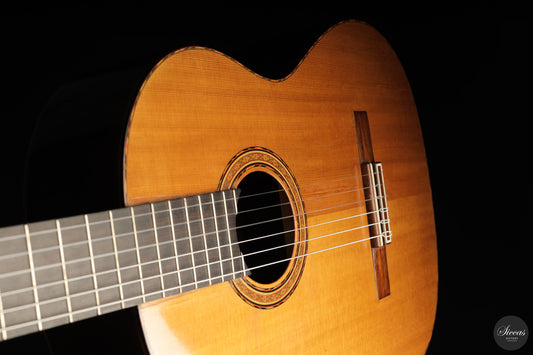
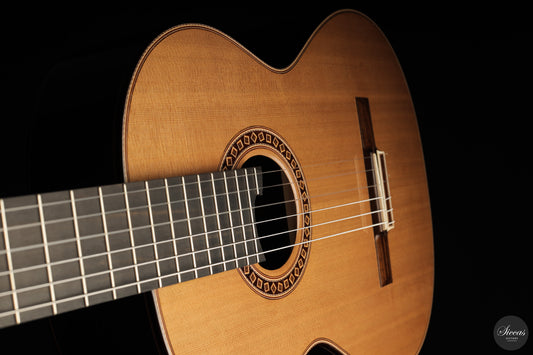
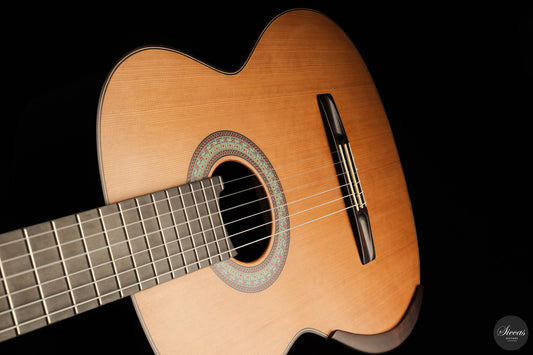
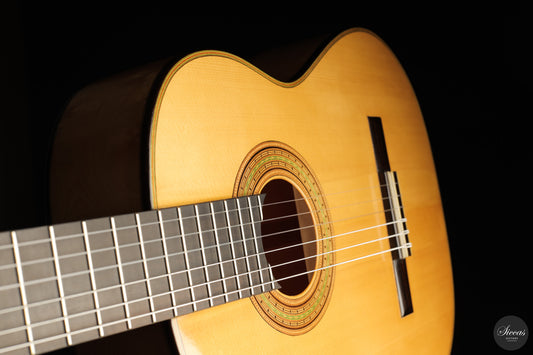
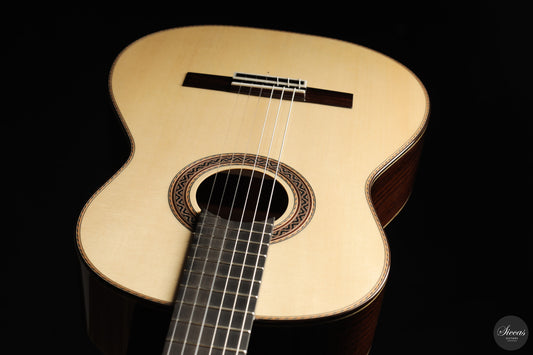
From the outset, Esteso concentrated almost exclusively on the flamenco guitar. Where his contemporaries sometimes moved between flamenco and classical construction, Esteso deepened his focus on the lighter, more immediately responsive instrument that flamenco demanded. His guitars were built with German spruce tops — selected for their exceptionally straight and even grain — and cypress back and sides, the material that gives the traditional blanca its characteristically bright, cutting tone and minimal sustain. This combination, handled with Esteso's precision, produced instruments that could project powerfully in the intense acoustic environment of a flamenco performance while remaining physically light enough for extended playing. A golpeador on the soundboard protected the top from the percussive tapping intrinsic to flamenco technique, a practical detail that also became part of the visual signature of his work.
The guitars Esteso produced during the late 1910s, 1920s, and into the 1930s are now considered among the finest examples of the Spanish flamenco instrument. They are described consistently — by players, dealers, and historians — as impeccable in construction, sober in appearance, and voluptuous in sound. The balance he achieved between structural discipline and tonal generosity is precisely what distinguished the Madrid school at its height, and Esteso embodied it as fully as any maker of his generation. His work invites comparison with the great luthiers of the same lineage: Ignacio Fleta in Barcelona and the later French masters such as Robert Bouchet each pursued their own interpretations of the classical guitar, but none operated within the same tradition of the flamenco blanca that Esteso made his own.
Notable Players and Instruments
The musicians who chose Esteso guitars were among the most demanding performers of the period. Agustín Barrios Mangoré — the Paraguayan virtuoso who John Williams would later describe as "the greatest guitarist/composer of any time" — is documented to have played an Esteso instrument. For a guitarist of Barrios's stature to choose a particular luthier's work was a meaningful endorsement: he was equally familiar with the guitars of Manuel Ramírez, Enrique García, and Francisco Simplicio, and his selection reflected real discernment. An Esteso guitar built in 1915 was also owned and played by Daniel Fortea, one of the direct disciples of Francisco Tárrega, connecting Esteso's work to the most important strand of Spanish guitar pedagogy of the era.
These associations speak to a quality that transcended genre boundaries. Although Esteso built primarily for the flamenco world, the tonal properties of his instruments — their clarity, their responsiveness, their physical ease — attracted serious classical players as well. The best guitars from his workshop occupy a space where the boundaries between flamenco and concert classical performance are less fixed than they might appear, a characteristic that continues to draw collectors and performers to surviving examples.
Family Succession and the Conde Hermanos Legacy
In 1926, Esteso's nephew Faustino Conde joined the workshop as an apprentice, followed three years later by Mariano Conde, and eventually by Julio Conde as well. The presence of the three nephews transformed the workshop into a multi-generational enterprise and ensured a continuity of method and aesthetic that would outlast Esteso himself. Domingo Esteso died in 1937, during the Spanish Civil War, from a respiratory illness believed to have been worsened by the drafts of the workshop and the absence of effective medical treatment.
Faustino, Mariano, and Julio Conde inherited the workshop and renamed it Conde Hermanos — Conde Brothers — a name that would itself become one of the most respected in twentieth-century guitar making. The Conde family went on to build instruments for Andrés Segovia, Paco de Lucía, and many of the defining artists of both classical and flamenco guitar. The lineage they carried forward was Esteso's lineage, rooted in the methods of the Ramírez workshop and refined through Esteso's own decades of concentrated craft. Today, the family tradition continues through separate workshops in central Madrid — a living extension of the chain that began when Esteso first arrived in the capital in the 1890s. The continuity of this tradition can be understood within the broader history of guitar construction approaches that have defined Spanish lutherie across generations.
The Lasting Significance of Esteso's Work
Domingo Esteso worked for fewer than twenty years under his own name, yet the instruments he produced in that time have endured as benchmarks of the flamenco guitar. They are studied by luthiers, sought by collectors, and played by performers who understand that the physical and acoustic qualities of a well-preserved Esteso cannot be easily replicated. His contribution to the Madrid school sits alongside that of Santos Hernández and the later masters whom his nephews would train — a continuous thread running from Manuel Ramírez's shop through the middle decades of the twentieth century and into the present. Among the great luthiers of Spanish tradition, Esteso holds a place defined not by volume of output but by the consistency and depth of quality he brought to every instrument he completed. Daniel Friederich in France later pursued a comparable ideal of refinement and focus, though in a very different national tradition — a reminder that the pursuit of the perfect guitar has always transcended borders.
Browse available Domingo Esteso guitars → in the Siccas Guitars collection.