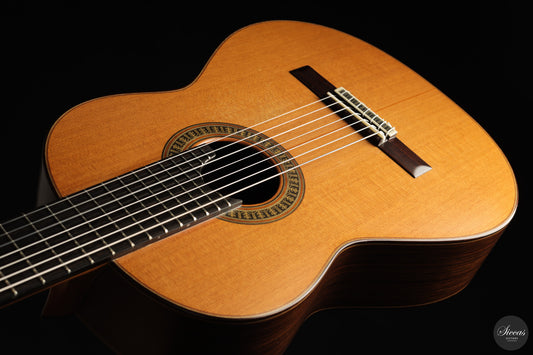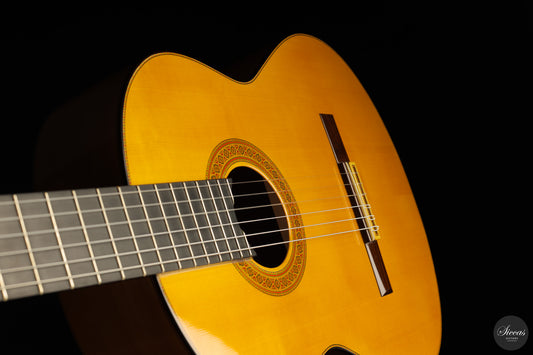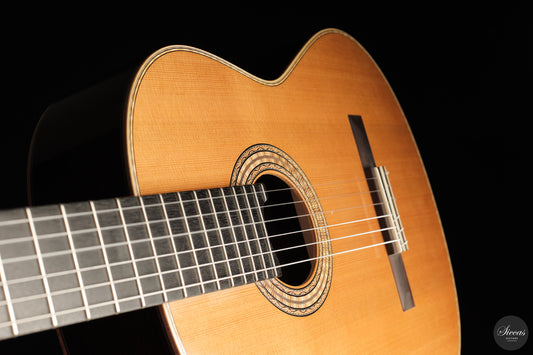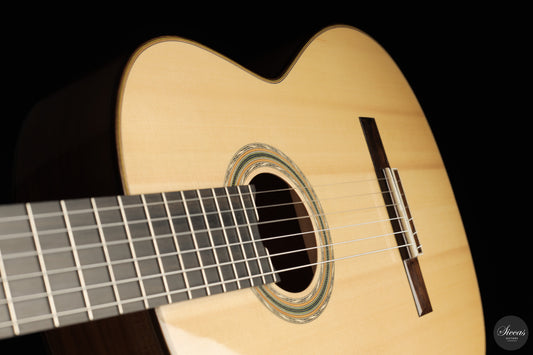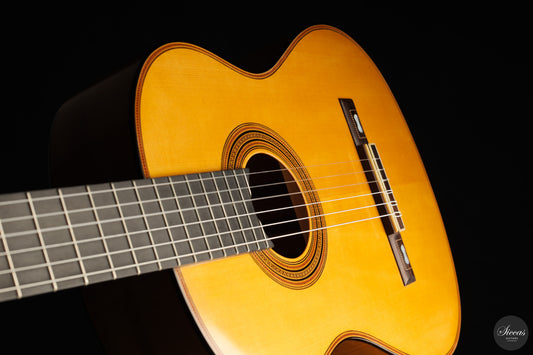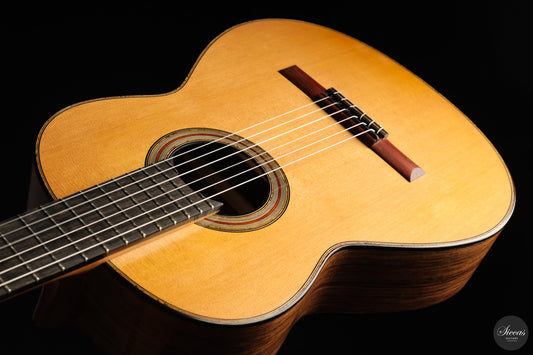

François-Régis Léonard – A Voice of the French Lutherie Tradition
François-Régis Léonard is one of the most compelling figures in contemporary French classical guitar making — a builder whose instruments bring together the tonal clarity of the great French masters with a quietly innovative approach to bracing and acoustics. Working from his workshop in Lorient, Brittany, he produces just six to eight concert guitars each year, each one shaped by years of scientific inquiry and deep respect for tradition. His instruments have earned the attention of serious players and collectors seeking something rare: a guitar that sounds unmistakably French while reaching the projection demands of the modern concert stage.
From Nantes to Newark – A Formation Across Borders
Born in Nantes in 1973, Léonard grew up close to the Atlantic coast of western France, a region where music and craft have long been woven into everyday life. His early interest in the guitar was shaped in part by the influence of a family member who was an ardent admirer of Hector Berlioz — an introduction to classical music that left a lasting impression on how Léonard would later think about timbre, colour, and emotional expression in his own work.
In 1995, he took the decisive step of enrolling at the Newark School of Violin Making in England, then as now one of Europe's most rigorous training grounds for instrument makers. Under the guidance of Roy Courtnall — author of the foundational text Making Master Guitars — Léonard spent five years immersed in the principles of fine lutherie, learning to read wood, build by hand, and think acoustically. Newark's ethos of placing handcraft above machinery left a permanent mark on his sensibility as a maker.
After completing his studies, Léonard joined the Lakewood guitar workshop in Germany in 2000, beginning a five-year collaboration that would transform his understanding of materials. Working with thousands of pieces of wood — measuring their densities, studying their deformations, testing their acoustic responses — he built the empirical foundation that would later define his own workshop practice. It was here that Léonard began the systematic, almost scientific engagement with wood selection that distinguishes his instruments today. The broader world of classical guitar makers rarely produces figures who combine this level of acoustic research with such refined hands-on building skill.
Lorient – The Workshop Takes Shape
In 2006, Léonard established his own workshop in Lorient, a port city on the southern coast of Brittany. From the outset, his approach was shaped by a close dialogue between tradition and measurement. Each year he consults with acousticians, using precise data on the physical properties of wood — density, stiffness, deformation under tension — to inform decisions that most luthiers make by intuition alone. This is not the cold language of engineering imposed on lutherie; rather, it is a method of listening more carefully to the wood itself.
The workshop in Lorient is small by design. Léonard builds slowly, with great care, completing no more than six to eight instruments per year. Each guitar passes through his hands at every stage, from selecting the top to fitting the final frets. This deliberate pace allows him to pursue the kind of refinement that only sustained attention makes possible — and it means that every instrument leaving his workshop has been shaped by hundreds of hours of considered work.
Construction Philosophy – Traditional Lattice with a French Soul
Léonard's construction approach is built around a distinctive interpretation of the lattice-braced top — an architecture more commonly associated with Australian makers working in the high-projection, carbon-reinforced idiom. His version is different in both materials and intent. He uses no balsa and no carbon fibre in his bracing, preferring solid wood throughout and allowing the natural properties of each top to guide the structural design. The result is an instrument that delivers the projection and sustain associated with lattice construction while retaining the warmth, roundness, and tonal complexity of the traditional French school.
This balance — between volume and colour, between clarity and depth — is precisely what defines the lineage Léonard sees himself as continuing. The influence of Daniel Friederich is audible in his instruments: a certain crystalline transparency in the trebles, a singing quality in the bass register, and a capacity for dynamic nuance that rewards expressive playing. Léonard also acknowledges the influence of Dominique Field, another figure in the Paris tradition who brought a refined aesthetic sensibility to the French school. To understand how bracing choices shape such outcomes, it is worth reading about fan-braced, double top and lattice guitars in more depth.
One of Léonard's structural innovations is his use of double sides — a construction technique that adds resonance and presence to the sound without altering the visual profile of the instrument. This detail, developed over years of experimentation, gives his guitars a particular fullness in the mid-range that distinguishes them from both conventionally braced instruments and standard lattice designs. His tops are available in both cedar and spruce, each lending a different character: cedar favouring warmth and immediate response, spruce offering brightness and long-term tonal development.
Sound and Playability – The Léonard Aesthetic
Players who have spent time with Léonard's instruments consistently describe the same qualities: a tone that is round and mellow at its core, rich in harmonics, and balanced across the full range of the fingerboard. The guitars are loud without being aggressive — a rare combination that makes them suited to both intimate salon playing and the demands of a concert hall. Sustain is a particular strength; notes bloom and carry, supporting the kind of singing legato line that is the hallmark of expressive classical performance.
Later models show a continuous evolution in Léonard's thinking. His instruments from the early 2020s onward reflect a deepening of the tonal palette, with updated top geometries that produce what some describe as a "modern take on the French traditional guitar" — thicker note weight, greater presence, but always the clarity that has been his signature from the beginning. The evolution is subtle rather than dramatic, the work of a maker who refines rather than reinvents.
Legacy and Place in the French School
Léonard occupies a distinctive place in the landscape of contemporary lutherie. He is not a maker who seeks recognition through spectacle or novelty; his guitars speak quietly but confidently for themselves. In an era when many builders have moved toward synthetic materials and high-output designs, Léonard's commitment to solid wood, careful measurement, and the tonal ideals of the French tradition represents a considered artistic stance. His work belongs to the same current that produced Robert Bouchet and Friederich — makers for whom beauty of sound was always the first criterion, inseparable from structural integrity and deep knowledge of materials.
Based in Brittany rather than Paris, Léonard brings a regional independence to his practice that suits the quieter, more introspective quality of his instruments. He continues to build, refine, and collaborate with acousticians, adding to a body of work that grows richer with each completed guitar. For players seeking a concert instrument that honours the French tradition while meeting the demands of contemporary performance, his guitars offer a compelling and enduring answer.
Browse available François-Régis Léonard guitars → in the Siccas Guitars collection.