
Giacomo Guadagna – Sicilian Soul, Tuscan Craft
Giacomo Guadagna is one of the most distinctive voices in contemporary Italian lutherie — a maker who carries the warmth of his Sicilian origins into every instrument he shapes in his Tuscan workshop. Born in Ribera, Sicily, and now settled in Castiglion Fiorentino in the province of Arezzo, Guadagna has built a reputation for concert-grade classical guitars that combine tonal depth, balanced registers, and a refined artistic sensibility that is entirely his own. His guitars do not merely perform; they communicate, and that quality has made him a sought-after name among serious players and discerning collectors alike.
From Ribera to Bologna: A Musical and Academic Formation
Guadagna's relationship with the guitar began early. He took up classical guitar at the age of fifteen, and the instrument remained central to his life as he pursued higher education in Bologna, where he eventually earned a Master's degree in Musicology. The academic years also broadened his musical horizons: extended time spent in New Orleans and Chicago introduced him to blues and jazz, genres that deepened his understanding of the guitar as an expressive medium across traditions. This cross-disciplinary curiosity — the musicologist who listens across genres, the classical player drawn to the voice of the instrument itself — would later prove formative for how Guadagna thinks about sound.
It was during his final year at university that lutherie began calling to him. Rather than a sharp pivot, it felt like a natural convergence of everything he had been absorbing: the study of musical instruments, the ethnomusicological ear, the hands already attuned to the guitar's body. He enrolled in courses on the construction of plucked and bowed string instruments at the School of Pieve di Cento near Bologna, and went on to complete a three-year vocational violin-making programme under Master Marcello Bellei. This foundation gave him not only technical rigour but also a deep understanding of acoustic resonance principles that span both families of instruments.
Mastery Refined: Rosettes, Finishes, and International Study
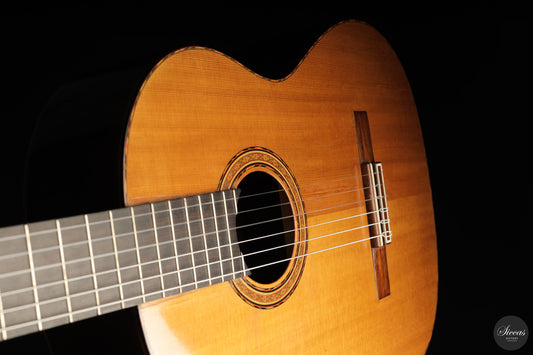
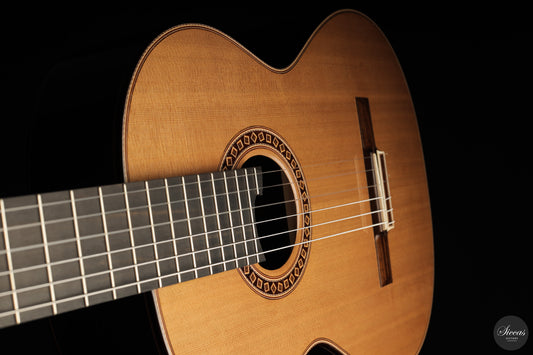
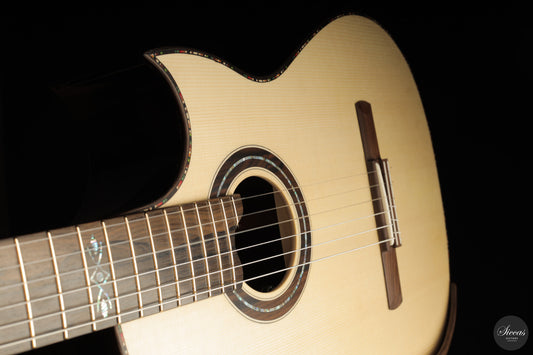
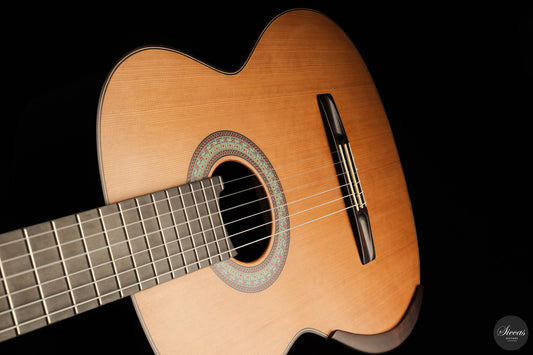
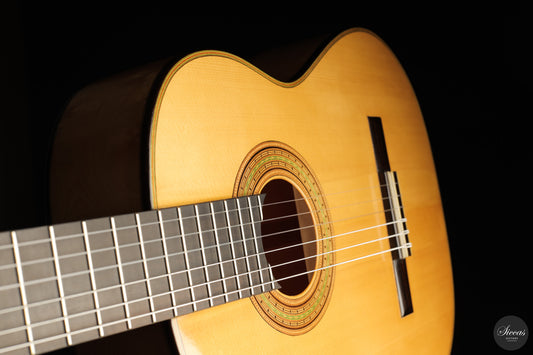
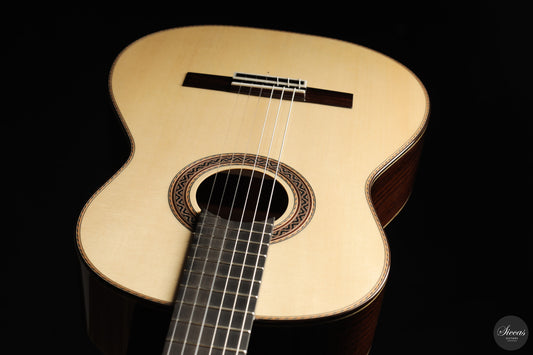
What separates Guadagna from many of his contemporaries is the degree to which he has pursued mastery in every dimension of the craft — not only structural and acoustic, but also decorative. He studied mosaic rosette design with two of the world's foremost specialists in that art: Master John Weissenrieder in Florence and Master Rafael Lopez in Cadiz, Spain. The result is a body of work in which the visual and the sonic are deeply integrated. His rosettes are not ornamental afterthoughts; they are the culmination of a distinct aesthetic vision rooted in his Sicilian heritage, drawing on the colourful geometry of traditional Sicilian majolica tilework and artifact design.
This background also informs his choice of finish: Guadagna uses traditional French polish throughout, a technique that demands extraordinary patience and skill but rewards the maker — and the player — with a surface that breathes with the wood rather than sealing it off. The tonewoods he selects are equally considered: Canadian cedar and European spruce for soundboards, paired with fine-grained rosewood and cypress for backs and sides, each chosen for its acoustic character as much as its visual beauty. Understanding the interplay between bracing, wood species, and finish is at the heart of what makes a classical guitar's voice so distinctive, and Guadagna approaches that interplay with the ear of a trained musician as much as the eye of a craftsman.
La Venere: A Guitar with a Name and a Soul
In 2007, Guadagna restored a historic farmhouse in Castiglion Fiorentino and established his permanent workshop there. It was in this setting — Tuscany's rolling hills, the stone and timber of a renovated rural home — that his signature concert model took final shape. He named it La Venere, a tribute to the goddess of beauty, femininity, and fertility, and the name captures something essential about the instrument's character. These are not cold, mechanical constructions; they are warm, communicative, and visually arresting.
La Venere is built on traditional seven-fan bracing, an architecture with deep roots in the Spanish tradition developed by makers such as Ignacio Fleta and refined across generations of Spanish and European luthiers. Guadagna's own contribution lies in how he voices that structure — tuning each brace, adjusting plate thicknesses, and calibrating the relationship between treble clarity and bass warmth until the instrument speaks with the kind of evenness that concert performers depend on. The Venere Concerto, his flagship model, is designed specifically for the demands of the recital stage: quick response, long sustain, and projection that carries across a concert hall without sacrificing intimacy.
Since 2008, Guadagna has also taught guitar-building courses in his workshop, passing on his methods and philosophy to a new generation of makers. This commitment to transmission — sharing not just technique but also a way of listening — places him squarely in the tradition of great Italian luthiers who understand that craft is also a form of culture. It is a tradition explored across the broader landscape of classical guitar makers, from the great Parisian ateliers of the mid-twentieth century to the workshops of contemporary Tuscany.
Italy's Living Lutherie Tradition
Guadagna's work sits comfortably within a proud Italian lineage. Italy has long been home to extraordinary instrument makers, and the contemporary generation of Italian luthiers — working from workshops in Tuscany, Florence, and beyond — has done much to affirm that tradition in the concert guitar world. Florentine makers such as Andrea and Giovanni Tacchi have similarly built reputations grounded in meticulous craft and musical intelligence, and Guadagna belongs to this milieu. He was also among the twenty Italian master luthiers who contributed to the remarkable collaborative project Italica, a single guitar assembled from the individual contributions of some of Italy's finest makers — a project that underlines both the vitality and the collegial spirit of Italian lutherie today.
Each Guadagna instrument is built entirely by hand, by Guadagna himself, which means his annual output is necessarily limited. That limitation is also a guarantee: every guitar that leaves his workshop has received his full attention at every stage. For players and collectors who value that kind of accountability — who want to know that every joint, every brace, and every brushstroke of French polish was placed by one pair of informed and careful hands — a Guadagna guitar represents something increasingly rare in the modern market.
A Voice Worth Seeking Out
Giacomo Guadagna has arrived at his mature style through an unusually rich accumulation of influences: Sicilian visual culture, Bolognese academic rigour, the violin-making tradition of northern Italy, the flamenco guitar aesthetics of Cadiz, and the musicological sensitivity of someone who has listened deeply across many genres. The guitars he makes today are the sum of all those encounters, filtered through a temperament that is both methodical and warmly expressive. Whether voiced with cedar for a more immediate, rounded response or with spruce for a brighter, more projecting character, a Venere Concerto is an instrument built with a clear musical purpose: to give the player everything they need, and then get out of the way.
Browse available Giacomo Guadagna guitars → in the Siccas Guitars collection.