Greg Smallman – The Australian Luthier Who Redefined the Concert Guitar
Greg Smallman is widely regarded as the most influential classical guitar maker of the late twentieth century — a luthier who looked at an instrument with centuries of accumulated tradition and dared to rethink it from the ground up. Born on 19 June 1947 in Cronulla, New South Wales, Australia, Smallman brought an engineer's analytical mind to lutherie and produced a design so effective that it changed the direction of guitar making worldwide. His lattice-braced, paper-thin soundboards deliver extraordinary projection and responsiveness, and his instruments have been the tools of choice for some of the greatest concert guitarists alive.
From Cronulla to the Workshop: Early Life and the Road to Lutherie
Smallman came to guitar making not through the classical Spanish apprenticeship tradition but through a practical, hands-on curiosity that owed more to engineering than to the workshops of Torres or Hauser. He began building guitars in 1972, initially working within the established canon — early instruments were modelled on the Fleta design and used spruce or cedar tops braced in the conventional fan pattern. But Smallman was dissatisfied. He believed the traditional construction left untapped acoustic potential, and he set about exploring alternatives with systematic rigour. By 1974 he had built his first lattice-braced soundboard, a moment that would prove to be one of the most consequential in the instrument's modern history.
Those early experiments placed him entirely outside the mainstream of guitar making as it was then understood. Contemporaries working in Europe — figures such as Daniel Friederich in Paris or José Luis Romanillos in Spain — were refining the inherited tradition with exceptional skill. Smallman, by contrast, was asking a different question altogether: not how to perfect the fan-braced guitar, but whether a fundamentally different structure could unlock something new.
The Lattice Revolution: Construction Approach and Signature Design
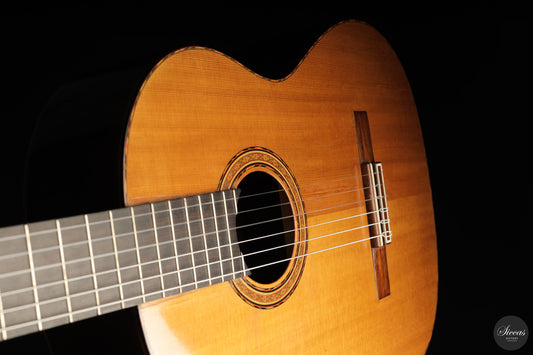
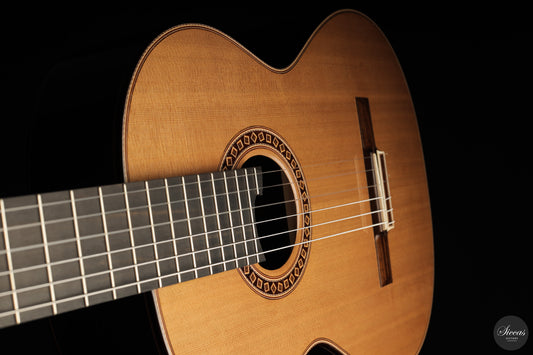
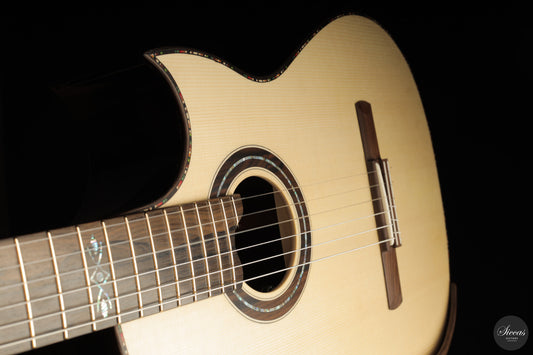
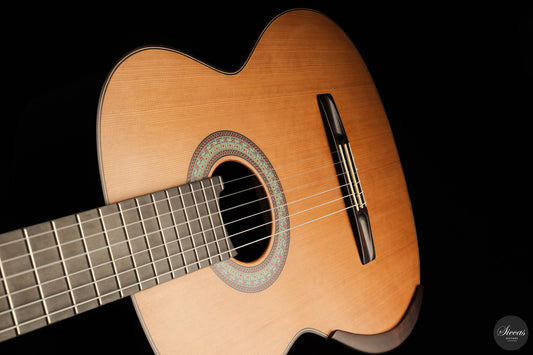
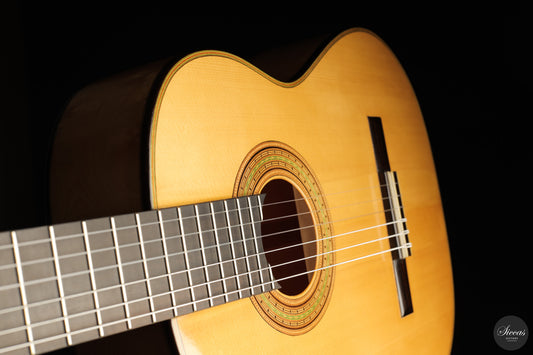
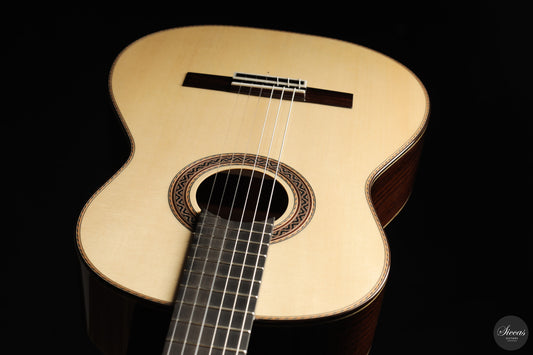
The defining feature of a Smallman guitar is its soundboard construction. Rather than the fan-shaped spruce or cedar struts used by traditional makers since Torres, Smallman developed a grid — a lattice — of balsa wood reinforced with carbon fibre. This framework is extraordinarily light and stiff, allowing the top to be thinned to dimensions that would be structurally impossible on a conventionally braced instrument. The result is a soundboard with remarkable responsiveness to even the lightest touch, capable of sustaining long, complex resonances and projecting clearly to the back of a large concert hall.
The back and sides depart equally from convention. Where most classical guitars use relatively thin back plates, a Smallman guitar features a high, arched, carved back — considerably thicker and heavier than a traditional instrument — typically built from Madagascar rosewood. This mass provides a rigid, reflective surface that channels energy into the soundboard rather than dissipating it through the back. The combined effect of the ultra-responsive top and the dense, inert back creates an instrument with a character quite unlike anything produced by the fan-braced tradition — warmer in the bass, more complex in the trebles, and capable of filling large spaces without amplification.
By 1980 the system had reached a mature form: a lattice of balsa and carbon fibre beneath a cedar top reduced to near paper-thin dimensions, combined with the arched rosewood back and a carefully calculated overall mass. Each guitar is built to what Smallman considers optimal resonant specifications, a process that requires measuring and adjusting the top as it is thinned until it reaches the precise stiffness-to-mass ratio he is seeking. It is a method as much scientific as intuitive, and it produces instruments of remarkable consistency alongside genuine individuality.
John Williams and a Defining Partnership
The trajectory of Smallman's career changed decisively in 1981, when the Australian-born guitarist John Williams acquired one of his instruments. Williams was already among the most celebrated classical guitarists in the world, and his public endorsement of Smallman's work brought it to an international audience overnight. More than mere advocacy, though, the relationship between the two became a sustained creative dialogue. Williams played Smallman guitars exclusively for many years, and his precise feedback — on projection, tonal balance, string response, and sustain — directly shaped the evolution of the design through the 1980s and 1990s.
The visibility Williams gave to Smallman's instruments was immense. His recording of the Sevilla Concert in the 1990s, performed on a Smallman guitar, demonstrated to a global audience exactly what the instrument could do in a major concert hall context. The sound was recognisably different from what listeners associated with the classical guitar — more powerful, more complex, more demanding of the room — and it sparked a wave of interest in lattice construction among luthiers far beyond Australia. Many makers, inspired by Smallman's openness about his methods (he has never patented his system and has always shared his ideas freely), incorporated elements of his approach into their own work, influencing a generation of builders across Europe, Asia, and the Americas.
Notable Players and the Smallman Sound in Concert
Beyond John Williams, a remarkable roster of concert artists has chosen Smallman instruments for their professional careers. Miloš Karadaglić, one of the most prominent classical guitarists of his generation, performs on a Smallman built in 2017. Xuefei Yang, whose international career has spanned major concert halls and recording studios across four decades, is another committed Smallman player. Craig Ogden, Judicaël Perroy, and Ben Verdery are among the many others who have performed and recorded on Smallman instruments. That this breadth of stylistically diverse artists — from the Romantic repertoire to contemporary works — finds common ground in the Smallman sound is itself a testament to the guitar's versatility.
In 1999 the workshop label became Greg Smallman & Sons Damon & Kym, as Greg's sons joined the family enterprise as full collaborators. The workshop has moved over the years — from Glen Innes in New South Wales to a brief period on the Mornington Peninsula outside Melbourne — and is now based near Esperance in Western Australia. Output remains small and deliberate: these are handmade instruments built to exacting standards, and waiting times for a commission can extend for several years.
Legacy and Influence on the Classical Guitar World
Among all the pioneering makers who have pushed the instrument beyond its traditional boundaries, Smallman occupies a singular position. Where most revolutionary luthiers — from Robert Bouchet to Ignacio Fleta — worked to perfect the existing model, Smallman proposed a structural alternative so different in principle that it effectively launched a new lineage of guitar design. Lattice construction, in its many variants, is now practised by dozens of makers worldwide and has become one of the defining characteristics of the contemporary high-performance classical guitar.
The Guitar Foundation of America recognised Smallman's contribution with an Artistic Achievement award, an acknowledgment of the scope and depth of his influence on the instrument. Yet perhaps his most enduring legacy is the spirit in which he has shared his knowledge. By remaining open about his methods — publishing, discussing, and explaining rather than guarding — he accelerated the development of the craft globally in a way no patent could have matched. Greg Smallman did not simply make better guitars; he changed what builders across the world believed a guitar could be.
Browse available Greg Smallman guitars → in the Siccas Guitars collection.