Martin Bretscher – Sustainable Craft and Sonic Innovation from Bavaria
Martin Bretscher is one of the most distinctive voices among contemporary German luthiers — a maker whose instruments are inseparable from his values of sustainability, ethical sourcing, and honest craftsmanship. Based in Franconia, Bavaria, Bretscher founded his workshop Soul Guitars in 2020, and in just a few years has built a reputation for guitars that balance expressive power with ecological conscience. His work stands as evidence that innovation in lutherie does not require compromising either the environment or the instrument.
From Cabinet Making to Master Craftsman
Bretscher's path to guitar making began in the workshop rather than the conservatory. He first trained as a cabinet maker, a foundation that instilled in him a deep sensitivity to wood — its grain, behaviour, and acoustic potential. In 2003 he formalised his dedication to the guitar by beginning an apprenticeship as a plucked instrument maker under Armin Hanika, one of Germany's most respected guitar makers, whose workshop in Baiersdorf near Erlangen has long been a centre of precision instrument building. By mid-2005 Bretscher had completed his journeyman examination, and in 2007 he earned his master's certificate as a Zupfinstrumentenmacher-Meister — a master plucked instrument maker. That same year the Bavarian State Government awarded him the Master Craftsman Prize, recognising his exceptional talent and commitment to the craft. It was a signal early in his career that Bretscher was building something worth watching.
The years following his qualification were spent deepening his understanding of guitar acoustics and construction, working across different traditions and experimenting with materials well beyond the industry standard. This period of quiet development would eventually give shape to Soul Guitars and the distinctive instrument vocabulary Bretscher has developed since.
Soul Guitars: A Workshop with a Philosophy
When Bretscher established Soul Guitars in 2020, he was not simply opening a workshop — he was articulating a position. The name carries its meaning deliberately: these are instruments conceived as complete musical systems, in which construction, ergonomics, and visual identity serve a unified acoustic goal. But Soul Guitars is also defined by what it refuses. Bretscher sources materials with rigorous attention to provenance and sustainability, avoiding endangered tonewoods in favour of alternatives that offer comparable or superior acoustic properties. Apple wood, smoked oak, thermo-treated timbers, and Richlite fretboards appear throughout his instrument line, each chosen not as a compromise but as a considered upgrade.
His approach to construction is equally methodical. Bretscher builds pairs of instruments, a practice that allows him to contrast and compare, refining his understanding of how small variables in bracing height, wood stiffness, or finish affect the final voice. Lattice bracing is central to his classical guitar output — a technique associated with high-projection, responsive instruments that reward the modern concert player. For those interested in the broader landscape of bracing innovations, the history of fan-braced, double-top and lattice guitars offers essential context for understanding where Bretscher's work sits within the contemporary tradition. His instruments also draw comparison to a broader generation of innovative European builders, including the double-top guitar pioneers who have reshaped expectations for what a modern classical guitar can achieve.
Signature Models: Flow Cut, Soul Cut, and the Soulmate
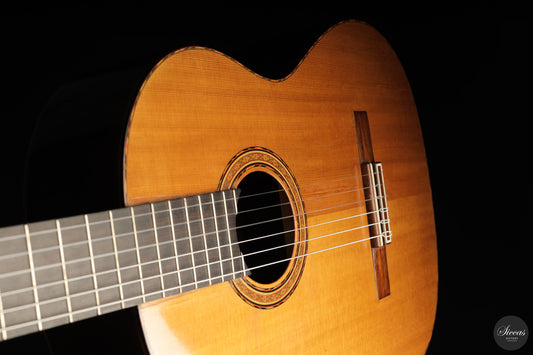
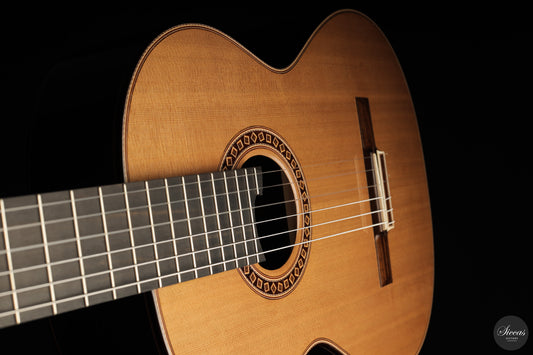
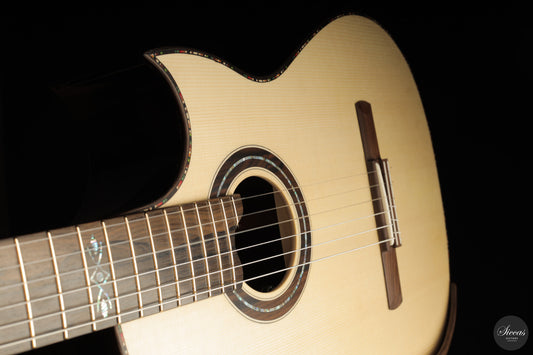
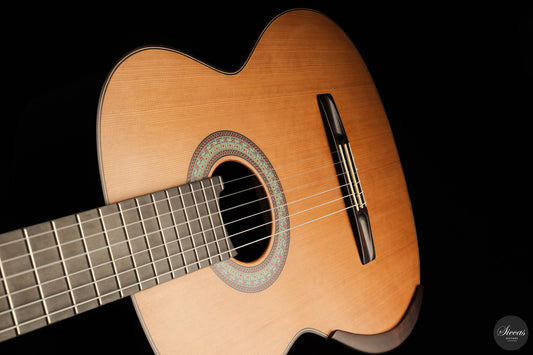
Bretscher's model range is coherent, purposeful, and continuously evolving. The Flow Cut is his most immediately recognisable design: a cutaway classical guitar developed to give players seamless access to the upper registers without the acoustic penalties that poorly designed cutaways typically impose. The Soul Cut follows similar ergonomic logic, offering the expressive advantage of the treble-side cutaway in a format that suits a wider range of playing styles. Both models are available with lattice bracing, and Bretscher often pairs them with smoked oak backs and sides or apple wood bodies — materials that contribute warmth and clarity in equal measure.
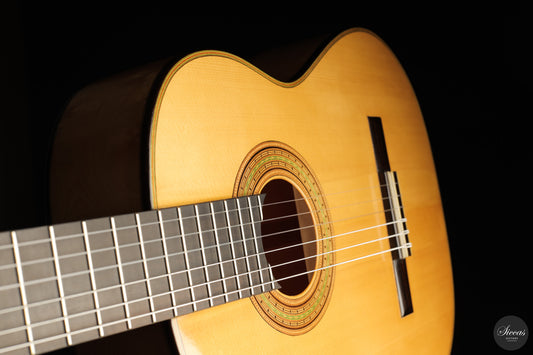
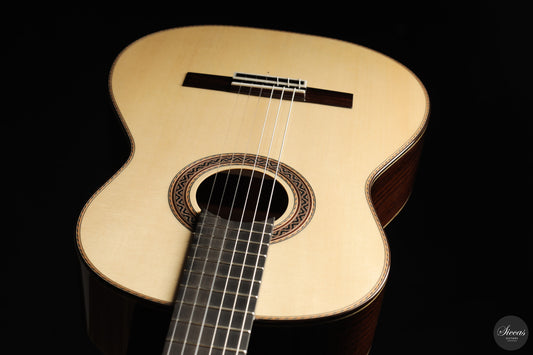
The Soulmate represents Bretscher's most refined concert instrument. Built in the Spanish tradition with spruce top, apple wood back and sides, a lattice bracing system, and finished in hand-polished shellac, the Soulmate is designed for players who demand both projection and tonal depth. Its appointments — EVO Gold fret wire, bone saddle inserts, custom tuning machines, and a Jakob Winter Greenline case — reflect Bretscher's attention to every detail of the player's experience. The Small Soul, with its 630 mm scale length, extends his range to younger players and those who prefer a more compact instrument without sacrificing the acoustic seriousness of a full concert guitar.
Each model can be configured through his custom shop, where players select wood species, scale length, neck width, and finish to suit their individual requirements. This degree of personalisation, rare among workshop luthiers building at Bretscher's level of quality, has made Soul Guitars particularly attractive to professional players commissioning instruments built around their technique.
A Distinct Voice Among Contemporary Makers
Bretscher's position within the wider world of classical guitar makers is that of a maker who has absorbed the lessons of the great twentieth-century tradition — the structural rigour of Daniel Friederich, the tonal idealism of Robert Bouchet — and redirected that inheritance toward the concerns of the present moment. Where those masters worked primarily within the established vocabulary of tonewoods and fan bracing, Bretscher has chosen to interrogate those assumptions without discarding the musical values they embodied. The result is a body of work that feels simultaneously rooted and forward-looking.
His guitars have attracted players from across Europe and beyond, with commissions arriving from professional guitarists seeking instruments that combine the acoustic power of the modern lattice school with the warmth and character that distinguishes a great concert guitar from a merely loud one. That combination — transparency, sustain, dynamic range, and an identifiable tonal personality — is what players who have spent time with a Bretscher consistently report.
Legacy and the Road Ahead
Martin Bretscher is still in the early decades of a career that carries the hallmarks of long-term significance. The precision of his training, the seriousness of his philosophy, and the quality of his output have already placed him among the most interesting luthiers working in Europe today. His commitment to sustainable materials and fair production practices adds a dimension to his work that resonates well beyond the guitar world, pointing toward a model of craft that future makers may well look back on as ahead of its time.
Browse available Martin Bretscher guitars → in the Siccas Guitars collection.