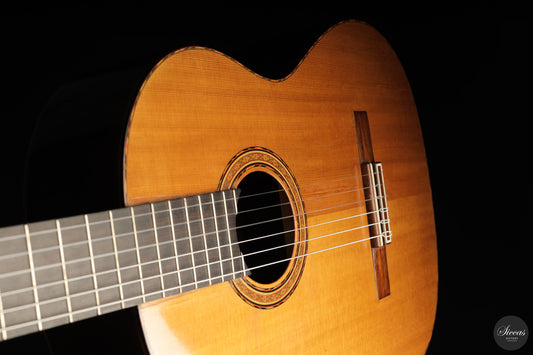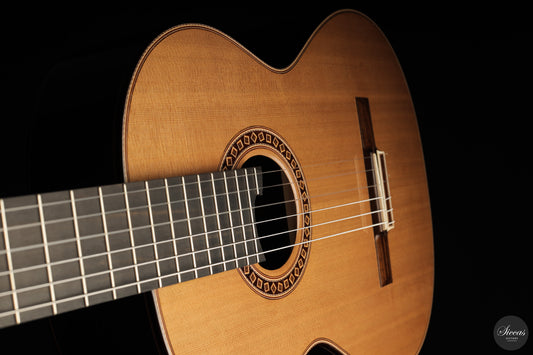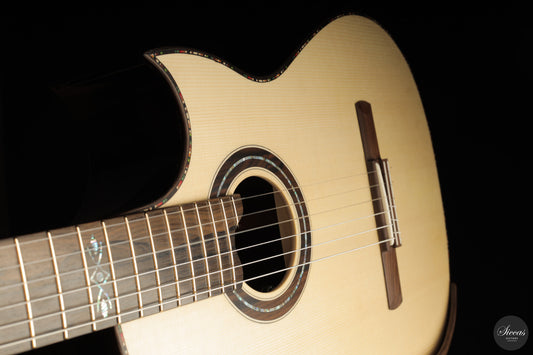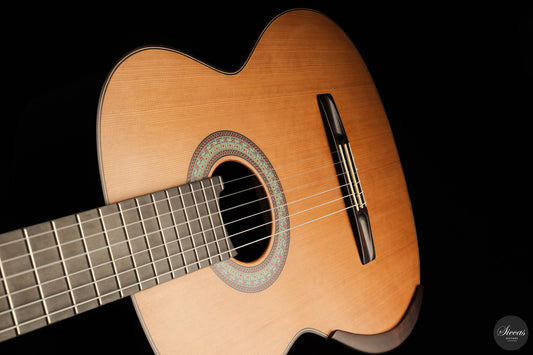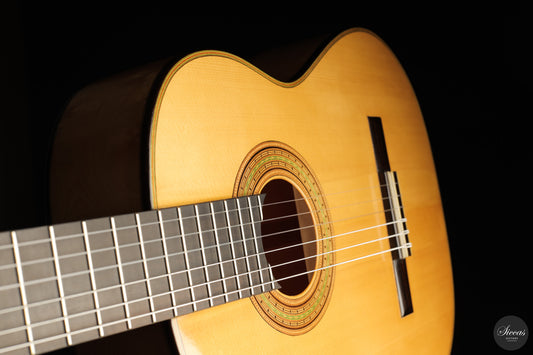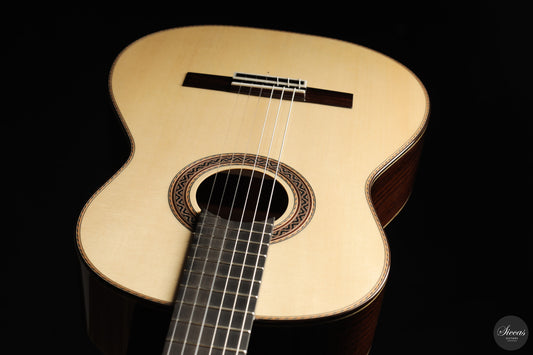

Matthias Dammann – Pioneer of the Double-Top Guitar
Few luthiers in the history of classical guitar making have reshaped the craft as profoundly as Matthias Dammann. Born in Germany in 1957, Dammann is the inventor of the double-top guitar — a construction approach so radical and so successful that it has influenced an entire generation of instrument makers and transformed what players expect from a concert guitar. His instruments are not merely admired; they are played at the highest levels of the international concert stage, cherished for their extraordinary projection, clarity, and responsiveness.
From Frankfurt to Eastern Bavaria – A Luthier Finds His Path
Dammann came to the guitar relatively late, taking it up seriously in his late teens. He immersed himself in the instrument, initially teaching himself before pursuing formal study and private lessons that eventually led him to the music academy in Frankfurt, where he later served as a guitar lecturer. It was during these years that he developed both the deep musicianship and the analytical rigour that would define his approach to guitar making.
In 1984, he made a decisive break from academic life, leaving Frankfurt to establish a workshop in Eastern Bavaria, near the Austrian border. This move was not a retreat but a declaration: Dammann intended to devote himself entirely to building guitars that he, as an active musician, could judge from the inside. He drew early inspiration from the instruments of Daniel Friederich, Robert Ruck, and Miguel Rodríguez, but it was his systematic study of the guitars of Antonio de Torres — the nineteenth-century Spanish master who established the foundational grammar of the classical guitar — that gave his research its intellectual direction. Dammann's reverence for Torres was not nostalgic; it was scientific. He wanted to understand, at a structural and acoustic level, why certain soundboards behaved the way they did.
That combined artistic and scientific sensibility earned him swift recognition in the wider lutherie community. In 1988, just four years after opening his workshop, Dammann was awarded the Grand Prix at the prestigious Paris/ORTF International Guitar Maker Competition — one of the most coveted distinctions in classical guitar making. The award confirmed what those who had played his early instruments already knew: here was a maker of exceptional gifts working on problems that mattered.
The Double-Top – A Revolution in Soundboard Design
Dammann's most consequential contribution to guitar making arrived in 1989, when he completed what is now recognised as the world's first double-top guitar. The concept was deceptively simple in description but technically demanding in execution: instead of a single solid soundboard, Dammann constructed a "sandwich" of two thin cedar tops enclosing a lightweight core. In these earliest instruments, the core consisted of thin cedar strips glued under pressure between the two soundboard skins. By varying the properties of this interface layer, Dammann could exercise unprecedented control over the acoustic character of the soundboard — tuning stiffness, flexibility, and resonant behaviour with a precision that a solid top could not afford.
The innovation continued to evolve. By mid-1995, having been introduced to Nomex — a Kevlar-based honeycomb material developed for aerospace and industrial applications — Dammann incorporated it as the core layer, bonding the assembly under vacuum pressure with a specially selected adhesive. The result was a soundboard of remarkable lightness and structural integrity simultaneously, a pairing that had seemed contradictory in traditional construction. This Nomex-core double top became the template that countless subsequent makers would study, adapt, and interpret. The broader story of how this design spread through the world of concert guitar is explored in detail in the article on Double-Top Guitar Pioneers: Dammann and Wagner.
Dammann did not stop there. In 2012 he introduced a third-generation core material — sometimes referred to informally as the "Dammann 3.0" system — moving beyond Nomex to proprietary refinements that continued to push the acoustic ceiling of the design. Each iteration brought not only a new soundboard but a recalibrated understanding of how mass, stiffness, and resonance interact in a plucked-string instrument. For those interested in how these ideas relate to other advanced construction philosophies, the article on Fan-Braced, Double-Top and Lattice Classical Guitars offers useful comparative context.
Concert Artists and the Dammann Sound
The acid test of any concert guitar is whether world-class players choose it for the stage. By the early 1990s Dammann already had a waiting list exceeding ten years — an extraordinary figure for a luthier working alone in a small workshop. The players who chose to wait were among the most distinguished in the profession.
Manuel Barrueco became the first internationally prominent guitarist to perform publicly on a Dammann, beginning in 1993. David Russell, one of the most celebrated classical guitarists of his generation, followed, and a guitar formerly in his hands remains one of the most documented Dammann instruments in circulation. Further testament to the breadth of the Dammann following came from players as stylistically varied as Pablo Sainz Villegas, Tilman Hoppstock, Thomas Müller-Pering, Franco Platino, Andrew York, Scott Tennant, and the Beijing Guitar Duo — a roster that spans continents, generations, and stylistic approaches, united by a shared appreciation for what the double-top construction makes possible in performance.
The consistency with which these players have retained Dammann guitars across long careers, rather than cycling through instruments, speaks to something beyond novelty. The guitars reward close listening and sustained familiarity; they are described by those who play them as instruments that grow in depth the better a player comes to know them.
Legacy and Influence on Modern Guitar Making
Matthias Dammann occupies a rare position in the history of classical guitar making: he is both a practitioner of the highest order and the originator of a structural paradigm that has been adopted widely enough to constitute a genuine school of thought. Where the innovations of earlier makers — Robert Bouchet's empirical approach to bracing, or the austere formal logic of Ignacio Fleta — shaped the course of lutherie through the instruments they left behind, Dammann's influence operates additionally through the techniques he introduced, which other builders now practise and develop in their own workshops around the world.
His approach also stands as a reminder that the classical guitar is not a finished object. It remains a site of serious inquiry, where the questions posed by Torres in the 1860s — what is the optimal relationship between mass, stiffness, and resonance in a soundboard? — continue to receive new answers. Dammann has provided some of the most important answers of the past half century, and his ongoing work in Bavaria suggests that the inquiry is far from closed.
Browse available Matthias Dammann guitars → in the Siccas Guitars collection.