
Max Cuker – Lithuanian Luthier Bridging Tradition and Modern Innovation
Among the generation of contemporary classical guitar makers who emerged from Eastern Europe after the turn of the millennium, Max Cuker occupies a distinctive place. Working from his workshop in Vilnius, Lithuania, he builds instruments that unite the warmth of traditional fan-braced construction with the projection and clarity of modern double-top and lattice designs — and he has earned international recognition for doing so with exceptional skill. His guitars are played from Tomsk to New York City, and players at the highest levels have singled them out for their responsive playability and crystalline tone.
Origins and a Return to the Craft
Maksim Cuker was born in 1975, and his relationship with the guitar began early — both as a player and, eventually, as a maker. In 1993, at the age of eighteen, he handcrafted his very first guitar under the guidance of luthier Yuri Zirin, an experience that gave him a foundational understanding of the instrument's construction. Life, however, interrupted the path, and Cuker set aside lutherie for nearly two decades. It was not until 2011 that he returned to the workbench, building two guitars whose resonant qualities struck him with such force that he resolved to pursue the craft in earnest.
The years that followed were marked by focused self-directed study and mentorship. Cuker drew on the expertise of several prominent luthiers: Timofey Tkatch from Moscow, Dmitriy Pavlovitch and Vitaliy Pahomov from Saint Petersburg, and, most influentially, the exceptional Ukrainian luthier Nikolay Rudenko, with whom he collaborated primarily through online exchange. He also deepened his knowledge by handling instruments built by renowned makers such as Masaru Kohno, José Ramírez, Manuel Contreras, Dieter Hopf, and John Price — a hands-on education in the accumulated traditions of the modern classical guitar.
Recognition and Award-Winning Work
By 2014, Cuker's progress had become unmistakable to the wider lutherie community. That year he submitted one of his instruments to the "Guitar Virtuosos" luthiers' competition in Saint Petersburg and took first place — a significant achievement in a region with a rich tradition of stringed instrument craftsmanship. The prize brought his work to broader attention and confirmed what players who had already tried his guitars already knew: that his instruments were capable of competing at the highest level.
This recognition is all the more notable given the context in which Cuker developed his skills. Unlike luthiers who trained in established workshops in Spain, France, or Italy — in the lineages that trace back through figures such as Robert Bouchet or Ignacio Fleta — Cuker built his expertise through a combination of mentorship, self-guided research, and direct empirical testing. The result is a voice that is entirely his own.
The Anastasia and Birute: Two Approaches to Sound
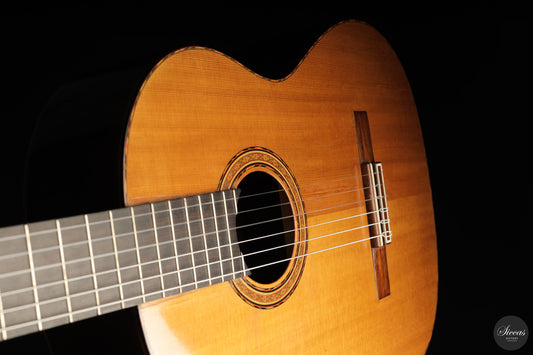
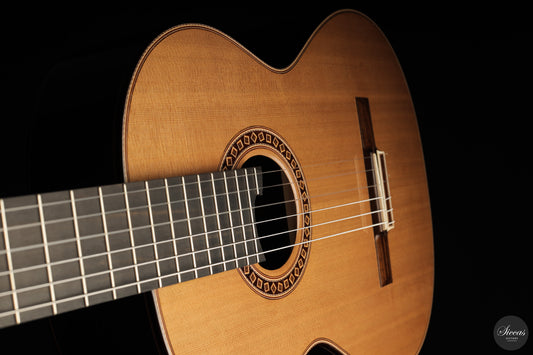
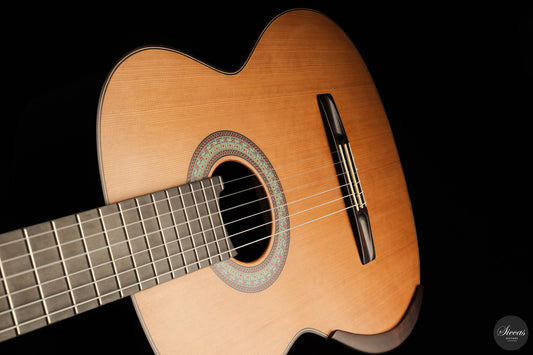
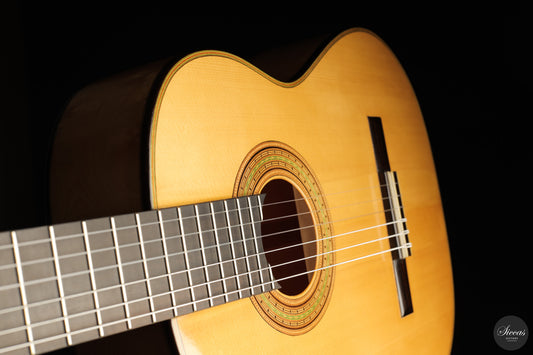
Cuker's output centres on two signature models, each reflecting a different philosophy of sound production. The Anastasia is his interpretation of the traditional fan-braced guitar, informed by his own research and adapted with a contemporary sensibility. It is available both in a standard configuration and as an Anastasia DT — a double-top version in which the cedar top is constructed from two thin slices bonded with a proprietary inner core of Cuker's own devising, replacing the Nomex or balsa typically used by makers working in this tradition. The result is an instrument with exceptional resonance and tonal complexity.
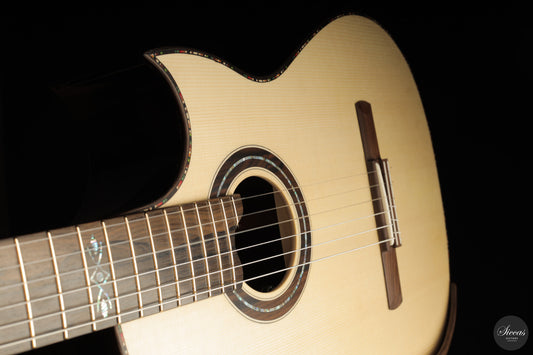
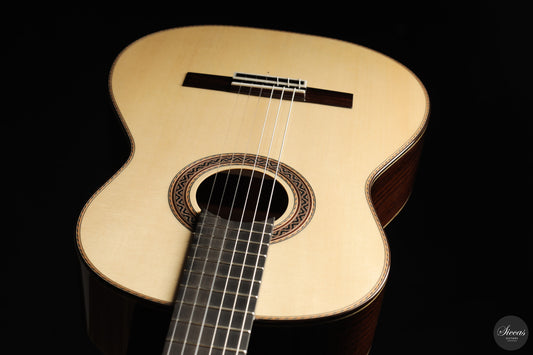
The Birute takes a different approach, employing a lattice-braced top that draws inspiration from techniques pioneered by Australian luthier Greg Smallman and developed by a generation of builders committed to maximising projection and dynamic range. Like the Anastasia DT, the Birute also features doubled back and sides — typically in Madagascar rosewood — alongside an elevated fingerboard for improved access to the upper register, a sound port, and a carved slot-head headstock. The combination of these elements produces what players consistently describe as a crystal-clear sound with slightly greater volume than comparable instruments, without sacrificing the warmth that defines the classical guitar tradition. To understand how these approaches compare within the broader landscape of construction philosophies, it is worth exploring the differences between fan-braced, double-top, and lattice guitars in more depth.
Across both models, Cuker's preferred tonewoods include Canadian cedar for the top, Madagascar rosewood or pau ferro for the back and sides, ebony for the fingerboard, and mahogany for the neck — a selection that reflects both acoustic priorities and the global network of tonewoods available to contemporary luthiers. Scale length is typically 65 cm, well suited to concert performance.
Notable Players and International Reach
Among the artists who have chosen Cuker instruments is Anton Baranov, a winner of the Guitar Foundation of America (GFA) International Competition — one of the most prestigious prizes in classical guitar — and Tali Roth, a professor at the Juilliard School in New York. That players of this calibre have selected Cuker guitars for both performance and teaching is a testament to the instruments' professional-grade quality. His guitars have found homes across multiple continents, reflecting the increasingly global nature of the contemporary lutherie market and the growing reputation of Eastern European makers within it.
This internationalisation of classical guitar making — where outstanding work emerges not only from the traditional centres of Spain, France, and Italy but also from Lithuania, Ukraine, and Russia — is one of the most significant developments in the craft over the past two decades. Cuker is a compelling representative of this shift, combining the rigour of the old European traditions with the openness to innovation that characterises the best contemporary work. His engagement with both fan-braced and double-top construction approaches places him in productive dialogue with the leading voices in modern lutherie.
A Distinctive Voice from Vilnius
What defines a Max Cuker guitar, above all, is its accessibility combined with its sophistication. Reviewers and players consistently describe his instruments as "easily played" and "active" — guitars that make music feel natural while offering professional-level response and projection. The aesthetic, too, reflects a maker who takes pride in every detail: decorative fillets echoing the rosette design, carved headstocks, and the tactile quality of a well-considered finish. These are not guitars built to a template; each instrument is the product of genuine inquiry into what the classical guitar can be.
In a field that stretches back centuries — through the innovations of José Luis Romanillos and the great Spanish makers who shaped the modern concert instrument — Max Cuker represents the craft's living present: curious, rigorous, and committed to sound above all else.
Browse available Max Cuker guitars → in the Siccas Guitars collection.