Nils Schebesta – A New Voice in German Classical Guitar Making
Among the most compelling figures to emerge from the current generation of European luthiers, Nils Schebesta has built a reputation that extends well beyond his Leipzig workshop. Working at the intersection of German precision, French elegance, and deep reverence for the Spanish tradition, Schebesta crafts classical guitars that speak with clarity, warmth, and expressive range. In a field defined by centuries of accumulated practice, he brings a fresh and disciplined perspective — one shaped by rigorous training, cross-disciplinary experience, and a restless pursuit of tonal refinement.
Training and the Road to Leipzig
Schebesta's path into lutherie began with a formal apprenticeship as a plucked-instrument maker, a thorough grounding in the manual and acoustic fundamentals of the craft. He then pursued specialized study in Markneukirchen, the historic Vogtland town in Saxony that has served as one of Europe's foremost centers of instrument making for several centuries. The density of craft knowledge concentrated in Markneukirchen — spanning string, wind, and percussion instruments — gave Schebesta an unusually broad technical foundation at a formative stage of his development.
Before establishing his own studio, he spent several years working in a violin-making workshop, a discipline renowned for demanding the highest standards of precision in joinery, graduation, and varnishing. The influence of violin making is visible in his finished instruments: the cleanness of his binding work, the evenness of his French polish, and the care taken over the internal architecture of the guitar all reflect habits of mind cultivated during those years. In early 2019, Schebesta opened his own workshop in Leipzig, a city with a long and distinguished musical heritage, and began building under his own name.
Aesthetic Roots and Construction Philosophy
Schebesta draws deep inspiration from the canonical Spanish makers of the late nineteenth and early twentieth centuries — Enrique García, Manuel Ramírez, and Santos Hernández among them. What captivates him in their instruments is their tonal character: a dark, warm timbre in the bass registers, tonal complexity across the midrange, and trebles that sing with a soft, sustained quality. These are not merely historical reference points but active models that inform his choices of geometry, bracing, and materials.
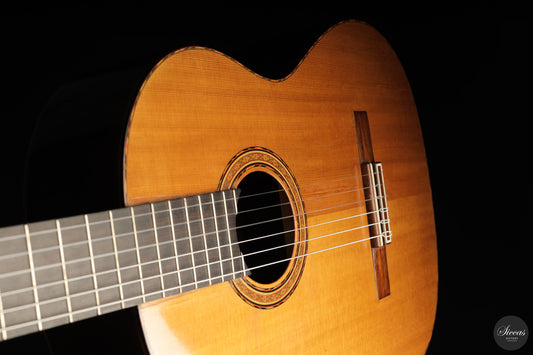
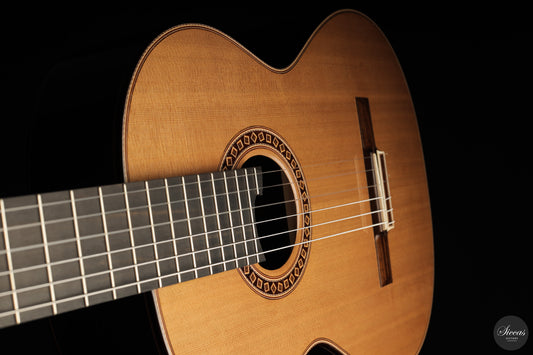
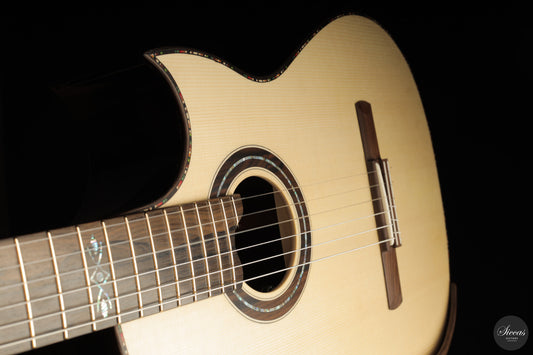
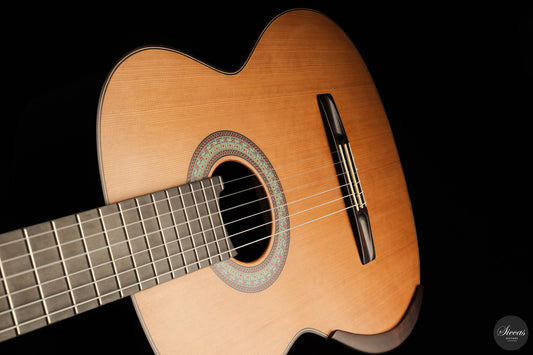
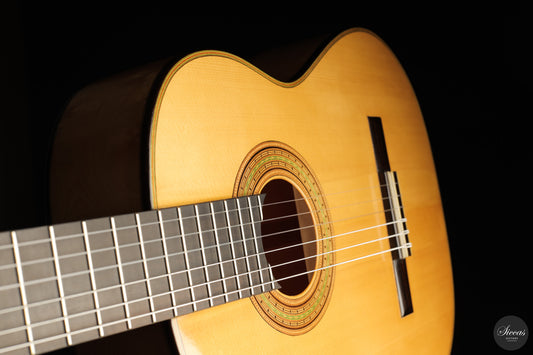
His instruments also carry the hallmarks of the German and French lutherie lineages. Where the Spanish tradition tends toward a particular flexibility and singing resonance, the German and French schools bring a structural clarity and dynamic precision that suit the demands of contemporary concert performance. Schebesta synthesizes these influences rather than selecting between them, and the result is a voice that is distinctly his own. A recurring feature of his builds is the elevated fingerboard — a modern refinement that improves access to the upper register without sacrificing the acoustic integrity of the top. This kind of considered detail reveals a maker who thinks carefully about what players actually need at the instrument.
For a broader look at how diverse construction philosophies have shaped the modern concert guitar, the article on fan-braced, double-top, and lattice guitars offers valuable context.
The Doubletop Turn
Since 2023, Schebesta has concentrated almost exclusively on doubletop construction, a method in which the soundboard consists of two thin veneers of tonal wood — typically cedar or spruce — bonded to an ultralight core, most often balsa or Nomex. This architecture produces a top of remarkable stiffness-to-mass ratio, enabling greater acoustic projection and responsiveness than a conventional single-ply top can achieve. The result, in Schebesta's hands, is a guitar that offers expanded dynamic range and a heightened clarity of attack without abandoning the warmth and tonal complexity he has always pursued.
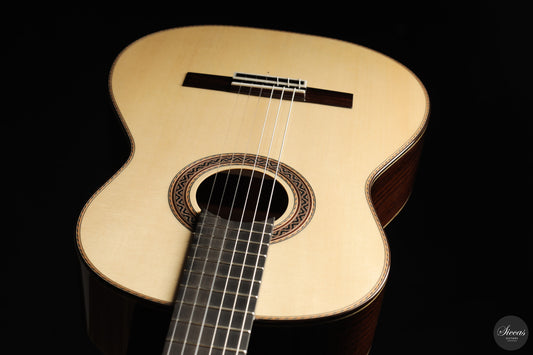
His doubletop instruments typically pair cedar soundboards with Indian rosewood back and sides, finished in French polish — a combination that produces a rich, nuanced palette well suited to a wide repertoire. Earlier instruments explored walnut as a back-and-sides timber, offering a somewhat brighter tonal response, and spruce-topped models have also appeared in his catalog. The use of Kris Barnett and Alessi tuning machines on his instruments reflects attention not only to playability but to the small material details that define a finished guitar's character.
The doubletop approach has become one of the defining developments in contemporary lutherie, with makers across Europe pushing its possibilities. The lineage runs through pioneers discussed in the article on double-top guitar pioneers, and Schebesta's work sits comfortably within — and advances — that tradition.
Legacy in Progress
Schebesta occupies an interesting position in the contemporary landscape of classical guitar makers. He works with the tools and knowledge of a long European lineage — one that includes towering figures such as Daniel Friederich, whose innovations in French lutherie redefined what the modern concert guitar could achieve — and yet his instruments are unmistakably products of the present moment. They address the technical and expressive demands of today's players, with features and construction choices calibrated to contemporary performance.
What distinguishes Schebesta among his peers is the clarity of his artistic purpose. His instruments are not simply well-made objects; they are conceived as tools for musical exploration, built to invite the player into the full expressive range of the instrument. That orientation — toward the player, toward music-making, toward sound — is apparent in every aspect of his work, from the choice of tonewoods to the geometry of the neck joint. As his output grows in volume and his doubletop craft continues to mature, Nils Schebesta is establishing himself as one of the most significant voices in German lutherie today.
Browse available Nils Schebesta guitars → in the Siccas Guitars collection.