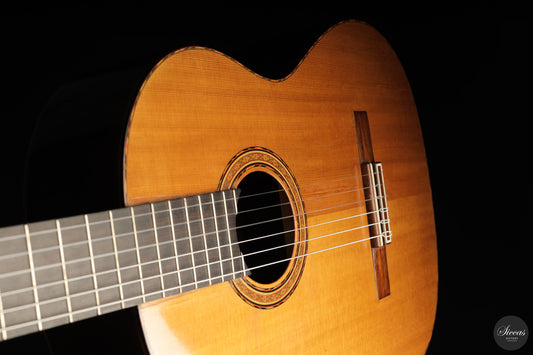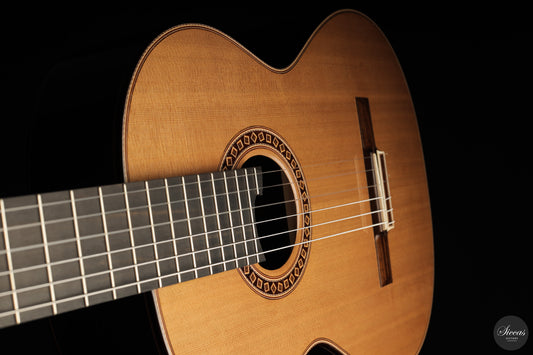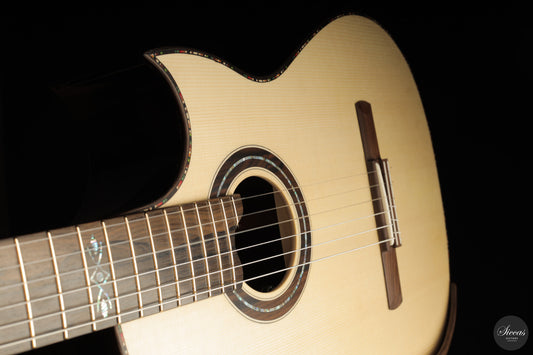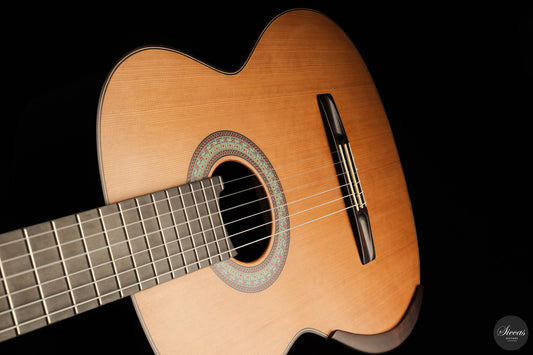

In the golden age of the Romantic guitar, one name stood above all others in Paris: René François Lacôte. Born in 1785 and active until his death in 1871, Lacôte built instruments for the most celebrated guitarists of his era — Fernando Sor, Dionisio Aguado, Ferdinando Carulli, Matteo Carcassi, and Napoléon Coste among them. Musicologist René Vannes, in his Universal Dictionary of Luthiers, did not hesitate to call him the "Stradivarius of the guitar." That comparison was not hyperbole. Lacôte's instruments combined meticulous craftsmanship with a restless spirit of invention, producing guitars that were not only beautiful objects but also tools precisely calibrated to the demands of the finest performers of his time.
Biography & Training
Lacôte came to lutherie relatively late in life. He was already approaching thirty when he began his apprenticeship under the Parisian luthier Joseph Pons, absorbing the technical foundations of instrument building during a period when the guitar was transforming rapidly from a parlour curiosity into a concert instrument of serious standing. By around 1820 he had established his own workshop on the Rue Montmartre, a street in the heart of Paris that placed him in direct proximity to the city's musical conservatory and close to the celebrated violin-making community — Vuillaume, Chanot, and Gand all worked nearby. That geographic and professional context was no accident. Lacôte understood that proximity to the city's finest musicians and craftsmen would sharpen both his reputation and his craft.
His workshop quickly gained a name for producing instruments of exceptional responsiveness and tonal clarity. The guitarists who came to him were not passive customers; they were virtuosos with precise ideas about what a great guitar should do, and Lacôte was, by all accounts, a luthier genuinely willing to listen. Fernando Sor wrote admiringly in his Méthode pour la Guitare that Lacôte was "the only person who, besides his talents, has proved to me that he possesses the quality of not being inflexible to reasoning." That openness to collaboration between maker and player became a defining characteristic of the Lacôte legacy.
Construction Philosophy
Where other makers of the period relied on fan bracing beneath the soundboard — a pattern that would eventually define the modern classical guitar tradition — Lacôte developed his own highly personal approach using ladder bracing: simple struts placed parallel to the bridge across the top. Far from a primitive solution, his ladder bracing was refined through years of experimentation, producing an instrument with a bright, immediate response ideally suited to the relatively lighter gut strings and smaller body proportions of the Romantic era.
Innovation ran through every aspect of his construction. His headstocks featured an enclosed tuning mechanism that housed the gears within the head itself, concealing the machinery and protecting it from wear while allowing, in certain designs, for single-handed tuning adjustment — a practical elegance that impressed both players and fellow craftsmen. Lacôte experimented with what he called "butterfly" pegs, and he refined the neck-heel joint and the method by which the neck was fitted into the upper block. He worked with solid mahogany and maple for his necks, materials chosen for their stability and tonal contribution rather than mere convention. The variety visible across surviving instruments — each one slightly different in some detail — testifies to a maker who never stopped questioning and refining his methods. As the romantic guitar tradition evolved across the first half of the nineteenth century, Lacôte's workshop stood at its technical frontier.
Signature Models and Surviving Instruments
Lacôte built guitars across a wide stylistic range, and the diversity of his output reflects both the demands of different players and his own experimental temperament. Among his most discussed models is what has come to be known as the "Legnani model," named after the Italian guitarist Luigi Legnani, which featured a larger body and particular structural details suited to a fuller tonal projection. Instruments from his workshop survive in important museum and private collections around the world, including at the Metropolitan Museum of Art in New York, and at the San Francisco Conservatory of Music. Guitars dated from the 1820s through the 1850s are known, each bearing the label "Lacôte, Luthier à Paris" and each revealing something slightly different about the evolution of his thinking.
His national profile was formally recognised when he won awards at the Great National Exhibitions of 1839 and 1844, acknowledgements by the French state that his workshop represented the pinnacle of the instrument-making craft. For collectors and scholars of early instruments, a Lacôte guitar is among the most significant objects a collection can hold — not only for its historical associations but for the direct evidence it provides of how guitars were built, played, and thought about during one of the most fertile periods in the instrument's history.
Notable Players
The roster of players who entrusted their performances to Lacôte guitars reads as a who's who of Romantic-era guitar. Fernando Sor, whose own compositions remain central to the classical guitar repertoire, was among the most prominent. Dionisio Aguado, Sor's great friend and rival, likewise performed on Lacôte instruments. Ferdinando Carulli, Matteo Carcassi, Napoléon Coste, and Marco Aurelio Zani de Ferranti — each a defining figure in the Parisian guitar world of the period — were also associated with his workshop. That so many leading guitarists of a single generation converged on one maker speaks to something beyond mere commercial success. Lacôte's guitars offered these musicians something they could not find elsewhere: an instrument that responded to their musical ideas with intelligence and precision.
The relationship between Lacôte and these players was often genuinely collaborative. Experimental features appearing on individual surviving instruments — particular refinements of the neck joint, variations in the internal bracing, or modifications to the tuning mechanism — are widely understood to reflect suggestions made by the performers themselves. This iterative dialogue between maker and virtuoso echoes the working relationships that produced so many landmark instruments across the history of lutherie, and it is part of what gives Lacôte guitars their documentary as well as musical value. Luthiers of later generations, including figures such as Robert Bouchet and Daniel Friederich, inherited a tradition of close collaboration between maker and performer that Lacôte helped to establish.
Legacy
René Lacôte died in 1871, having outlived many of the virtuosos for whom he built. His workshop had helped to define what a great guitar could be during the era in which the instrument reached its first peak of concert popularity. The guitars he built continue to be studied, played, and collected today — copied by contemporary makers who regard the Lacôte model as an essential reference point for understanding the acoustic and structural logic of the nineteenth-century instrument. His influence extends beyond any individual design or feature; it lies in the standard of craft and the depth of musical understanding that his instruments embody.
For anyone interested in the history of the guitar at its most inventive, a Lacôte instrument is an encounter with a maker who took nothing for granted and refined everything he touched. His willingness to collaborate, to experiment, and to serve the expressive needs of the musicians who relied on him sets a model that the finest luthiers of every generation have sought to follow. The label "Lacôte à Paris," found inside guitars that have survived nearly two centuries, remains one of the most respected marks in the entire history of the instrument.
Browse available René Lacote guitars → in the Siccas Guitars collection.