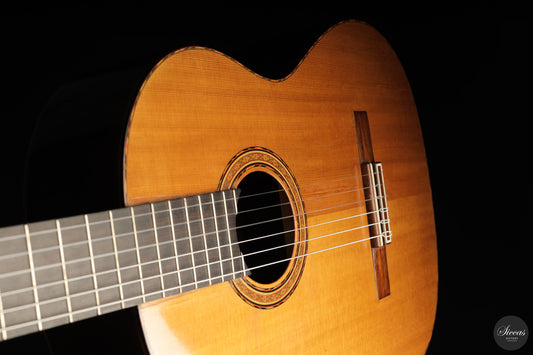
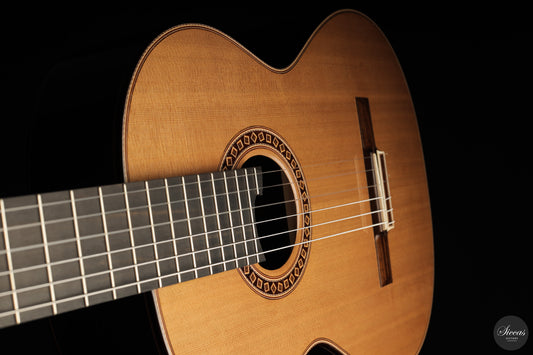
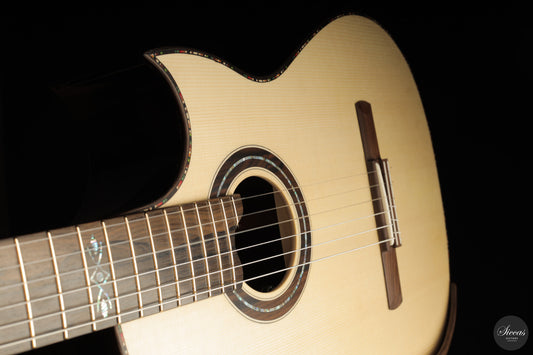
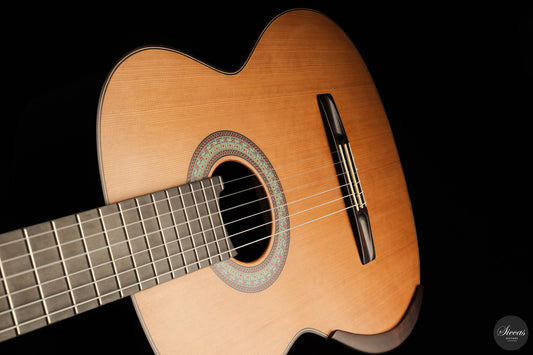
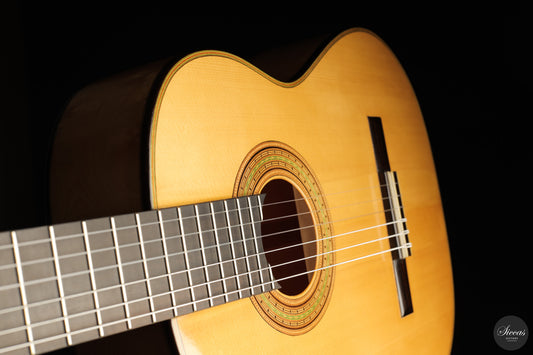
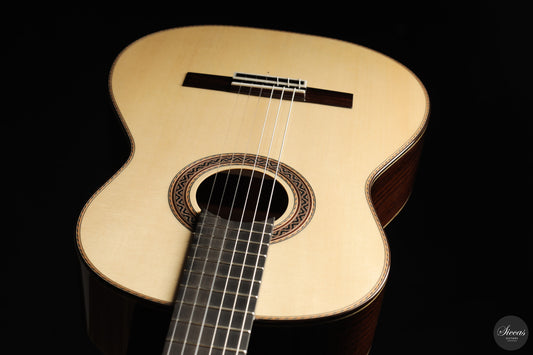
Few figures in the contemporary classical guitar world embody the deep connection between playing and building as fully as Reza Safavian. Born in Iran and later based in Germany, Safavian came to lutherie through the ears of a musician — a trained classical guitarist who grew frustrated searching for an instrument that could satisfy his exacting tonal standards. That frustration became a calling. Today, working from his workshop in Eppsteinhausen near Frankfurt am Main, he produces a strictly limited number of double-top concert guitars each year, and his instruments are considered by many specialists to rank among the finest available anywhere in the world.
Biography & Training
Reza Safavian grew up in Iran before moving to France in the early 1980s, where he first encountered the classical guitar with genuine seriousness. It was a televised concert by the German guitarist Wilfried Halter that proved decisive: so moved was Safavian by what he heard, he resolved to travel to Germany and study with Halter directly at Dr. Hoch's Konservatorium in Frankfurt. That decision would shape the rest of his life in ways he could not have anticipated. Frankfurt would become his permanent home, and the city's tradition of rigorous musical craft would leave its mark on everything he built.
His training as a guitarist gave Safavian something that relatively few luthiers possess from the outset: a performer's intimate understanding of how a concert instrument must feel and respond under the hands. He knew what projection meant not as an abstract acoustic goal but as the sensation of sound filling a recital hall. He understood sustain as a guitarist measures it — the dying fall of a note, the way a melody line can breathe or feel suffocated depending on the soundboard beneath the strings. These were the standards he would eventually hold his own instruments to.
The Path to Lutherie
The transition from player to maker was gradual, driven not by ambition but by dissatisfaction. Safavian found that the instruments available to him, however fine on paper, rarely met the tonal ideal he carried inside him from years of attentive listening and playing. The turning point came in 1996, when he encountered Matthias Dammann, one of the pioneering figures behind the modern double-top guitar. You can read more about Dammann's innovations and their influence on contemporary guitar building in the Siccas Guitars overview of double-top guitar pioneers.
Safavian purchased a Dammann guitar and was struck immediately by what the double-top construction could achieve: the transparency, the balance between registers, the way notes could project with power while retaining an almost vocal intimacy. He began studying the principles of double-top construction, combining that knowledge with his own sense of what a concert guitar should be. His first double-top guitar was completed in 2001. By 2003, he had committed to building instruments full-time, leaving performance behind to focus entirely on the craft.
Construction Philosophy
Safavian's approach to guitar building is rooted in the double-top tradition pioneered by Dammann and his contemporaries, but it reflects his own distinct sensibility. His soundboards typically use a cedar or spruce outer layer over a honeycomb Nomex core — the same basic architecture that defines the double-top family — but the specific thicknesses, bracing patterns, and tonal adjustments he applies are the result of years of experimentation informed by his musical background. For a broader understanding of how double-top construction works and what distinguishes it from fan-braced and lattice approaches, the Siccas Guitars guide to fan-braced, double-top and lattice classical guitars offers a thorough comparison.
What sets Safavian's instruments apart in the eyes of many players and critics is his ability to avoid the tonal imbalance that can afflict double-top guitars: a tendency toward darkness or muddiness, particularly in the bass register. Reviewers who have played his instruments extensively note that they achieve an unusual brightness-to-warmth ratio — luminous trebles that carry clearly across a concert hall, balanced against a bass that is rich without being overwhelming. Sustain, too, is consistently noted as exceptional, with notes holding and decaying in a way that suits a wide range of repertoire.
Aesthetically, Safavian's guitars are classical in their proportions and forms, but they carry subtle personal touches. His rosettes are frequently inspired by antique Persian decorative motifs — a quiet acknowledgement of his Iranian heritage woven into the visual identity of each instrument. Matching veneers and carefully chosen tonewoods ensure that each guitar is as beautiful to look at as it is to play.
Recognition and Reach
Safavian produces only a small number of guitars each year, and it is reported that most of them are already spoken for before they leave his workshop. This scarcity has done nothing to diminish demand — if anything, it has enhanced the reputation of each instrument as something genuinely rare. Specialists at concert guitar dealers who have tested his instruments against some of the most prestigious names in contemporary lutherie have placed them at the very highest level, comparing them favourably with instruments by other leading German makers.
The world of high-end concert guitars is a small one, populated by a handful of builders whose instruments circulate among professional players, collectors, and dedicated amateurs who understand what distinguishes a great guitar from a merely excellent one. Safavian has earned a secure place in that world, and his instruments have found their way into the hands of players across Europe and beyond. His trajectory — from a young man in Iran watching a televised guitar recital, to a Frankfurt-trained musician, to one of Germany's most respected luthiers — is a reminder of how deeply personal the craft of guitar making can be.
Those interested in understanding the broader lineage of great guitar builders whose ideas shaped the modern concert guitar will find much of interest in the Siccas Guitars profiles of figures such as Daniel Friederich and Ignacio Fleta, both of whom helped define the standards that makers like Safavian continue to push forward. And for those curious about how the most demanding concert players approach the instruments they choose, the Siccas Guitars piece on how concert guitarists practice offers an illuminating perspective on the relationship between performer and instrument.
Playing Style & Musical Influence
Although Safavian stepped back from performing to build full-time, his identity as a guitarist never left him — it migrated into his hands at the workbench. The guitars he makes are not the work of someone who builds by formula or who optimises for a single acoustic parameter. They are the work of someone who can hear what a guitar ought to sound like and who possesses the skill to realise that sound in wood. Players who have spent time with a Safavian instrument frequently remark on how naturally they respond: how little effort is required to draw a singing tone, how the dynamic range opens up under the fingers without resistance. These are the qualities a guitarist listens for, and they are qualities that only a guitarist-turned-luthier is likely to have made central to his craft from the very first instrument.
Reza Safavian's story is not simply the story of a skilled craftsman. It is the story of a musician who found, in the end, that the deepest way he could serve the music he loved was to build the instruments that bring it to life.