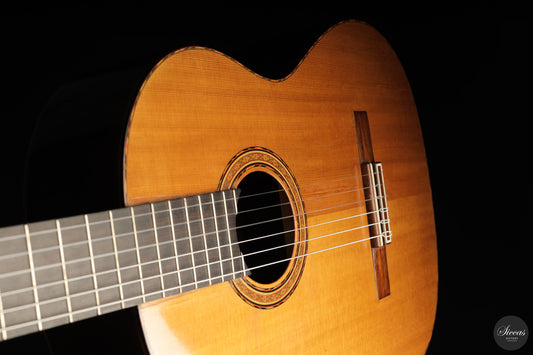
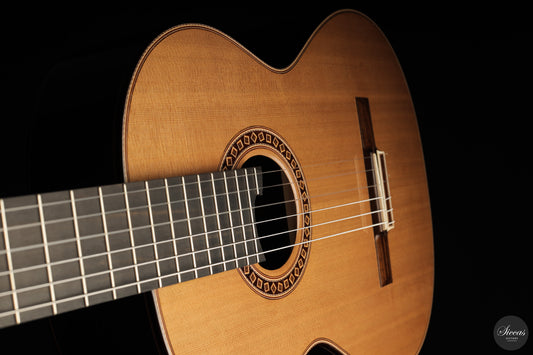
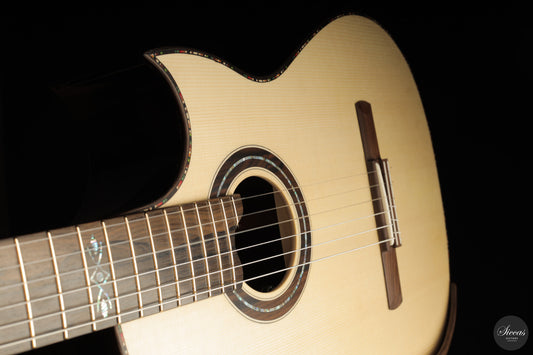
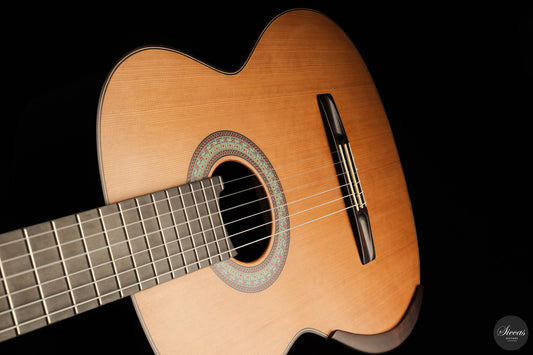
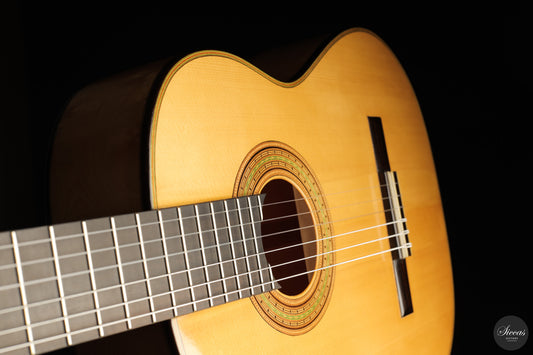
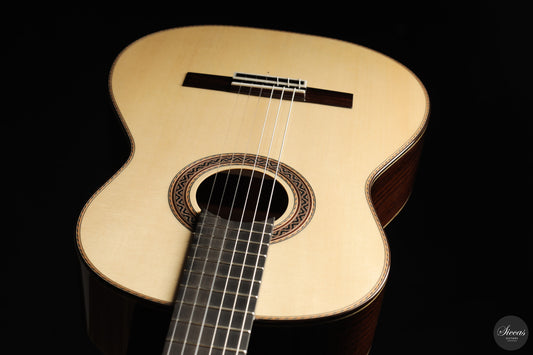
Rinaldo Vacca – Sardinian Master of the All-Wood Lattice Guitar
From the island of Sardinia, where ancient craftsmanship traditions run deep, Rinaldo Vacca has emerged as one of Italy's most distinctive voices in contemporary classical guitar making. Born in 1960 in Cabras, a small town in the province of Oristano, Vacca has spent four decades refining an approach to instrument construction that is both deeply personal and strikingly original — an all-wood lattice system that delivers concert-level projection without sacrificing the warmth and colour that define great classical tone.
Origins and Self-Taught Path
Vacca's route into lutherie was shaped not by formal conservatory training but by a love of the instrument and the kind of curiosity that cannot be satisfied by playing alone. His childhood friend Sandro Vargiu, with whom he shared a passion for the guitar, is credited with sparking the early impulse that eventually led Vacca to the workbench. Beginning in the late 1980s, he taught himself the craft through close observation, experimentation, and an increasingly obsessive study of how tonewoods behave under tension and vibration.
His earliest instruments followed the traditional Spanish model — a sensible starting point for any maker serious about the classical tradition. Yet Vacca found himself dissatisfied. The instruments he was producing were fine by conventional standards, but they did not answer the questions he was asking of the wood. Concert guitarists increasingly required instruments capable of filling large halls without amplification, and the fan-braced architecture, however refined, had limits that Vacca was unwilling to simply accept. He began to look elsewhere. To understand the broader landscape of bracing philosophies that has shaped the modern instrument, it is worth consulting the overview of fan-braced, double-top and lattice classical guitars.
The All-Wood Lattice: A Distinctive Philosophy
What sets Vacca apart from many of his contemporaries is a deliberate refusal to use carbon fibre or balsa wood in his lattice bracing — two materials that have become near-standard in modern high-output guitars. Instead, every element of his lattice structure is built entirely from wood. This is not merely a philosophical stance; it has direct sonic consequences. Wood lattices tend to produce a warmer, more complex overtone spectrum than carbon, and they age differently, often improving in character over time in a way that synthetic materials cannot replicate.
For his soundboard tops, Vacca favours torrefied spruce sourced from Val di Fiemme, a valley in the Trentino region of northern Italy with a centuries-long reputation for producing tonewoods of exceptional quality — the same forests that supplied Stradivari and Guarneri. Torrefaction, a process of controlled heat treatment, mimics the cellular changes that occur in aged wood, effectively fast-forwarding the maturation of the soundboard and delivering a responsiveness and openness normally associated with decades-old instruments. In some models Vacca has also worked with torrefied cedar, offering an alternative tonal palette that favours immediacy and warmth over brightness.
The result of these choices is an instrument of considerable power — capable of holding its own in the concert hall — yet one that retains the nuance, dynamic range, and tonal palette that serious repertoire demands. Vacca's goal, consistently stated, is to build loud guitars without losing any tonal colour. It is a deceptively simple ambition and an extraordinarily difficult one to fulfil.
Workshop Practice and Attention to Detail
Vacca works entirely alone in his Sardinian workshop, overseeing every phase of construction himself. This single-maker approach is a hallmark of the finest Italian lutherie tradition — one that connects him to a lineage of craftsmen who understood that consistency of quality is inseparable from continuity of hands. Each instrument bears a serial number, and his output reflects the pace of a maker who refuses to compromise execution for volume. By 2025 his numbered series had reached the mid-340s, a body of work built steadily over roughly three and a half decades.
Italian lutherie today encompasses a remarkable breadth of regional voices, from the Florentine school — represented by makers such as Andrea and Giovanni Tacchi — to the independent workshop traditions of the south and the islands. Vacca occupies a genuinely singular position within this landscape: a Sardinian maker whose instruments are sought by international concert artists, and whose construction philosophy places him among the most innovative practitioners working today. The broader context of this Italian tradition is explored in the story of Italica, a project that brought together twenty Italian master luthiers.
Notable Players
The true measure of any concert guitar is the quality of the musicians who choose to perform on it. By that measure, Vacca's reputation is unambiguous. Among the most prominent artists associated with his instruments is Kazuhito Yamashita, the Japanese guitarist widely regarded as one of the most technically formidable players of his generation, who has performed on a Vacca guitar since around 2017. His daughter Kanahi Yamashita, herself an accomplished concert artist, has also chosen Vacca instruments. Other performers documented using his guitars include Enea Leone, Jozsef Eotvos, and Salvatore Seminara — a roster that spans multiple generations and international markets, confirming the guitar's reputation well beyond Italy.
The choice of Vacca's instruments by players of this calibre speaks directly to the practical virtues of his all-wood lattice approach. Concert guitarists at the highest level cannot afford instruments that project well at the expense of expressive range, and the fact that artists known for interpretive depth as much as technical power have adopted his guitars is a form of endorsement that no award can replicate.
Legacy and Place in the Modern Tradition
The history of classical guitar making is populated by figures who transformed their craft by refusing to accept inherited limitations — makers like Daniel Friederich, who brought engineering rigour to the French tradition, or Robert Bouchet, the painter-turned-luthier whose sensitivity to tone remains a benchmark. Vacca belongs in that tradition of independent thinkers — makers who arrived at their own solutions by following the logic of the instrument wherever it led, rather than deferring to convention.
What is particularly remarkable about Vacca's trajectory is that it unfolded largely in isolation, on an island far from the established lutherie centres of Madrid, Paris, or even mainland Italy. Without institutional training, without proximity to a school or tradition he could simply adopt, he developed a coherent and original approach through sheer persistence and attentiveness. His guitars are the direct expression of that process — instruments whose character is inseparable from the particular mind and hands that built them.
For players seeking an instrument that combines the acoustic power of modern lattice construction with the tonal warmth and complexity only wood can provide, Vacca's guitars represent one of the most compelling propositions in contemporary lutherie. The all-wood lattice, the Val di Fiemme torrefied tops, the serial-numbered workshop output — each element reflects a maker who knows precisely what he is trying to achieve and has spent a lifetime developing the means to achieve it.
Browse available Rinaldo Vacca guitars → in the Siccas Guitars collection.