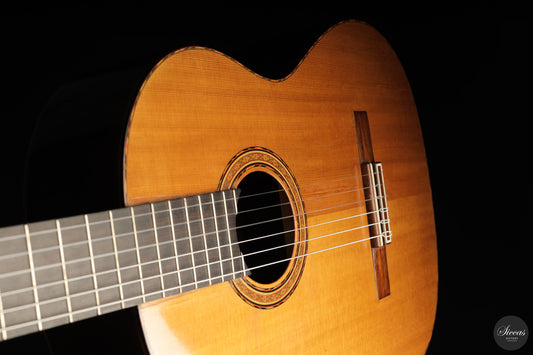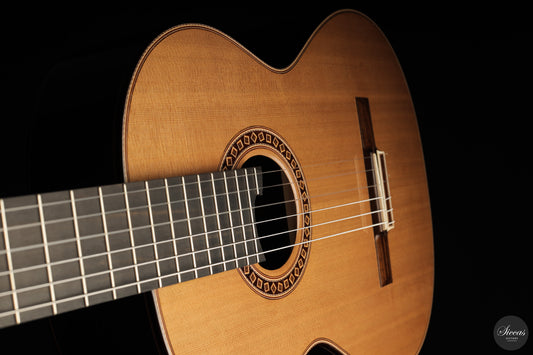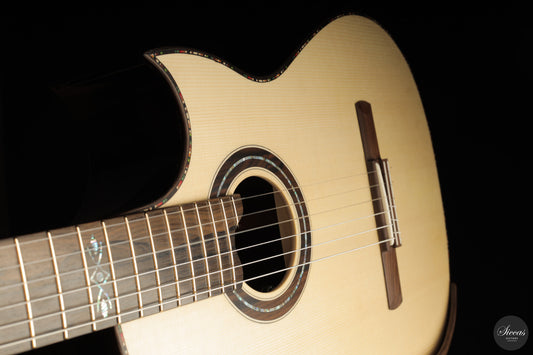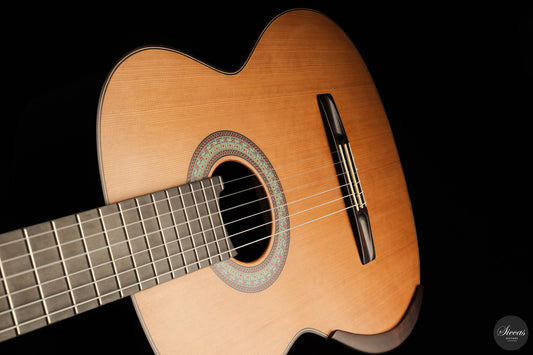

Robert Ruck – The Luthier's Luthier from Miami
Robert Ruck (1945–2018) stands among the most revered figures in American classical guitar making — a builder so respected by his peers that he earned the informal title "the luthier's luthier." Over more than five decades, he crafted well over a thousand instruments of extraordinary quality, shaped the practices of a generation of builders who followed him, and placed his guitars in the hands of some of the most celebrated concert artists of the twentieth and twenty-first centuries. His passing in August 2018 at the age of 72 left a void in the world of classical guitar makers that will not easily be filled.
Early Life and the Making of a Craftsman
Born in 1945, Robert Ruck came to guitar making through a combination of musical curiosity and hands-on apprenticeship. He settled in Miami, Florida, where he studied classical guitar with the late Juan Mercadal and immersed himself in the rich Hispanic musical culture of the city — even studying flamenco singing with Elena Marbella. This deep connection to both the instrument and the music it carries would inform everything he built. At around eighteen years old he began building guitars, and after a brief apprenticeship with an Irishman named John Shaw he was working professionally by 1966. From that moment, he never stopped.
Miami in the mid-1960s was not an obvious centre for classical guitar lutherie, but Ruck made it one. His proximity to the Latin musical community gave him an ear trained on flamenco and classical idioms alike, and it was through his teacher Juan Mercadal that he would soon be introduced to a young Cuban-born guitarist who would change both their lives.
Guitar No. 58 and Manuel Barrueco
Of all the guitars Ruck made in his long career, none is more famous than No. 58, completed in 1972 when he had been building for only about six years. Juan Mercadal introduced the teenage Manuel Barrueco to Ruck because Barrueco needed a better instrument than the one he was playing. What followed was one of the most celebrated partnerships between a maker and a performer in modern classical guitar history. Barrueco adopted No. 58 as his primary concert guitar and played it for years at the highest levels of international performance, allowing audiences worldwide to hear what a Ruck guitar sounded like in the most demanding of contexts. The association gave Ruck's name global recognition and demonstrated conclusively that American lutherie could compete with the great Spanish and European traditions.
Barrueco was far from the only world-class artist to trust Ruck's instruments. His guitars were also played by Sharon Isbin, Carlos Barbosa-Lima, Berta Rojas, Leo Brouwer, Gerardo Nuñez, Paulo Bellinati, Tilman Hoppstock, and members of the Romero family — Celedonio, Celin, and Pepe Romero among them. This remarkable roster speaks not just to the sound Ruck achieved but to the reliability and consistency that professional musicians demand from their instruments night after night on tour.
Construction Philosophy and Bracing Innovation
Ruck's approach to building evolved continuously throughout his career, but it was always grounded in deep respect for the Spanish tradition. He drew inspiration from the great European makers — the lineage that runs through Torres, Hauser, and on to figures such as Robert Bouchet and Ignacio Fleta — while developing his own systematic voice.
By 1985, Ruck had settled into three distinct bracing systems that he used selectively depending on the tonal goals of a given instrument. The first was a traditional six- or seven-fan brace pattern with a diagonal treble bar derived from a Torres layout. The second was his own Wide Brace System, a variation of the six- or seven-fan arrangement in which three of the normal fan braces are made significantly wider and lower, producing a different mass distribution across the soundboard. The third was a nine-fan system. His careful experimentation with these approaches allowed him to tailor each guitar's voice rather than simply replicating a fixed formula.
Among his lesser-known but genuinely forward-looking contributions was his early adoption of soundports — holes drilled into the upper bout of the guitar to allow the player to hear the instrument more directly. Ruck is credited by those who knew him as one of the first contemporary builders to take this step, a feature that has since become widely adopted and discussed in the context of fan-braced and modern classical guitar design. He was also meticulous about his choice of tonewoods, aging his materials carefully before committing them to an instrument.
A Voice in the Broader Lutherie Community
Ruck's influence extended well beyond his own workshop. He was one of the very first members of the Guild of American Luthiers and attended its founding convention in 1974, helping to shape the culture of craft knowledge-sharing that the organisation would come to represent. His generosity with knowledge and his willingness to mentor and encourage other builders made him a central figure in the American lutherie world for five decades.
The builders who cite him as a direct inspiration include Matthias Dammann — one of the pioneers of the double-top guitar — as well as Andres Marvi and many others. The fact that makers of such distinction count Ruck among their formative influences is itself testimony to the depth and originality of his thinking. He was, in the fullest sense, a teacher to his craft as much as a practitioner of it.
Away from the workshop, Ruck was a devoted practitioner of Bikram Yoga, and those who knew him noted that the meditative discipline of yoga complemented the focused, patient state of mind that great lutherie demands. He brought the same quality of attention to his personal life as he brought to selecting a piece of spruce for a soundboard.
Legacy
When Robert Ruck died on 13 August 2018, the tributes that poured in from luthiers, performers, and collectors around the world reflected a career of remarkable breadth and depth. He had built over a thousand guitars, mentored countless craftspeople, helped found an institution central to American lutherie, and placed his instruments at the summit of the concert world. His guitars continue to be played, traded, and treasured — each one a document of a singular sensibility that combined Spanish tradition with American independence of mind. In the company of the great postwar masters, alongside figures such as Daniel Friederich and José Luis Romanillos, Robert Ruck holds a permanent and honoured place.
Browse available Robert Ruck guitars → in the Siccas Guitars collection.