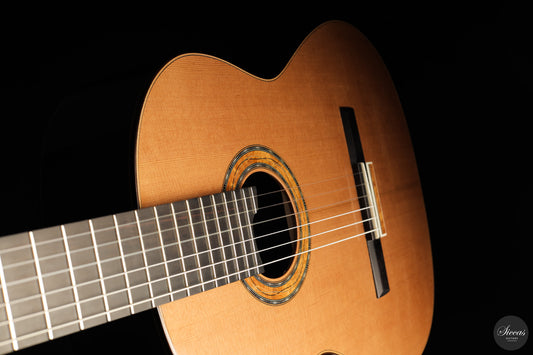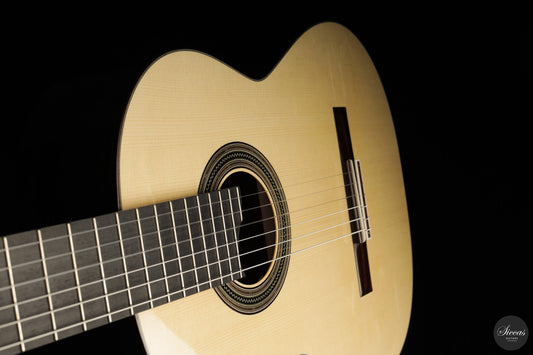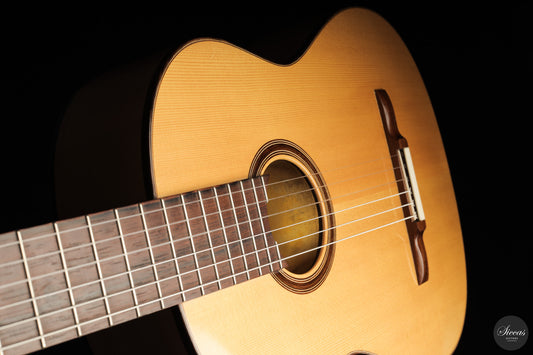

Roy Fankhänel – Master Luthier from the Ore Mountains
Roy Fankhänel is one of the most distinctive voices in contemporary German guitar making — a craftsman whose instruments carry the quiet authority of a centuries-old regional tradition while speaking in an unmistakably personal voice. Based in Oelsnitz in the Erzgebirge (Ore Mountains) of Saxony, Fankhänel has built a reputation for instruments that blend impeccable construction with tonal versatility, drawing professional performers and serious amateur musicians from across the classical guitar world.
Roots in a Region of Makers
The Erzgebirge region has been synonymous with instrument making for hundreds of years. Its neighbouring town of Markneukirchen grew into one of Europe's great centres of lutherie, producing craftsmen whose skills were passed through generations in workshops and specialist schools. It was in this tradition that Roy Fankhänel began his formal training. He studied at the Vocational Secondary School for Musical Instrument Construction in Klingenthal, a school that has long served the region's instrument-making community, before completing his apprenticeship in the workshop of master luthier Armin Gropp in Markneukirchen. Under Gropp's guidance, Fankhänel absorbed both the technical rigour and the subtle sensibility that define the best instruments to emerge from the German tradition.
Following his apprenticeship, Fankhänel pursued his master certification — the formal qualification that marks the highest tier of German craft training — and since 2012 has operated his own Meisterwerkstatt (master workshop) at Pflockenstraße 15 in Oelsnitz. The workshop sits within a landscape that has shaped instrument makers for generations, and that historical depth is not lost on him. Each guitar he produces is built by hand, from the initial selection of tonewoods through to the final setup, with no step delegated or mechanised.
Construction Philosophy and Signature Approach
Fankhänel's approach to guitar construction begins long before the first cut of wood. He works closely with each customer to understand their tonal preferences, physical requirements, and aesthetic sensibilities, then translates those wishes into every dimension of the instrument. The process of customisation starts with wood selection — a choice that determines much of the guitar's eventual character — and extends through ornamental details, rosette design, headstock shape, and scale length, all of which can be tailored to the player's needs.
The soundboard, which Fankhänel considers decisive for tonal character, is offered in both European spruce and cedar, each lending the instrument a different expressive register. For the back and sides he works with a wide range of tonewoods: traditional choices such as Honduras, Madagascar, and East Indian rosewood sit alongside cocobolo and katalox, but he is equally comfortable working with native European timbers — maple, walnut, robinia, and a variety of fruitwoods that connect his instruments to the forests of the Erzgebirge itself. This breadth of material knowledge reflects a builder who understands that the guitar's voice is always a dialogue between the maker's hands and the wood's own properties.
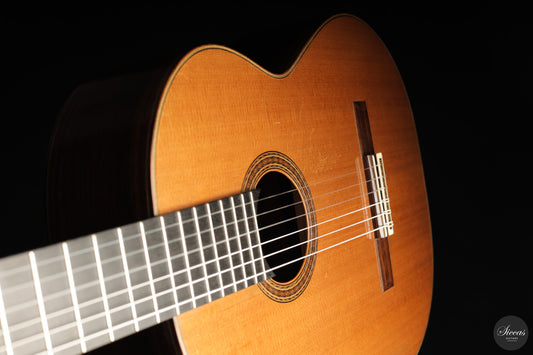
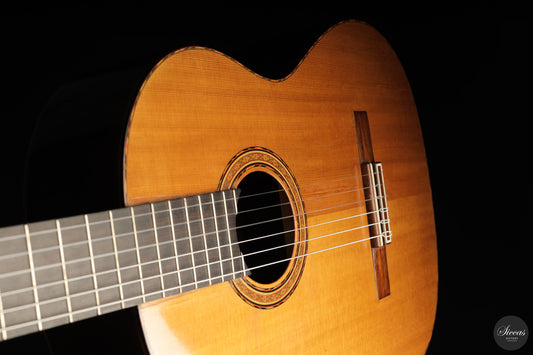
Among the technical features that define his instruments, the elevated fingerboard with a slight radius stands out as both a practical and aesthetic signature. This detail, combined with his characteristic V-joint at the neck-to-head transition and meticulously executed rosettes, gives Fankhänel guitars an immediately recognisable profile. His instruments are widely praised for their easy playability — a slightly radiused neck profile and precise action make them responsive instruments for professional virtuosos and advancing students alike. The sound is characterised by clear articulation, well-balanced basses, and a brilliant treble register that rewards expressive playing at all dynamic levels. For players requiring a more comfortable reach, Fankhänel also builds instruments with a 64 cm reduced scale length without compromising tonal depth.
This synthesis of individual customisation and consistent craft quality places Fankhänel's work in a tradition of classical guitar makers who treat lutherie as a collaborative art between builder and player. The best instruments from this tradition — think of the great French makers such as Robert Bouchet or Daniel Friederich — have always been shaped by dialogue with the performers who played them.
Models and Notable Instruments
Fankhänel assigns sequential RF model numbers to his guitars, a system that documents his output chronologically and allows players and collectors to trace the evolution of his craft over time. Instruments from the RF 140s through the RF 220s span more than a decade of continuous development. Among the most admired examples are guitars built with bear-claw spruce tops — a rare figuring in the grain that contributes both visual drama and a particularly resonant tonal quality — paired with exotic back and side woods such as katalox and cocobolo. These instruments represent the upper tier of his production, combining the finest available materials with construction refinements accumulated over years of building and listening.
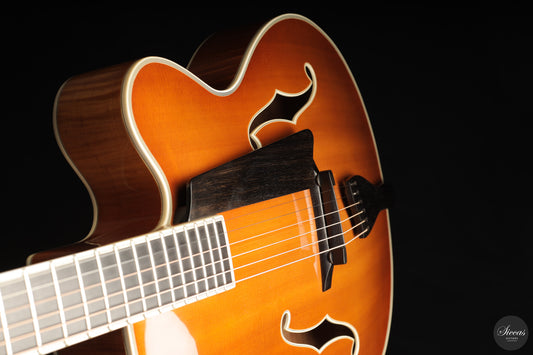
His guitars are not limited to the classical concert instrument. Fankhänel also builds steel-string acoustic and electric guitars, and his workshop has attracted commissions from players well beyond the classical world. Among his more widely reported projects, he has built instruments for the guitarist of Die Toten Hosen, the celebrated German rock band — a testament to the versatility of his craft and the reach of his reputation across musical boundaries. The classical guitarist Heike Matthiesen is among the professional players who have chosen Fankhänel instruments for concert performance.
A Workshop Tradition in the Modern Era
What makes Fankhänel's position in contemporary lutherie particularly interesting is the way he balances inherited regional tradition with openness to material and formal experimentation. The diversity of bracing approaches and construction systems available to modern luthiers is considerable, yet Fankhänel has developed a coherent personal voice rather than simply following fashion. His instruments are marked by a directness of sound — clear, powerful, and immediate — that reflects a builder more interested in serving the music than in demonstrating technical novelty for its own sake.
The Erzgebirge workshop tradition from which he emerged has historically been associated with quantity production, but Fankhänel represents its finest expression: the individual master craftsman working at the highest level of quality for a discerning international clientele. In this respect, his work shares something with the great Spanish masters — the seriousness of purpose found in the workshops of Ignacio Fleta or José Luis Romanillos — even as it remains rooted in a distinctly German craft heritage.
Browse available Roy Fankhänel guitars → in the Siccas Guitars collection.