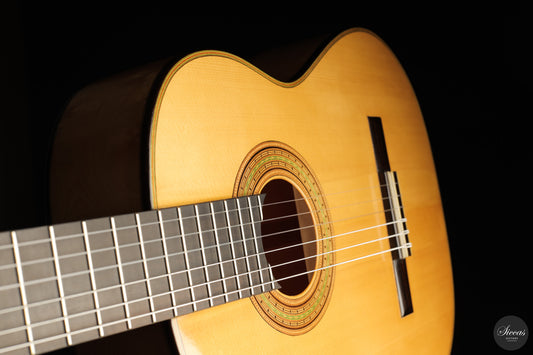
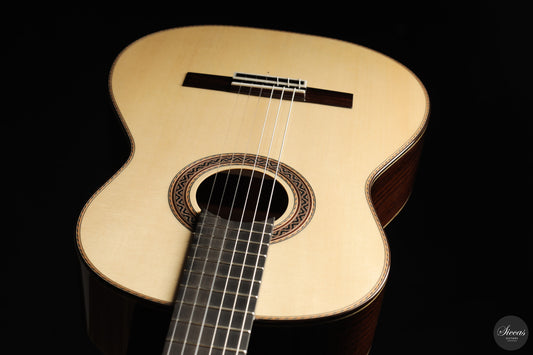
Sebastiano Fracasso – Italian Luthier from the Veneto
Sebastiano Fracasso is one of the most compelling voices to emerge from Italy's contemporary classical guitar-making scene. Working from his workshop in Chiampo, a small town in the Vicenza province of the Veneto, Fracasso builds instruments that are at once deeply rooted in tradition and unmistakably personal — guitars that carry the weight of the landscape around him and the precision of a rigorous formal education. Though still early in his career, he has already attracted serious attention from players and collectors seeking instruments of exceptional tonal clarity, lightness, and artistic intention.
Formation and Mentorship
Fracasso's path into lutherie followed one of Italy's most respected formal routes: the Civica Scuola di Liuteria di Milano, where he studied the construction of traditional plucked instruments. The Milan school, long regarded as a benchmark institution for stringed instrument making in Italy, gave him a rigorous grounding in both historical methods and acoustic principles. But it was the time spent in working workshops that truly shaped his approach.
After graduating, Fracasso sought out direct apprenticeships with established makers. In Milan he worked alongside Roberto de Miranda, gaining exposure to the practical demands of classical guitar construction and restoration. He then moved to the workshop of Ennio Giovanetti in Gropparello, near Piacenza, deepening his understanding of tonal refinement and structural integrity. He also spent time with steel-string maker Emanuele Faggion in Trissino, broadening his experience with repairs and alternative construction techniques. Together these formative relationships gave Fracasso a foundation that blends institutional knowledge with the kind of hands-on, observational learning that cannot be taught in a classroom. Italy's long lineage of master builders — a tradition explored in depth on the Classical Guitar Makers overview — runs clearly through his development.
A Philosophy of Lightness and Meaning
What immediately sets Fracasso apart is his commitment to instruments that are physically light without sacrificing resonance or projection. His design philosophy holds that a guitar should respond with immediacy — that the player's touch should translate directly into sound without resistance or delay. This emphasis on lightness is not simply an aesthetic preference but a structural conviction: he believes that reducing mass while preserving rigidity unlocks a fuller range of tonal color and dynamic nuance.
Fracasso selects his tonewoods with exceptional care. Alpine spruce tops — some aged for decades — are chosen for their density and grain consistency. Back and sides may be Indian rosewood for warmth and balance, or Canadian birdseye maple for brightness and projection. His bracing draws on Torres-inspired fan patterns, a nod to the foundational tradition that continues to define the classical guitar's sonic identity, as discussed in the guide to Fan-Braced, Double Top and Lattice Guitars. Finishing is done in French polish, a method that preserves the acoustic sensitivity of the top and gives each instrument a luminous visual quality.
Equally distinctive is the personal dimension Fracasso brings to each guitar. Inside every instrument he places a unique, hand-written inscription — a quiet act of authorship that connects the maker to the moment of creation and to the player who will eventually receive the guitar.
Signature Models: Dolomia, Caparbia, and Arenaria
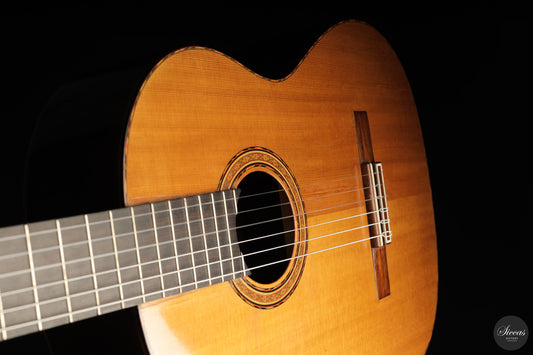
Fracasso names his models after the natural world of northern Italy, and each name carries deliberate meaning. The Dolomia takes its inspiration from the Dolomiti and Piccole Dolomiti mountain ranges that define the landscape of his region. The goal of this model is bold: a guitar of deep, resonant basses, a sweet singing treble, and an overall body resonance tuned around the note E. The name itself — derived from the geological term for the rock that forms the Dolomite peaks — anchors the instrument in something ancient and enduring.
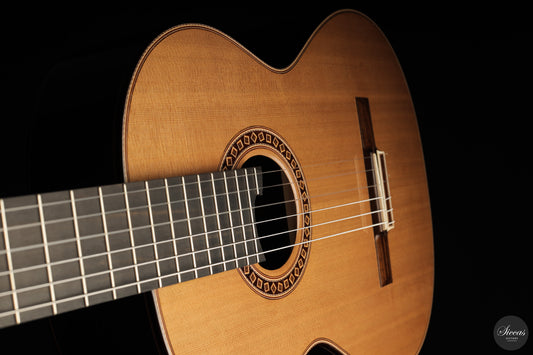
The Caparbia, whose name translates from Italian as "stubborn" or "stubbornness," is designed with a specific performance context in mind. It is built to project into the silence of a large concert hall — to fill space without forcing the player to push. The stubbornness of the name suggests a guitar that refuses to be overlooked, one that asserts its presence through tonal richness and clarity rather than sheer volume. Fracasso builds the Caparbia to be highly responsive and immediate, a tool for the soloist who needs both intimacy and power.
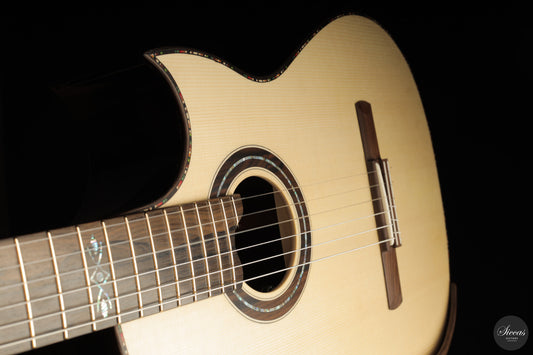
The Arenaria, his more recent model, is named after sandstone — the sedimentary rock formed through millennia of compression and geological process. Fracasso conceived the Arenaria as, in his own words, "an uncompromised tool made for serving music." The model reflects his passion for climbing, connecting the physical act of moving through rock and mountain to the act of making a guitar that is honest, functional, and free of decoration for its own sake. It is perhaps his most direct statement of artistic intent: an instrument stripped to its essential purpose.
Recognition and Presence
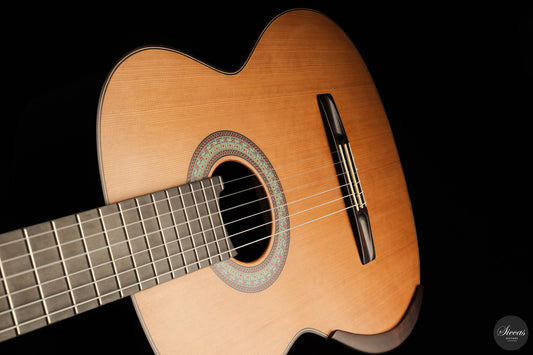
Despite his relative youth as a maker, Fracasso has been described by experienced players as producing some of the most exciting guitars they have encountered in recent years. His instruments have appeared at Roma Expo Guitars 2026, one of the most significant gathering points for contemporary luthiers in Italy, where his guitars were noted for their even, balanced tone and refined build quality. At events like this, Fracasso has shown multiple configurations of his models — including a special edition with birdseye maple and an Indian rosewood version — demonstrating that his approach produces consistent results across different material choices.
The Italian lutherie tradition to which Fracasso belongs is a rich one. Makers from across the peninsula — from Florence, Rome, and the Po Valley — have contributed significantly to the classical guitar's development, as evidenced by collaborative projects such as the Italica guitar built by twenty Italian master luthiers, and by the Florentine tradition represented by Andrea and Giovanni Tacchi. Fracasso's work from the Veneto adds a distinct regional voice to this chorus — one inflected by the mountains, the rock, and the quiet discipline of a maker who takes his time.
A Maker to Watch
Sebastiano Fracasso represents a generation of Italian luthiers who bring both scholarly grounding and genuine artistic personality to their craft. His guitars are not produced in large numbers; the limited annual output ensures that each instrument receives full attention from conception to final adjustment. For players seeking something beyond the familiar — a guitar that carries the maker's landscape within it, that responds with immediacy, and that bears a handwritten inscription as a mark of its individuality — Fracasso's work offers something rare. The tradition he draws on stretches back through the great Iberian and Italian makers who defined the classical guitar, figures such as Ignacio Fleta and José Luis Romanillos, and he carries that lineage forward with quiet confidence.
Browse available Sebastiano Fracasso guitars → in the Siccas Guitars collection.