
So Kimishima – Heir to Japan's Greatest Guitar-Making Dynasty
So Kimishima occupies a singular position in contemporary classical guitar making: as the grandson of Masaru Kohno — the most celebrated Japanese luthier of the twentieth century — he carries one of the most storied lineages in the instrument's history. Yet Kimishima is far more than an inheritor of a name. Through years of rigorous training at the legendary Kohno-Sakurai workshop and a deeply personal, scientifically informed approach to construction, he has forged an artistic identity entirely his own, producing guitars that are already in the hands of the world's finest concert artists.
A Dynasty Rooted in Tokyo
The story of So Kimishima's craft begins with his grandfather. Masaru Kohno (1926–1998) trained in Spain under Arcangel Fernández in the late 1950s and returned to Tokyo to establish a workshop that would change the history of the instrument. His guitars won the Gold Medal at the prestigious Elizabeth's Concours International in Belgium in 1967 and were played and recorded by guitarists of the stature of Julian Bream, Oscar Ghiglia, and Sharon Isbin. Kohno demonstrated that a non-Spanish maker could produce concert instruments of the very highest order — a revelation that permanently broadened the world's understanding of where fine classical guitars could come from.
After Masaru Kohno's death in 1998, the workshop was entrusted to Masaki Sakurai, who had worked alongside Kohno for decades and whose instruments continued to evolve the tradition. When So Kimishima joined the Sakurai-Kohno workshop in 2007, he entered this environment as both student and, on his mother's side, a direct member of the founding family. He spent fifteen years working and training under Masaki Sakurai, absorbing the master's understanding of bracing geometry, acoustic theory, and the disciplined craft of Spanish-style construction that underpins the entire Kohno lineage. The depth of that formation is evident in every instrument Kimishima makes today. For a broader view of where this tradition sits within the wider world of lutherie, the classical guitar makers overview offers useful context.
A Scientific Sensibility, a Personal Voice
In 2021, with Masaki Sakurai's endorsement of the quality of his work, So Kimishima began building guitars under his own name. The transition was not a departure from tradition but a considered extension of it. Kimishima's working method draws directly on his analysis of wave propagation and soundboard vibration across the frequency spectrum. Rather than applying a single bracing design to every instrument, he adapts the internal architecture to the specific tonal characteristics of each top, believing that spruce and cedar respond differently to bracing geometry and that a thoughtful maker should nuance the construction accordingly. This approach — systematic, empirical, yet rooted in sensory judgement — reflects his dual inheritance from Kohno's tonal ideals and Sakurai's more analytical working style.
Before settling on his current designs, Kimishima built approximately fifty prototype instruments, using each one to test and refine his understanding of how structural choices translate into acoustic outcomes. The result is a guitar-making philosophy that is at once grounded in one of the great Japanese traditions and genuinely innovative. His instruments draw on the warm, singing character of Kohno's finest guitars from the 1950s and 1960s while incorporating the constructional refinements he absorbed from Sakurai — a lineage that places him in direct conversation with the masters covered in our article on Double-Top Guitar Pioneers and the broader history of acoustic innovation.
The Stella – Kimishima's Signature Model
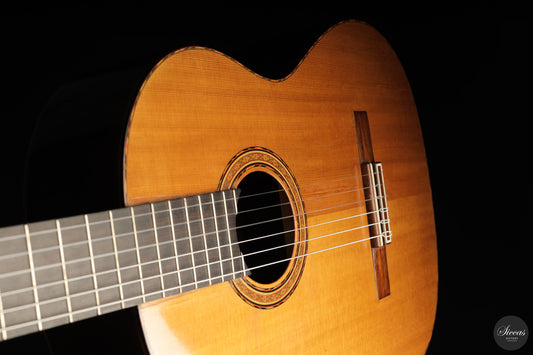
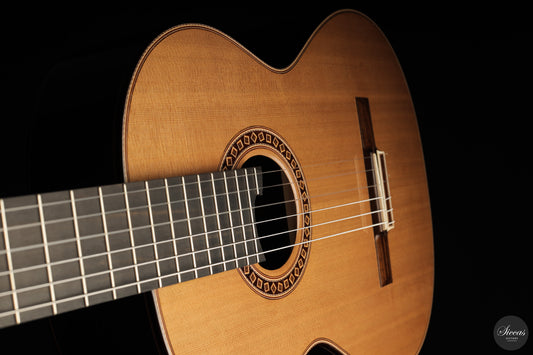
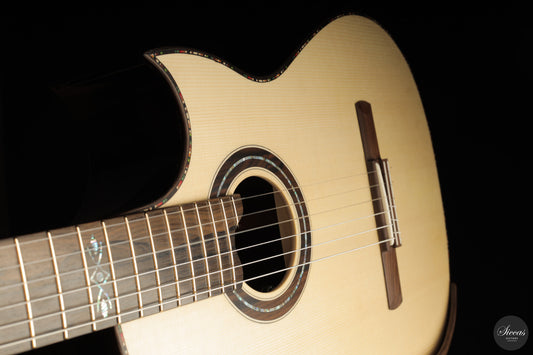
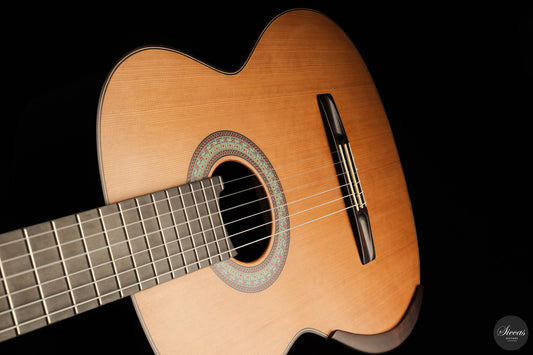
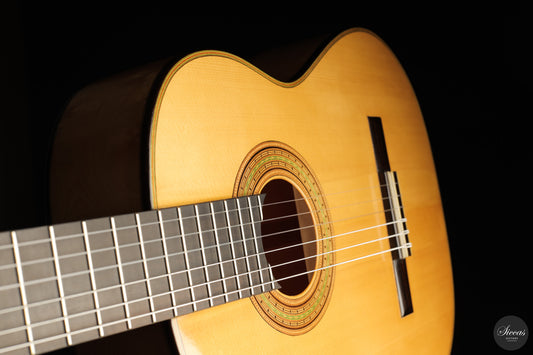
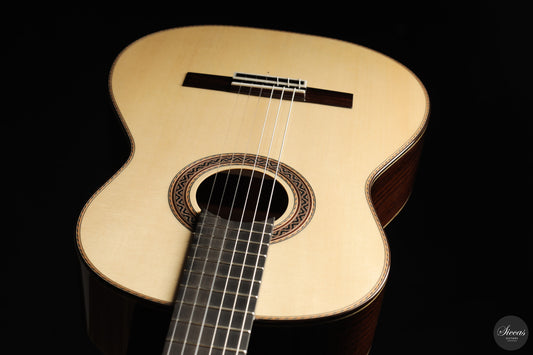
So Kimishima's primary model is named the Stella, and it is available in two distinct lines. The Stella Classic is oriented toward a traditional, warm, and balanced sound that traces its roots to the Kohno instruments of the mid-twentieth century. The Stella Normal is tuned for enhanced projection and a more pronounced high-register presence, making it particularly suitable for concert work in larger halls. Both versions are offered with tops in either European spruce or cedar, and in each case Kimishima adjusts the internal bracing to suit the tonewood — a practice that sets his instruments apart from makers who apply a single standard template regardless of material.
The Stella's construction follows the Spanish school: cedar or spruce top, Indian rosewood or similar back and sides, and the careful attention to neck-set and scale length that characterises the Kohno workshop's output. The scale length is typically 650 mm, though Kimishima also builds a 640 mm variant for players who prefer a slightly more compact reach. Tonal consistency, responsive dynamics, and a singing sustain are the qualities most frequently cited by players and reviewers who have spent time with these instruments.
Notable Players and Concert Endorsement
The most prominent advocate of So Kimishima's work is Shin-Ichi Fukuda, widely regarded as one of the greatest living classical guitarists. Fukuda — who has a long association with the Kohno-Sakurai workshop going back to Masaki Sakurai's instruments — chose a Kimishima Stella as his concert and recording guitar for his album of guitar duos with Eduardo Fernández, entitled Les Deux Amis, and for a series of concert performances in Japan and the United States in 2024 and 2025. The endorsement by an artist of Fukuda's calibre is significant: it places Kimishima's work in a lineage of concert instruments that stretches back through the Kohno era, when the workshop's guitars were trusted by Bream, Ghiglia, and Isbin.
The fact that Fukuda chose a Kimishima for a major recording project is not merely a mark of personal affinity. It is a statement about the instrument's professional reliability and tonal authority — qualities that matter enormously when a guitarist is committing a performance to a permanent record. For the broader tradition of Japanese guitar making and how it relates to the European schools pioneered by figures such as Daniel Friederich and Robert Bouchet, the story of So Kimishima offers a compelling counterpoint — proof that the finest concert instruments are now built on every continent.
Legacy and the Living Tradition
So Kimishima's position in the world of classical guitar lutherie is still in its early chapters. He launched his independent label only in 2021, yet his instruments are already sold internationally and sought by leading concert artists. His significance lies not only in what his guitars sound like today but in what his emergence represents: the continuation of a Japanese tradition that Masaru Kohno built from almost nothing in the post-war decades, and that Masaki Sakurai sustained and deepened over the following generation. The Kohno-Sakurai-Kimishima lineage is, by any measure, one of the most remarkable in the history of the instrument.
What distinguishes Kimishima from a maker who simply perpetuates an inherited style is the evident willingness to question, experiment, and refine. The fifty prototypes, the bracing variations, the spectral analysis — these are not the habits of someone coasting on a famous name. They are the habits of a craftsman who takes the responsibility of that inheritance seriously and intends to justify it through the quality of the work itself. In that sense, So Kimishima stands among the most thoughtful and promising members of the current generation of classical guitar builders, whatever their national tradition.
Browse available So Kimishima guitars → in the Siccas Guitars collection.