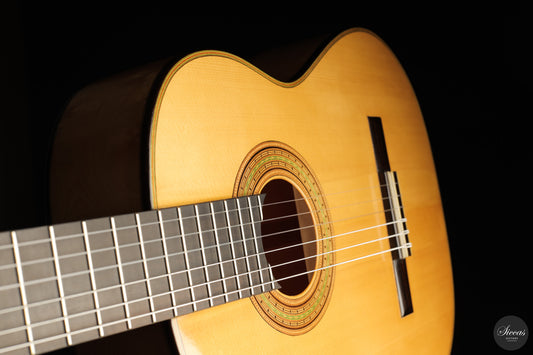
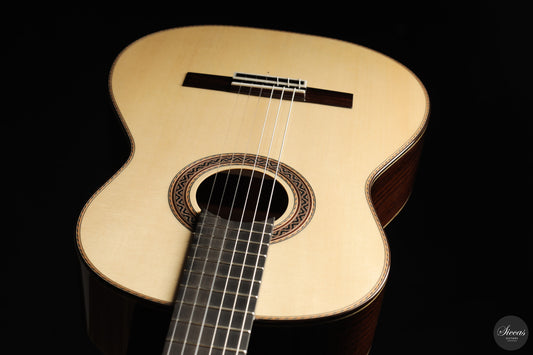
Stephan Connor – American Luthier and Pioneer of the Sound Portal
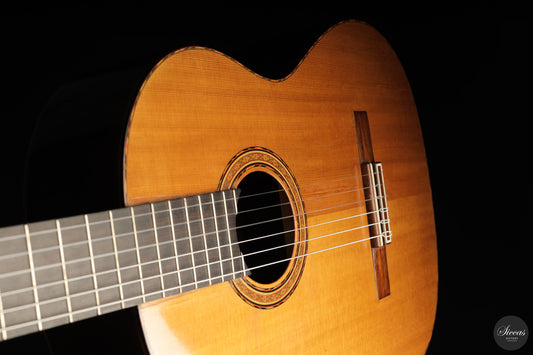
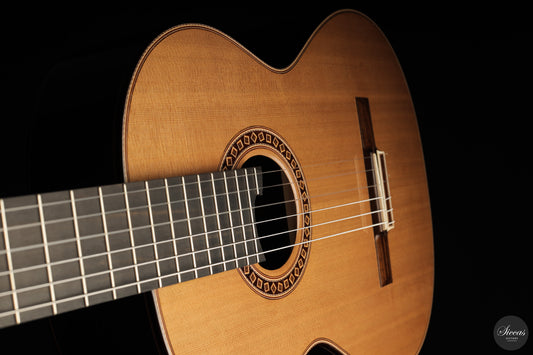
Stephan Connor is one of the most distinctive voices in contemporary classical guitar making. Working from his workshop on Cape Cod in Cataumet, Massachusetts, he has spent more than three decades refining an approach to instrument building that combines deep roots in the Spanish tradition with genuinely original innovations — most famously the Sound Portal, a side opening that acts as a personal monitor for the player. His guitars are played on concert stages worldwide, trusted by some of the most celebrated names in classical guitar.
From Ohio to Cape Cod – The Making of a Luthier
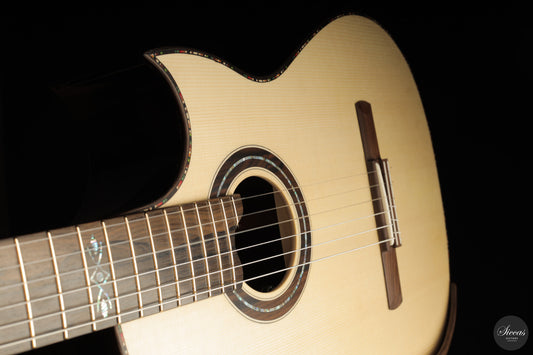
Connor's path to guitar making began at the College of Wooster in Ohio, where he pursued a music major and discovered a passion for woodworking. These two interests converged naturally: after graduating in 1994, he enrolled at Timeless Instruments, a respected guitar-making school in Saskatchewan, Canada. His formal training gave him a thorough grounding in the craft, but even before he finished his studies, his restlessly inventive mind was already pushing beyond convention. In 1993, while still thinking through the problems guitarists face on stage — chiefly the difficulty of hearing themselves clearly without amplification — he drilled a hole in the side of an inexpensive guitar. The result was a revelation: a focused channel of sound directed toward the player's ear without compromising the instrument's projection into the concert hall. The Sound Portal was born.
Since establishing his workshop, Connor has built approximately eighteen instruments per year, a deliberate output that allows him to give each guitar individual attention. That discipline has earned him a reputation for consistency that few makers can match. Like the great makers of the French and Spanish traditions — figures such as Robert Bouchet or Ignacio Fleta — Connor treats each instrument as a long-term statement rather than a product to be rushed.
Construction Philosophy – Lattice Bracing, the Sound Portal and a Voice All His Own
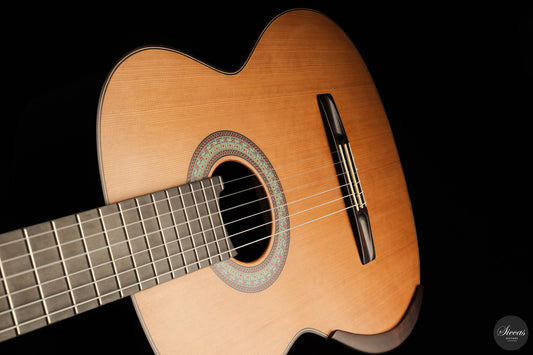
The aesthetic foundation of Connor's guitars is rooted in the Spanish tradition, with its emphasis on responsiveness, tonal balance, and intimacy of voice. Yet his construction choices have evolved into something distinctly personal. His hallmark all-wood lattice bracing system — a subtle combination of fan-bracing logic and lattice geometry — provides the instrument with exceptional lightness and structural integrity at once. The result is a guitar capable of remarkable projection and dynamic range while retaining the warmth and tonal complexity that concert repertoire demands. Connor himself describes his house sound as "exuberant, punchy, rambunctious, strong" — a guitar with singing trebles that carry color and nuance even in the upper registers.
The Sound Portal, the elliptical opening cut into the upper bout on the player's side, remains his most celebrated innovation. It functions as a precision monitor, channeling a focused stream of the instrument's voice directly toward the performer. On instruments built to order, Connor fits the portal with a magnetized door that can be closed fully or partially, allowing the player to adjust the blend between personal monitoring and hall projection depending on the acoustic of the venue. This practical intelligence — solving a real performer's problem with an elegant structural answer — is characteristic of his thinking. For readers interested in how bracing choices shape the character of an instrument, the broader context is explored in the guide to fan-braced, double-top and lattice guitars.
Notable Players – A Who's Who of Classical Guitar
The roster of artists who have chosen Connor guitars for their concert careers reads like a survey of the finest classical guitarists of the past three decades. His breakthrough came roughly ten years into his career, when the legendary American guitarist Eliot Fisk tried instrument number 74 and immediately committed to performing on it. Word spread quickly: soon after, the guitarist Angel Romero — having heard Fisk's new instrument — reached out directly. From there, the list of Connor players grew to include Sergio and Odair Assad, Scott Tennant, Marco Tamayo, Anabel Montesinos, Jose Maria Gallardo, and David Tannenbaum, among many others. These are not peripheral endorsements: these are artists who rely on their instrument for their livelihood and reputation, and their sustained loyalty to Connor's work speaks to the consistency and quality of his output. Connor has spoken openly about the particular satisfaction he finds in working with younger artists as well, offering them instruments that can grow with their careers.
Legacy and Place in American Lutherie
Stephan Connor occupies a singular position in the landscape of classical guitar makers. He is the most prominent American luthier working in the concert classical tradition, a field long dominated by European — and especially Spanish — workshops. His achievement has been to absorb that tradition deeply and then extend it on his own terms, producing instruments that feel native to the repertoire while sounding unmistakably like themselves. The Sound Portal, once a curiosity, has since been adopted in various forms by other builders around the world, a mark of genuine influence. His all-wood lattice approach has been noted alongside innovations by other contemporary makers who have pushed bracing design forward, including those working in the double-top tradition.
What makes Connor's story particularly compelling is its consistency: more than thirty years of focused, disciplined work in a single workshop, building guitars by hand for some of the most demanding players in the world, refining and deepening a voice rather than chasing trends. His instruments are not simply tools; they are the product of a sustained conversation between a maker and his craft, one that continues to yield new answers without abandoning the questions that have always mattered most in classical guitar.
Browse available Stephan Connor guitars → in the Siccas Guitars collection.