Tamara Stahl – A New Voice in European Classical Guitar Making
Tamara Stahl represents one of the most compelling new voices to emerge from the European classical guitar making scene in recent years. Trained in the rigorous traditions of the Mittenwald School of Instrument Making and shaped further by an apprenticeship in southern Spain, she brings together the discipline of Germanic craftsmanship with the warmth and responsiveness that define the Spanish guitar heritage. Her instruments are sought after by discerning players precisely because they refuse to choose between beauty and power — they offer both.
From Karlsruhe to Mittenwald: The Making of a Luthier
Tamara Stahl began playing classical guitar at the age of seven, and that early, intimate relationship with the instrument never left her. When she joined Siccas Guitars in Karlsruhe in 2016, something shifted. Surrounded daily by instruments of the highest calibre — guitars built by historical masters and contemporary makers alike — she found herself not merely selling and appraising guitars, but listening to them with the ears of someone who needed to understand how they were made. The nuances of tone, the relationship between wood and finish, the subtle geometry of the soundboard: all of these became compelling questions that she could only answer by learning to build herself.
That conviction led her to the Mittenwald School of Instrument Making in Bavaria, one of Europe's most prestigious institutions for the craft of stringed instrument building. She completed her training there in 2019, earning a rigorous foundation in woodworking, acoustics, and the traditions that have shaped European lutherie for generations. Mittenwald has long stood as a gateway into the world of classical guitar makers, and Stahl left the school with both the skills and the ambition to pursue her own artistic path.
Learning from the Spanish Tradition
Formal schooling, however, can only take a luthier so far. The classical guitar is fundamentally a Spanish instrument, and to truly understand it, Stahl made the decision to move to southern Spain — the birthplace of the modern guitar — after completing her studies. There she had the opportunity to work alongside established master luthiers, absorbing the hands-on knowledge and cultural sensibility that distinguish the Spanish approach to guitar making. The Spanish workshop tradition, with its emphasis on structural integration between neck and body and its reverence for the tonal possibilities of the cedar and spruce soundboard, left a permanent mark on her philosophy.
This period in Spain gave Stahl direct access to a lineage that stretches back through the great figures of twentieth-century lutherie. Makers such as Ignacio Fleta and José Luis Romanillos had defined what a concert-level classical guitar could be, and immersing herself in that tradition gave Stahl both a foundation and a reference point against which to measure and develop her own voice.
Weimar Workshop and a Collaborative Spirit
In 2022, Stahl returned to Germany and co-founded a workshop in Weimar together with fellow luthier Johanna Vogl. The choice of Weimar — a city historically associated with creative endeavour and the meeting of artistic disciplines — feels entirely fitting. The shared workshop allows both makers to work individually on their instruments while drawing inspiration, support, and critical exchange from each other. This kind of collegial arrangement has a long history in European craftsmanship, where the proximity of skilled peers has always accelerated both technical development and artistic vision.
The Weimar studio has become the home of Stahl's numbered series of classical guitars. By the mid-2020s she had completed more than twenty instruments, each assigned a sequential number that speaks to the deliberate, unhurried pace at which she works. Quality, for Stahl, is not compatible with volume. Every guitar that leaves her workshop is the product of sustained attention, refined judgement, and a relationship with the specific pieces of wood from which it is made.
Construction Philosophy and Tonal Identity
At the heart of Stahl's approach is a conviction that every piece of wood is unique. Grown under different conditions of climate, soil, and light, each top, back, and set of sides has its own acoustic personality — its own resonant frequencies, stiffness-to-weight ratio, and capacity for sustain. Rather than forcing each instrument into a fixed template, she treats every guitar as an individual project, adjusting her voicing and bracing work to suit the particular character of the materials at hand. It is a patient, empirical method, and it is precisely what gives her instruments their sense of individuality.
Her model follows the Spanish traditional construction, building the guitar around a solera with the neck integrated from the outset — an approach that has been refined over decades by the Spanish master-builder tradition. To this foundation she brings modern sensibilities: careful attention to weight, the selection of tonewoods chosen for balance across the full range of the instrument, and a French polish finish that allows the wood to vibrate as freely as possible. The result is a guitar that is warm and round in its lower register, clear and singing in the trebles, and responsive enough to reward the full dynamic range of a skilled player.
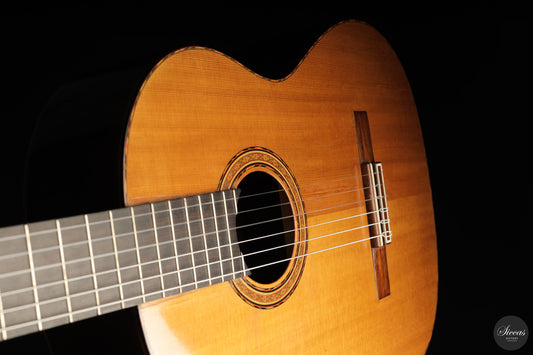
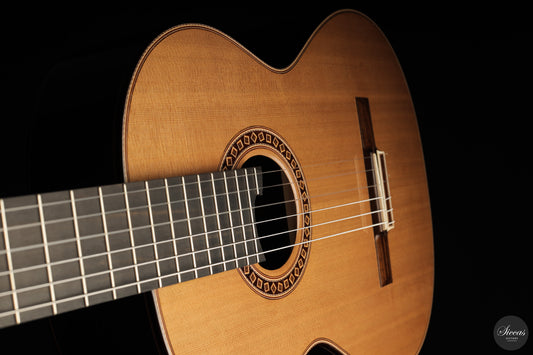
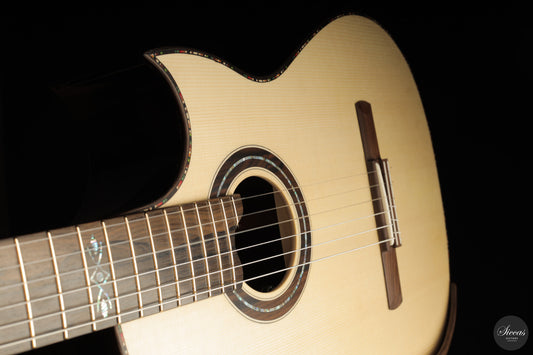
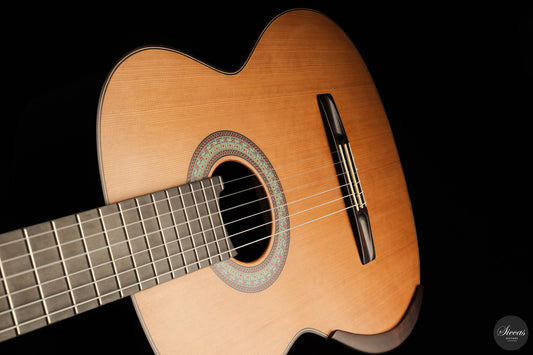
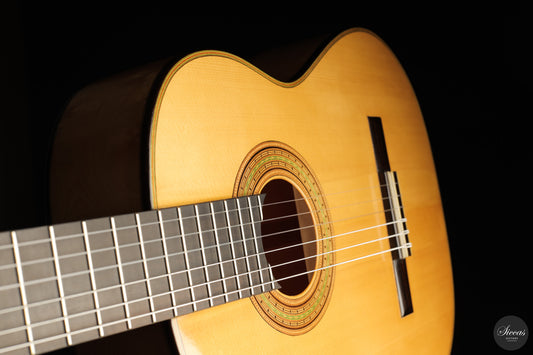
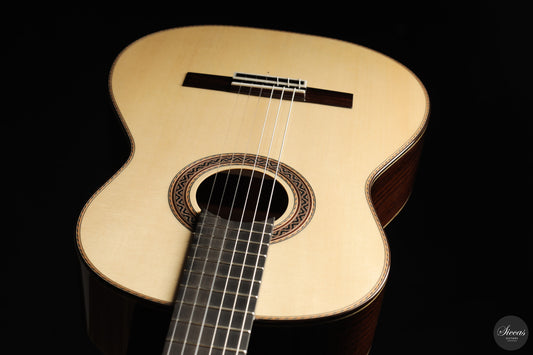
Her instruments typically feature Indian rosewood for the back and sides, paired with either a cedar or spruce soundboard depending on the tonal character she is working toward. Cedar tends toward immediacy and warmth — a sound that opens quickly and envelops the listener. Spruce, by contrast, rewards patience, offering greater dynamic contrast and a brighter projection that suits players who demand the full dramatic range of the concert repertoire. Understanding the distinction between these two paths is part of what the fan-braced, double top, and lattice guitar traditions have collectively explored, and Stahl's work sits thoughtfully within that broader conversation.
A Maker of Her Generation
Tamara Stahl belongs to a generation of European makers who have inherited the full richness of the classical guitar's history — from the foundational experiments of Robert Bouchet and the rigorous innovations of Daniel Friederich — and who are now developing their own responses to those legacies. What distinguishes her is not a single defining innovation but a quality of sustained seriousness: a refusal to rush, a commitment to learning from the best sources available, and a willingness to let each instrument reveal what it wants to become.
Her guitars have already found homes with players who value tonal complexity, precise intonation, and the kind of playability that comes from instruments built with full awareness of how they will actually be used in performance. As her numbered series grows and her voice as a maker becomes more distinctly her own, Tamara Stahl stands as one of the most promising figures in contemporary European lutherie.
Browse available Tamara Stahl guitars → in the Siccas Guitars collection.