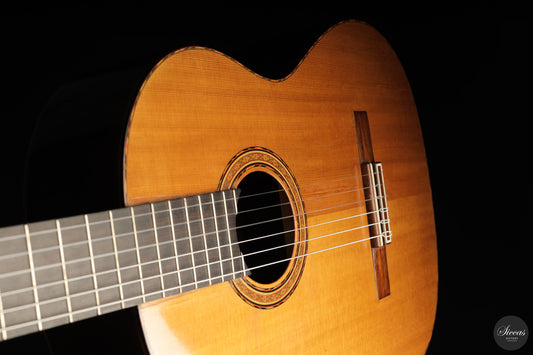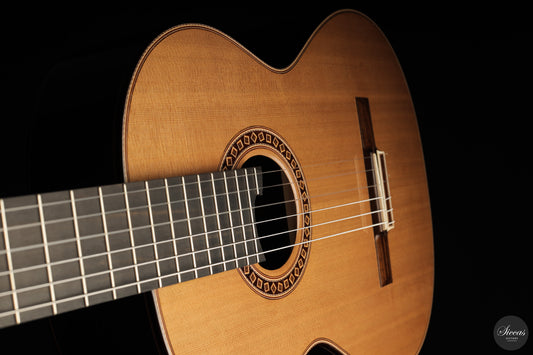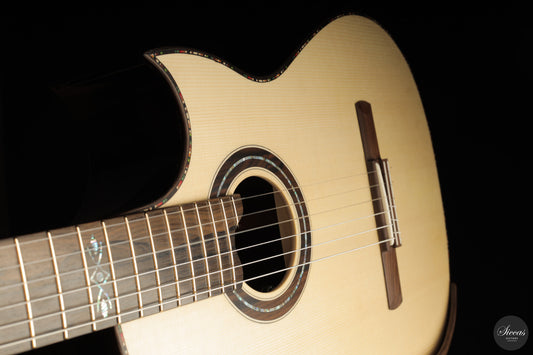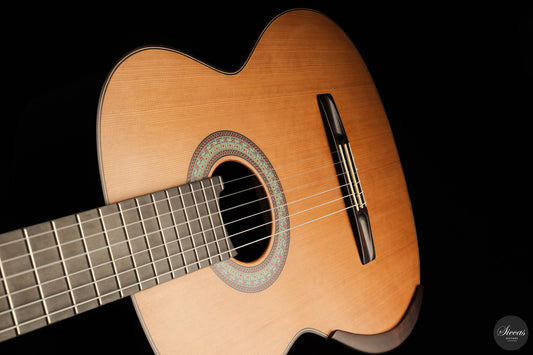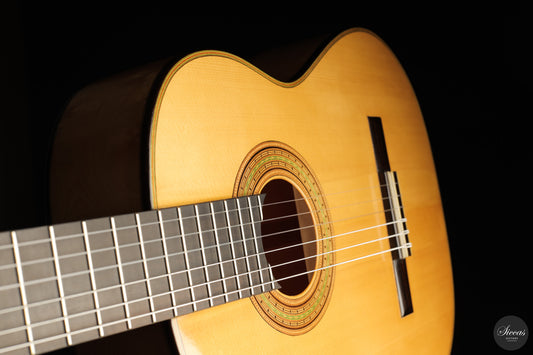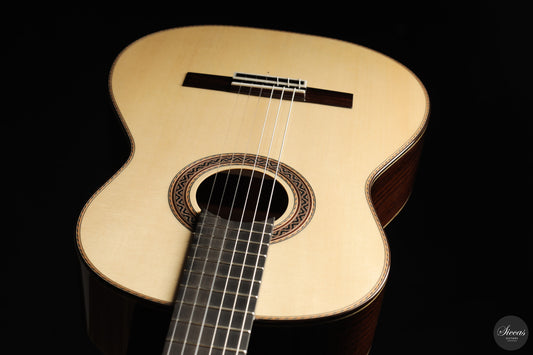

Teodoro Pérez is one of the most respected classical guitar makers working in the Madrid tradition today. Born in 1952 in the province of Soria in central Spain, he grew up to spend more than two decades inside the most influential guitar workshop of the twentieth century — the atelier of José Ramírez III — before eventually founding his own celebrated workshop. His instruments carry forward the unmistakable character of the Madrid school: powerful, resonant basses, singing trebles, and a commanding projection that concert performers demand. Over a career now spanning more than half a century, Pérez has built a reputation for meticulous craftsmanship and for the deeply personal relationship he maintains with each piece of wood he selects.
Biography and Training
In 1966, at the age of fourteen, Teodoro Pérez moved from Soria to Madrid and began his apprenticeship in the workshop of José Ramírez III, the house that defined the modern concert guitar for a generation of performers. It was an extraordinary environment in which to learn. During those years at the Ramírez bench, Pérez built not only classical guitars but also lutes, bandurrias, and mandolins, acquiring the kind of broad lutherie knowledge that would later inform his sensitivity to materials and acoustics. He also had the remarkable privilege of meeting some of the defining figures of twentieth-century guitar: Andrés Segovia and Narciso Yepes, among others, passed through the workshop, and their presence gave the young craftsman a direct sense of what the finest players required from their instruments.
By 1970, after passing the required examinations with the approval of Ramírez himself, Pérez was elevated to First Official — the highest rank for a workshop craftsman — and began stamping the guitars he made with his own initials, GPM. He remained with the Ramírez house for a total of twenty-five years, an unusually long and loyal tenure that gave him an extraordinarily deep grounding in the Madrid approach to guitar construction.
In 1991, Teodoro Pérez took his long-held aspiration and made it real by setting up his own workshop in Madrid. For a period he collaborated with Mariano Tezanos, a fellow Ramírez veteran, and the two built instruments together under the Tezanos-Pérez label until 2005. After that partnership concluded, Pérez continued under his own name. Gradually, the workshop became a family enterprise: his son Sergio joined in 1998, his daughter Beatriz in 2005, and his son-in-law Marco Tejeda followed in turn. Today the Pérez workshop is one of the finest family-run lutherie operations in Spain, with every instrument bearing the collective care and skill of multiple generations.
Construction Philosophy
Teodoro Pérez describes his approach to lutherie as inseparable from the quality and character of the raw materials. Wood selection is not merely a preparatory step for him — it is the heart of the entire process. He sources his tonewoods with exceptional care and subjects them to natural drying periods that most contemporary workshops would consider impractical: tops of Canadian red cedar may be dried for as long as ten years, while neck blanks can rest for up to twenty years before he considers them ready for the bench. This patience with materials is a deliberate investment in the long-term quality and stability of the finished instrument.
Pérez is said to be able to look at a piece of wood and sense, from its grain density, flexibility, and weight, what kind of guitar it will ultimately become. This intimate knowledge of materials connects his practice to the tradition of classical guitar makers throughout history who treated acoustics as an empirical craft rather than an applied science. While he works firmly within the Spanish tradition, his long experience gives him a nuanced understanding of how small variations in top thickness, internal bracing geometry, and the placement of harmonic bars translate into the sonic character a player will ultimately experience.
The Madrid school's hallmarks — robust projection, a warm but defined bass register, and a treble voice with both clarity and body — are present throughout his output. For Pérez, these qualities are not achieved by formula but by a combination of accumulated judgment, fine materials, and the kind of attentive hand-finishing that only a craftsman of his experience can deliver. His guitars are entirely hand-made and French-polished, a finish that demands considerable skill but rewards the player with a resonance and responsiveness that synthetic finishes cannot match.
Signature Models
The Pérez workshop produces a range of models that address different levels of performance and repertoire, while maintaining a consistent identity across the range. The Concierto is one of the most celebrated models in the line — the first Pérez guitar to be finished entirely in French polish — and it exemplifies the Madrid sound at its most refined. Its basses are deep and rounded, its trebles luminous and sustained, and players consistently note its immediate responsiveness and tonal evenness across the fingerboard. This model has found favour with concert performers who want an instrument with a strong identity that does not sacrifice nuance for volume.
The Maestro sits at the upper level of the range and represents the fullest expression of Pérez's vision: a potent, well-balanced concert instrument with resonant lows and clear, vibrant highs. Built with the finest available tonewoods — typically European spruce or cedar tops paired with rosewood or Indian rosewood backs and sides — the Maestro is designed for large concert halls and demanding repertoire. The Maestro Especial takes this further still, offering the most elaborate ornamentation and the very finest selection of materials available from the workshop at any given time. Those interested in the broader landscape of construction approaches will find useful context in our guide to fan-braced, double-top, and lattice classical guitars.
Alongside these top-tier models, the workshop also builds the Estudio series, which extends the Pérez ethos of careful construction and honest materials to players who are developing their technique and seeking a serious instrument at a more accessible level.
Notable Players
The players drawn to Teodoro Pérez guitars tend to be those who value the direct, unmediated connection between performer and instrument that the Madrid tradition provides. Among the documented players of his instruments are Scott Wolf of Duo Solaris, who performs on a Pérez Concierto, as well as Yury Nugmanov, Tom Farrell, and Almer Imamovic, each of whom has worked with different models from the workshop. These are not necessarily household names at the level of the grand soloists, but they represent the working concert guitarist community — the players who travel, record, and perform seriously — for whom a Pérez guitar is a trusted professional tool rather than a collector's object.
The long connection between the Pérez workshop and the world's leading concert guitarists extends back, indirectly, to the years Teodoro spent at the Ramírez bench, where he would have built instruments for some of the most celebrated players of his era. That formative exposure to professional demands at the highest level shaped the standards he brought to his own independent work.
Legacy and the Family Workshop
Teodoro Pérez recently celebrated more than fifty years as a luthier — a milestone that places him among the most experienced active guitar makers anywhere in the world. What distinguishes his legacy is not only the quality of the individual instruments he has produced but the way in which he has managed to transmit his knowledge and values within his own family. The workshop he founded in Madrid has become a model of continuity: Sergio, Beatriz, and Marco Tejeda each bring their own contribution to the bench, ensuring that the Pérez approach to lutherie will survive its founder and continue to develop.
In the context of the broader Madrid tradition — a lineage that includes the towering figures documented in the histories of Ignacio Fleta and José Luis Romanillos — Teodoro Pérez represents a living bridge between the post-war golden age of Spanish lutherie and the present day. His guitars carry the sound and spirit of that tradition forward without nostalgia, made with the same patient commitment to natural materials and handcraft that has always distinguished the finest Spanish instruments.
Browse available Teodoro Pérez guitars → in the Siccas Guitars collection.