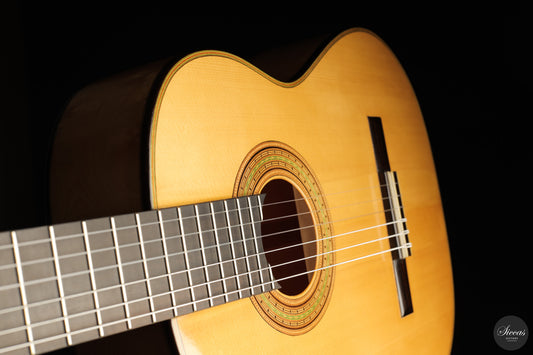
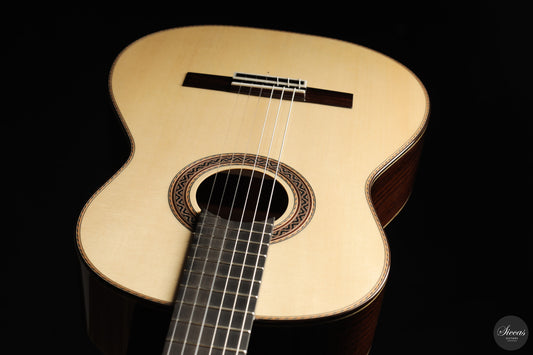
Yulong Guo – China's Master of the Double-Top Guitar
Yulong Guo stands apart as the most internationally recognised classical guitar maker to emerge from China — a luthier who has spent four decades quietly rewriting the rules of what a guitar built outside the traditional European centres can achieve. Since he first picked up his tools in 1983, Guo has transformed from a self-taught craftsman into a builder whose instruments compete on equal terms with the finest European workshops, earning competition prizes in Granada and commanding the attention of concert guitarists around the world.
From Student to Craftsman – The Early Years
Guo's path to lutherie began through music rather than woodworking. He became a student of Professor Cui Min, a member of China's Musician Association, and pursued formal training in classical guitar performance, even winning second prize in the classical category at a national-level guitar competition in China. That immersion in music — in the demands a player places on an instrument — shaped his sensibility as a maker. He understood, from the inside, what a concert guitar needed to do.
He began building guitars in 1983 and spent years honing his craft, studying the innovations coming out of European workshops and subjecting himself to the exacting discipline of working with fine tonewoods. By the time he formalised his enterprise as Yulong Guo Guitars Workshop in 2011 — previously operating as Yulong Guo Guitar Studio — he had already built a reputation that extended well beyond China's borders. His approach sits squarely within the tradition of builders who, like classical guitar makers throughout history, combine rigorous study of the past with a willingness to experiment.
Pioneering Double-Top Construction in China
If Guo is known for one thing above all others, it is his mastery of the double-top technique — a construction method pioneered by German luthiers in the late twentieth century and described in more detail in our overview of double-top guitar pioneers. Guo became the first Chinese luthier to apply lattice bracing to classical guitars and, crucially, the first — and for a considerable period the only — builder in China capable of constructing a true Nomex double-top soundboard.
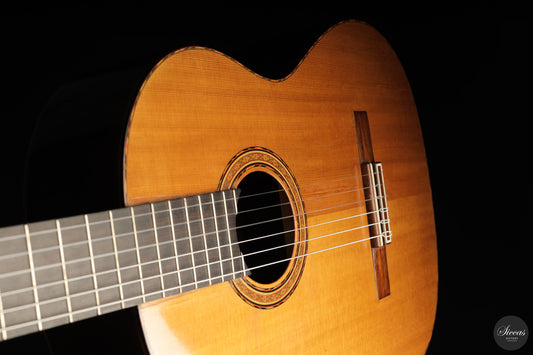
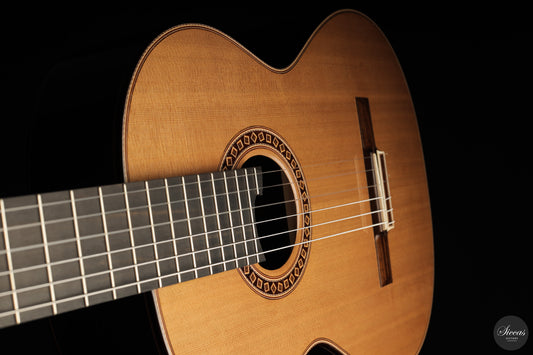
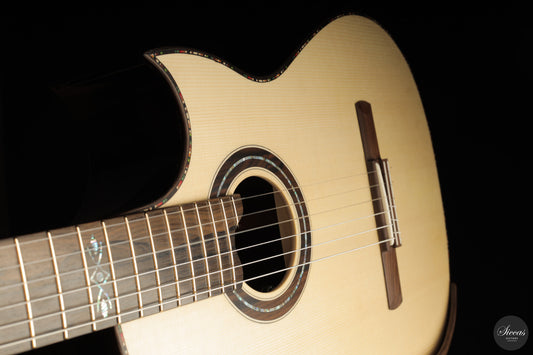
The double-top technique involves sandwiching a layer of Nomex honeycomb composite between two ultra-thin sheets of spruce or cedar. The resulting soundboard combines lightness with rigidity in a way that a conventional solid-wood top cannot match, producing greater volume, enhanced projection, and a sensitivity to the player's touch that many guitarists find transformative. Guo mastered this demanding process and built it into his flagship Chamber Concert model, which features a spruce-Nomex-spruce or cedar-Nomex-cedar sandwich top paired with a distinctive arched back — constructed in the manner of a cello or violin — that further amplifies the instrument's resonance. The elevated fretboard, another hallmark of his higher-end builds, eases access to the upper register and is particularly valued by players who spend time in the higher positions.
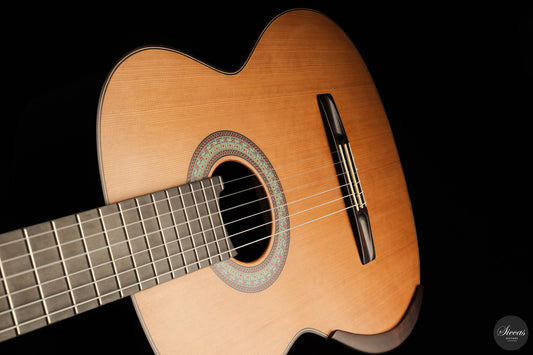
The breadth of his construction knowledge is also reflected in his more accessible lines. His Echoes series brings the double-top concept to a wider audience, offering the sonic benefits of Nomex construction with solid tonewoods — including rosewood or Santos back and sides, Spanish cedar neck, and ebony fingerboard — at a level that makes his work available to advancing students and amateur players as well as professionals. An understanding of fan-braced, double-top, and lattice construction helps to situate just how technically ambitious his approach has always been.
The Granada – A Return to Tradition
By 2018, Guo had become sufficiently confident in his grasp of the European tradition to put his work to one of its most searching tests. At the MusikMesse in Frankfurt that year, he had the rare opportunity to examine an authentic Antonio de Torres guitar — the nineteenth-century Spanish maker whose instruments Ignacio Fleta and generations of Spanish builders regarded as the foundational template for the modern concert guitar. The experience was, by his own account, a revelation. The directness, warmth, and singing quality of the Torres instrument prompted Guo to design a traditionally built concert model of the highest order.
The result was the Granada — a guitar with a spruce top, Indian rosewood back and sides, five-fan bracing, and a 650mm scale length, built entirely without the composite materials that define his double-top work. Guo entered the Granada in the second International Antonio Marín Montero Guitar Building Competition in Granada, Spain, where it won second prize. The award placed him among an elite group of luthiers recognised in a competition named for one of the great living masters of the Spanish tradition — a remarkable achievement for a Chinese builder working far from the traditional centres of the craft.
Workshop, Collaboration, and Reach
Guo's workshop employs a small team of between three and five experienced luthiers, most of whom he trained personally and who have worked alongside him for many years. This tight collaborative model allows him to maintain consistent quality across his range while producing enough instruments to meet international demand. The workshop's output spans handmade concert instruments built to individual specification through to production-assisted models that bring his construction philosophy to a broader market.
His guitars have attracted concert guitarists internationally, and his instruments have been played and discussed in competitions, master classes, and recital halls across Europe, the Americas, and Asia. His standing reflects a broader shift in the classical guitar world — a growing recognition that exceptional lutherie can emerge from anywhere, provided the maker combines deep musical understanding with technical mastery. In that sense, Guo joins a lineage of transformative makers; the ambition that drove Daniel Friederich to push against the limits of what a guitar could do resonates clearly in Guo's own career.
Legacy and Significance
Yulong Guo has done something genuinely rare: he has built a body of work that commands respect in a field dominated by centuries of European tradition, doing so from China and without the benefit of a lineage that connects him directly to the Spanish or French masters. His innovations — the introduction of double-top and lattice construction to Chinese lutherie, the Granada's competition success, the Chamber Concert's distinctive arched-back engineering — have established him as a benchmark for what is possible in contemporary guitar making outside Europe. For players seeking an instrument that combines modern acoustic technology with meticulous handcraft, his guitars represent one of the most compelling propositions in the classical guitar world today.
Browse available Yulong Guo guitars → in the Siccas Guitars collection.