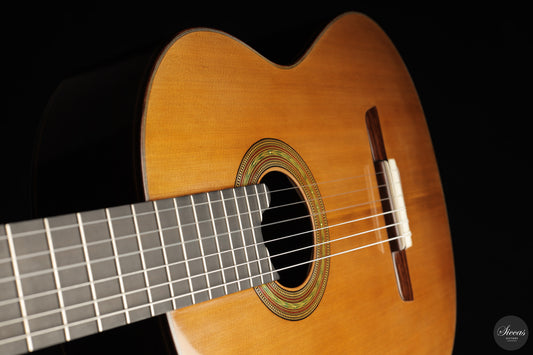
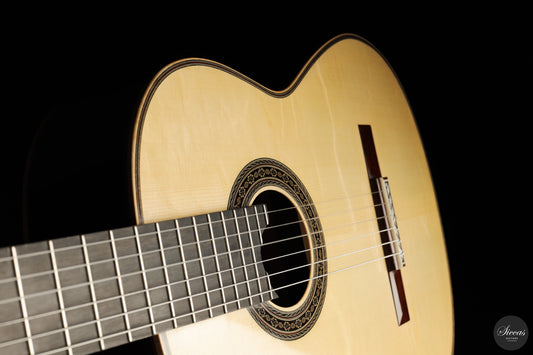
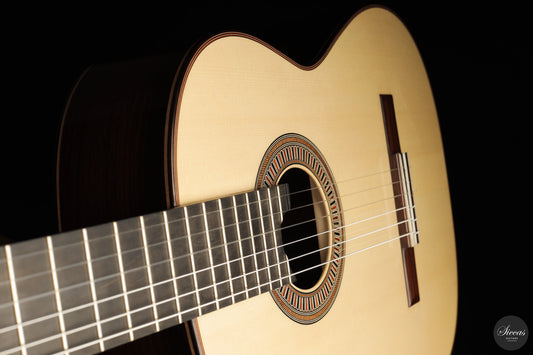
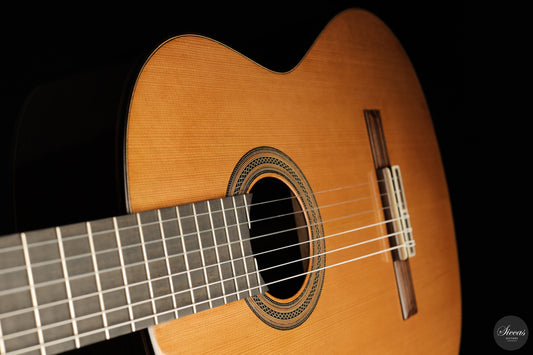
Antonio Raya Pardo – Granada Luthier of Two Lineages
Antonio Raya Pardo builds classical guitars in Granada, the city whose workshops have shaped the sound of the Spanish guitar for more than a century. He comes from two distinct lines of that tradition: his father, Antonio Raya Ferrer, was himself a luthier, and Raya Pardo grew up learning the craft inside a working shop rather than arriving at it later through study alone. That origin shows in the consistency of his instruments.
Granada luthiers occupy a specific place in the history of the classical guitar. The city's school developed partly in parallel with Madrid and partly in opposition to it, favouring a lighter build, a more responsive top, and a tonal character that players describe as warm and direct — suited to the repertoire of Francisco Tárrega, Isaac Albéniz, and the Spanish nationalist composers who defined much of the concert classical guitar's canon. Raya Pardo works within that lineage and does not deviate from it in search of novelty.
The Granada School: What It Means in Practice
The term "Granada school" refers to a set of building choices, not a single dogma. Fan bracing — the arrangement of spruce struts radiating beneath the soundboard — is central to it. Granada makers historically used a lighter fan than their Viennese or German contemporaries, and that choice affects how quickly the top responds to the player's touch. A lighter brace means earlier response, more nuance in pianissimo passages, and a natural sustain that does not require the player to force projection.
Raya Pardo uses traditional fan bracing in his instruments. The top materials are European spruce or cedar depending on the individual guitar, selected for stiffness-to-weight ratio rather than appearance. Back and sides are typically Indian rosewood or cypress, the latter associated with flamenco and with the drier, more percussive tonal palette that flamenco technique demands. His choice of tonewoods follows function rather than fashion.
Scale length, neck geometry, and string height are set according to the demands of classical technique. The instruments at Siccas Guitars are inspected and set up before delivery, which matters: even a well-made guitar can underperform if action and nut are not correctly fitted to the player's approach.
Two Lineages: Raya Ferrer and the Granada Tradition
Antonio Raya Ferrer, the father, was part of the generation of Granada makers who kept the craft active through the latter half of the twentieth century. That generation included builders whose names are now recognised internationally, and it produced instruments that are today sought by players and collectors. Antonio Raya Pardo learned the trade directly from his father, which means he carries not only the technical knowledge of the Granada school but also the specific approach of the Raya Ferrer workshop — proportions, finishing methods, the handling of the harmonic bar, the placement of the fan struts.
This dual inheritance is not common. Most luthiers working today trained under a single master or in a school setting. Raya Pardo's position — son of a luthier, trained in Granada, working within a family workshop tradition — places him in a narrower category of makers for whom the craft is genuinely continuous rather than acquired.
The result is a builder whose instruments do not try to be something other than what they are. A Raya Pardo guitar is a Granada classical guitar in the orthodox sense: fan-braced, traditionally voiced, built to be played. Players looking for extended range, elevated fretboards, or experimental construction will find other makers more suited to those needs. Players looking for a reliable, well-made Spanish classical guitar with documented lineage will find Raya Pardo's instruments worth serious attention.
Tonal Character and Playing Response
Describing tone is imprecise by nature, but some observations are consistent across Raya Pardo's instruments. The treble strings — particularly the first and second — have clarity without brightness becoming hardness. The bass registers are present without muddying the midrange. This balance is one reason the Granada tradition suits a wide range of repertoire: from Baroque transcriptions that require articulation and separation to Romantic pieces that need warmth and colour in the inner voices.
Response under the right hand is immediate. Players accustomed to instruments that require more force to speak will notice that a Raya Pardo guitar replies readily to lighter strokes. This characteristic is useful in concert settings where dynamic range — not just maximum volume — determines expressivity. Pieces like Recuerdos de la Alhambra, with their continuous tremolo and demand for tonal gradation, benefit from a top that does not resist.
The instruments are not loud in the way that some contemporary lattice-braced or double-top guitars are loud. They project in the manner of traditional Spanish guitars: with a natural decay, a resonance that carries in a room without amplification, and a response that favours the player who listens as much as they play.
Antonio Raya Pardo in the Context of Spanish Guitar Making
Spain's guitar-making tradition is concentrated in a small number of cities — Almería, Madrid, and above all Granada. The Granada school produced makers whose instruments are now in the hands of the world's leading soloists: José Romanillos, Antonio Marin Montero, Manuel Contreras, and others whose names appear on the labels of the guitars that defined the sound of the twentieth-century concert stage. Raya Pardo builds in that context.
This does not mean his instruments are comparable to those of the historical masters in terms of age or provenance. It means they share a tradition, an approach, and a set of technical decisions that connect them to a lineage with proven results. For a player looking to understand what Spanish guitar making actually is — not as a marketing category but as a craft with specific geographic and historical roots — Raya Pardo's instruments are an honest entry point.
A broader overview of makers working in this tradition and others appears in our guide to great classical guitarists, which covers both the players who shaped demand for these instruments and the makers who answered it. The relationship between player and maker in the Spanish tradition is close: many of the great soloists collaborated directly with their luthiers to arrive at the tonal and physical specifications of their concert instruments.
Choosing a Classical Guitar: What Raya Pardo Offers
For players considering a Spanish classical guitar at this level, the practical questions come down to tonal preference, playing style, and repertoire focus. Raya Pardo's instruments suit players who work primarily within the classical Spanish and Latin American repertoire, who value traditional construction, and who prefer a guitar that responds immediately rather than one that requires a period of adjustment.
The question of how much time and effort the classical guitar demands is one that comes up early for most players. Our guide on how long it takes to learn classical guitar addresses the realistic timeline for developing the technique that allows an instrument like this to show what it can do. A well-made guitar at this level will reward the player who puts in the work; it will also reveal clearly when technique needs attention, which is itself useful information.
Players drawn to the Spanish repertoire — and to the Andalusian tradition in particular — will find that a guitar built in Granada by a maker trained in that tradition creates a direct connection to the music. Francisco Tárrega, whose work defines much of the foundational classical guitar repertoire, played guitars built in the Spanish tradition. The tonal assumptions of that repertoire are built into the construction of these instruments.
Available at Siccas Guitars
Siccas Guitars carries instruments by Antonio Raya Pardo alongside guitars from other Spanish, European, and international makers. The available stock changes regularly; the current selection can be found in the classical guitars collection. Each instrument is inspected before listing, and detailed photographs and specifications accompany every guitar to allow remote buyers to assess the instrument before purchasing.
For players whose interest extends to flamenco — an area where the Granada tradition also has strong roots — the flamenco guitars collection includes instruments built for that technique, with the lighter construction, lower action, and tonal dryness that flamenco demands.
Further reading on the repertoire associated with this tradition is available in our overview of famous classical guitar pieces, which covers the works that appear most frequently on concert programmes and on the recordings that have defined the instrument's place in music.
Summary
Antonio Raya Pardo is a Granada luthier whose instruments connect two specific lines of the Andalusian guitar-making tradition: the Granada school itself, and the direct teaching of his father, Antonio Raya Ferrer. His guitars are traditionally fan-braced, built from carefully selected tonewoods, and voiced for the classical Spanish repertoire. They are available at Siccas Guitars for players seeking an instrument with documented lineage and honest construction.
The sound and the choice of instrument. For the Granada school and the two lineages behind it, see Antonio Raya Pardo — A Granada Master of Two Lineages.