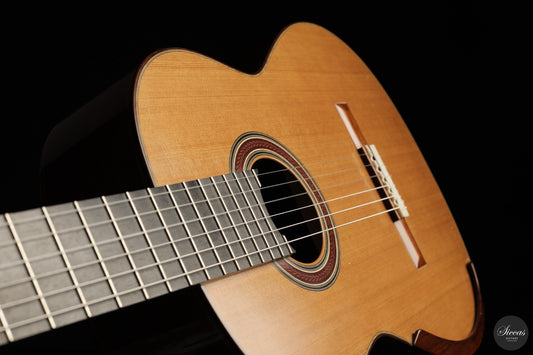

Can You Use a Pick on a Classical Guitar?
It is one of the most common beginner questions: can you play a classical guitar with a pick (plectrum)? The short answer is yes, you can — but understanding why the instrument was designed for fingers, what changes when you use a pick, and when a pick is genuinely fine will help you make a better decision for your own playing.
Classical Guitar Is a Fingerstyle Instrument
The classical guitar was designed from the ground up to be played with the fingers — specifically the fingertips and nails of the right hand plucking each string individually. This is not a convention or a tradition for its own sake. It is the technical foundation that makes everything else possible.
When you play with your fingers, you can pluck two, three or four strings simultaneously, producing independent melodic lines, harmonic accompaniment, and a bass line all at the same time. The entire classical repertoire — from Tárrega to Villa-Lobos to Britten — is written assuming this capability. A single pick can only contact one string at a time in a single direction. This fundamental limitation means that most classical guitar music is simply not playable with a pick in any recognisable form.
There is also the question of tonal control. A fingerstyle player can draw a warm, round tone from the flesh of the fingertip, a brighter, more projecting tone from the nail, or infinite gradations between the two by angling the hand. Each finger can produce a different volume and colour simultaneously — the melody note louder and brighter, the bass note deeper, the inner voices softer. A pick delivers a single, fixed tonal character determined by its material and angle, and it applies that character to every string equally.
What a Pick Does to the Sound
Using a pick on nylon strings produces a noticeably different sound from fingerstyle playing. The attack is sharper and more percussive. The tone tends to be brighter and more cutting. The natural warmth and roundness of the nylon string — one of its defining qualities — is partly lost, replaced by a more strident character. This can actually sound appealing in some musical contexts, particularly pop, folk, and some Latin styles. But for classical music, where tonal nuance, dynamic shading between voices, and the ability to blend or separate parts are central to the music's meaning, the pick's limitations are severe.
Some crossover players — musicians who play both classical nylon-string guitars and popular styles — use thin, flexible picks on nylon strings and find that the softer pick material reduces the harshness. A thin nylon or tortoiseshell-style pick, held lightly, can be gentler on the instrument and produce a less aggressive tone than a stiff, heavy pick. But it still cannot address the fundamental limitation of playing multiple independent voices at once.
When Is a Pick Perfectly Fine?
If your goal is to strum chords, play a single melody line, or explore pop, folk, bossa nova, or flamenco-influenced styles on a nylon-string guitar, using a pick is entirely reasonable. Many famous musicians have played nylon-string guitars with picks throughout their careers. In these musical contexts, the pick's bright, forward character can be an advantage rather than a liability.
Flamenco playing, for instance, uses a range of right-hand techniques including rasgueados (strumming with the fingers) and picado (single-note lines played with alternating fingers), but some players in popular flamenco styles do use picks for rhythmic strumming passages. The instrument accommodates this, though the classical tradition does not use it.
If you are a guitarist who plays steel-string guitar with a pick and is exploring nylon-string guitar as a secondary instrument for its softer, warmer sound, using a pick in the same way you would on your steel-string is a practical starting point. The musical results will differ, but the guitar will not be damaged by careful pick use.
Will a Pick Damage a Classical Guitar?
This is worth taking seriously. A classical guitar's soundboard is a thin plate of spruce or cedar — typically around 2.5 to 3mm thick — designed for the gentle, controlled contact of fingertips and nails. Aggressive pick strumming, particularly with a heavy, stiff pick, can scratch the top over time. With very sustained heavy use, the scratching can become a groove worn into the surface.
The practical precaution is simple: if you do use a pick on a classical guitar, use a soft, thin one and approach the strings with a lighter touch than you might on a steel-string. The strings themselves — nylon and wound nylon — are not at risk from a pick in the way that the soundboard surface can be.
Classical Technique: What You Are Missing Without Fingers
For anyone genuinely interested in classical guitar music, the argument for learning fingerstyle technique goes beyond mere convention. The repertoire is simply not accessible in any other way. Works like Recuerdos de la Alhambra by Tárrega — with its continuous tremolo melody over a moving bass — or any of the Bach lute suites arranged for guitar, with their independent contrapuntal voices, require the ability to control each string individually and simultaneously. This is what the classical right-hand technique, developed over centuries, makes possible.
The good news is that fingerstyle technique on classical guitar is learnable, and the early stages are accessible to any motivated beginner. The nails of the right hand are grown slightly and shaped to produce a clear, projecting tone, and the hand learns the basic p-i-m-a (thumb-index-middle-ring) patterns that form the foundation of the technique. With a teacher and consistent practice, the basics of fingerstyle playing are within reach within weeks.
The Classical Guitar Tradition
The association between the classical guitar and fingerstyle technique goes back at least to the early 19th century, when composers and performers like Fernando Sor, Mauro Giuliani, and Dionisio Aguado codified the instrument's technique in detailed method books. The tradition was continued and deepened by Francisco Tárrega in the late 19th century, whose innovations in right-hand nail technique still influence players today. By the time Andrés Segovia championed the instrument on the concert stage in the 20th century, fingerstyle playing was the universal assumption of the classical guitar world.
This history matters not because tradition is sacred, but because the technique developed for a reason. The guitar's expressive potential — its ability to sound like a small orchestra, to carry independent melodic and harmonic voices, to produce a full range of tonal colours — depends on the fingers. Using a pick bypasses all of this in exchange for simplicity of attack. For some musical purposes, that trade is fine. For classical music, it is not.
Practical Advice for Beginners
If you are learning classical guitar from scratch, start with your fingers. Get a teacher who can show you the correct right-hand position and nail care. The technique will feel unfamiliar at first — especially if you have played steel-string guitar with a pick — but it is the gateway to the full range of the instrument.
If you are a pick player exploring classical guitar as a secondary instrument and want to learn some pieces without committing to full classical technique, be patient with yourself. The simplest approach is to use your right-hand index finger alone to pick out melodies while you develop a feel for the instrument. From there, adding the thumb for bass notes and the middle finger for a second voice gives you a basic three-voice capacity without requiring months of technique development.
Whatever your starting point, a quality classical guitar will reward careful playing. The instrument's voice opens up when the strings are addressed thoughtfully, whether with fingers or — in appropriate contexts — a light, flexible pick.
Summary
Can you use a pick on a classical guitar? Yes. Should you, if you want to play classical music? No — the repertoire demands fingerstyle technique. Is a pick fine for strumming, folk, or pop on a nylon-string guitar? Absolutely. The instrument is physically capable of accepting pick technique; classical music is not.
FAQ
Can you use a pick on a classical guitar?
Yes, physically a pick works on nylon strings. For classical repertoire, however, fingerstyle technique is required to play multiple voices simultaneously. A pick is fine for strumming or single-note melody playing in folk, pop, or similar styles.
Will a pick damage a classical guitar?
A hard pick used with heavy strumming can scratch or, over time, wear the thin soundboard. Using a soft, thin pick with a lighter touch greatly reduces this risk.
Why do classical guitarists not use picks?
Fingerstyle technique allows each finger to control an individual string, enabling multiple simultaneous voices, independent dynamic control, and a wide range of tone colours — all of which the classical repertoire requires. A pick cannot do this.
Can I learn classical guitar if I normally play with a pick?
Yes. The transition requires developing the right-hand fingerstyle technique, but it is learnable. Many players come to classical guitar from a pick-based background and successfully make the transition.
What kind of pick is best for classical guitar if I want to use one?
A thin, flexible pick in nylon or a similar soft material, held lightly, is the least harsh option on nylon strings. It will produce a brighter, more percussive tone than fingers but will not be aggressive on the instrument's surface.
Famous classical guitar pieces → · Browse our classical guitars · Great classical guitarists