
Introduction
Claude Debussy's Clair de Lune is one of the most recognised pieces in the entire classical music repertoire. Originally composed for piano, this luminous work has found a second life on the classical guitar — an instrument whose nylon strings and intimate resonance seem tailor-made for Debussy's moonlit soundworld. In this article we trace the origins of Clair de Lune, examine what makes it so compelling on the guitar, and offer practical guidance for guitarists ready to take on this impressionistic masterpiece.
The Origins of Clair de Lune
Clair de Lune (French for "Moonlight") is the third movement of Debussy's Suite bergamasque. Debussy composed the suite around 1890, but it was substantially revised before its eventual publication in 1905. The title is drawn directly from Paul Verlaine's poem Clair de lune, in which moonlight transforms a garden into a dreamlike, shimmering space. Debussy (1862–1918) was deeply influenced by Symbolist poetry, and the piece reflects that literary world: atmosphere and suggestion take precedence over formal structure.
Debussy was one of the leading figures of musical Impressionism — a label he himself resisted, though it has stuck. His music prioritises colour, texture, and mood over the developmental logic of the Austro-German tradition. Clair de Lune exemplifies this approach: the melody drifts, the harmony shifts in unexpected directions, and the overall effect is less a narrative than a sustained impression of nocturnal stillness.
Debussy's Impressionistic Language
To understand why Clair de Lune translates so beautifully to the guitar, it helps to understand the harmonic and textural language Debussy developed. He drew on non-functional harmony, modal scales, and the whole-tone scale to create a sense of floating, unresolved tension. Rather than driving forward to a clear resolution, his music suspends the listener in a particular emotional state.
These qualities are not unique to Clair de Lune. Throughout his career, Debussy was fascinated by timbral variety — by the idea that music could evoke visual and sensory experience. His piano writing makes extensive use of the sustain pedal to blur harmonic boundaries, creating washes of sound rather than clearly articulated chords. When arrangers transpose this music to the guitar, they face the challenge of recreating those washes with an instrument that, by its nature, lets notes decay rather than sustain.
Yet this challenge is also an opportunity. The guitar's natural decay gives Debussy's harmonies a certain translucency. Notes fade at different rates depending on how and where they are plucked, creating an effect that can be just as atmospheric as a pedalled piano — simply in a different way.
Transcribing Clair de Lune for Guitar: A Delicate Art
Transcribing a piano piece for guitar always involves compromise. The piano has a far wider range, can sustain notes indefinitely with the pedal, and can voice chords in ways that are simply not possible on a six-string instrument. For Clair de Lune specifically, the main challenges include:
Capturing Melodic Flow
The piano's sustain pedal allows the melody to sing over a continuously resonating harmonic bed. On guitar, the arranger must find fingerings that keep the melody prominent while allowing the accompanying notes to ring as long as possible. Slurs, vibrato, and judicious use of open strings all help to bridge the gap.
Maintaining Harmonic Richness
Debussy's harmony is one of the defining features of the piece. Guitar arrangements must find creative voicings that preserve the essential harmonic character without the full range of the piano keyboard. This often means transposing the piece to a guitar-friendly key and redistributing voices across the strings.
Balancing Dynamics and Tone Colour
The piece moves from passages of extreme delicacy to moments of fuller, more resonant texture. On guitar, this dynamic range is achieved through right-hand positioning — playing closer to the bridge produces a brighter, more projecting tone; playing over the soundhole yields warmth and softness. Skilled guitarists use this continually to shape the music's emotional arc.
The Role of Natural Harmonics
Several guitar arrangements incorporate natural harmonics to evoke the shimmering, bell-like quality of certain passages in the original. This is one area where the guitar can do something the piano cannot: harmonics on nylon strings have an ethereal, otherworldly quality perfectly suited to Debussy's aesthetic.
Notable Guitar Arrangements
Since the mid-twentieth century, many guitarists have produced their own arrangements of Clair de Lune, each reflecting a different set of priorities:
Roland Dyens
The late French-Tunisian guitarist Roland Dyens (1955–2016) produced one of the most celebrated guitar arrangements of the piece. Dyens was both a virtuoso performer and a prolific arranger, and his version of Clair de Lune is known for its fidelity to the spirit of the original while fully exploiting the expressive resources of the classical guitar. His arrangement is widely studied in conservatories.
Per-Olov Kindgren
Swedish guitarist Per-Olov Kindgren is known for his lyrical, sensitively phrased approach. His arrangement of Clair de Lune has been widely circulated online and introduced the piece to a new generation of guitarists, demonstrating that impressionistic piano music can find a natural home on nylon strings.
Watch: Arabesque Guitar Duo Plays Debussy
The following performance by the Arabesque Guitar Duo offers a compelling example of how Debussy's music translates to the guitar — here explored across two instruments, expanding the harmonic and textural possibilities even further:
Techniques for Mastering Clair de Lune on Guitar
If you are an advanced guitarist adding Clair de Lune to your repertoire, the following technical areas deserve focused attention:
Legato and Voice Leading
The piece depends on smooth, connected melodic lines. Practise hammer-ons, pull-offs, and position shifts until they feel natural at a slow tempo before increasing speed. Pay particular attention to voice leading — the inner voices must move logically even when the melody and bass demand your primary focus.
Right-Hand Tone Production
Vary your right-hand position throughout the piece to reflect changes in mood and dynamics. Passages marked pp call for a soft, warm touch over the soundhole; moments of greater intensity benefit from a slightly brighter sound nearer the bridge. The quality of your nail preparation and the angle of your right hand will both have a significant impact here.
Use of Natural Harmonics
If your chosen arrangement incorporates harmonics, practise them in isolation before integrating them into the musical flow. Harmonics on the classical guitar are unforgiving — the left hand must be precisely positioned over the fret, and the right-hand touch must be light and consistent.
Studying the Piano Original
Listening carefully to benchmark piano recordings — artists such as Walter Gieseking, whose recordings of Debussy remain touchstones, or Arturo Benedetti Michelangeli — will give you a richer understanding of the intended phrasing, tempo flexibility, and dynamic shaping. The guitar version should always feel like a translation of the original, not a different piece.
Slow Practice and Mental Listening
Begin at a significantly reduced tempo. Clair de Lune is deceptive: it sounds slow and simple, but the coordination required to balance melody, inner voices, and bass simultaneously demands a high level of independent control in both hands. Record yourself regularly and listen back critically.
Why Clair de Lune Belongs in Every Guitarist's Repertoire
Beyond its intrinsic beauty, learning Clair de Lune offers concrete musical and technical benefits:
- Expression and Phrasing: Few pieces demand such refined attention to phrasing, dynamic gradation, and tonal colour. Working on this piece will improve your expressive vocabulary across your entire repertoire.
- Technical Depth: The combination of legato playing, harmonic voicing, and tonal control required makes it an excellent advanced study piece.
- Repertoire Versatility: A guitarist who can perform Clair de Lune convincingly demonstrates the ability to work outside the traditional guitar canon — a valuable quality in recital programming.
- Audience Connection: The piece is immediately recognisable to a wide audience. Performing it on classical guitar consistently surprises and moves listeners who have only heard it on piano.
If you are looking to expand your repertoire with similarly atmospheric works, our guide to famous classical guitar pieces is a good starting point. You might also explore the harmonic world of Tárrega's Capricho árabe or the nocturnal character of Recuerdos de la Alhambra — two pieces that share something of Debussy's atmospheric sensibility.
The Guitar as an Impressionistic Instrument
It is worth stepping back to consider why the classical guitar is so well suited to Impressionist music in general. The instrument's ability to produce a wide range of tonal colours — from glassy harmonics to warm, resonant bass notes — mirrors the palette of the Impressionist painter. The natural decay of nylon strings, far from being a limitation, creates a kind of built-in resonance that piano arrangements can only approximate with the sustain pedal.
Debussy himself was not a guitarist, but his fascination with timbre and texture aligns closely with the aesthetic possibilities of the instrument. Many of the great works of the classical guitar repertoire share this Impressionistic quality: think of the hazy shimmer of Rodrigo's Concierto de Aranjuez, or the evocative nocturnal atmosphere of Tárrega's finest compositions. Debussy fits naturally into this tradition, even if he arrived there from a different direction.
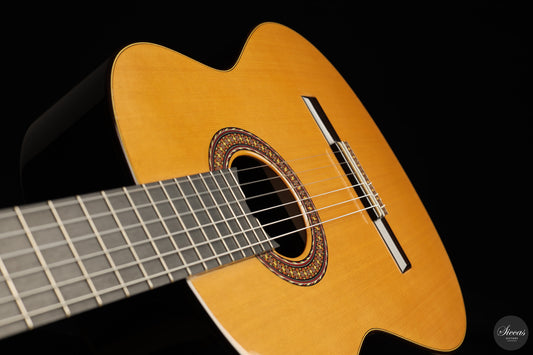
For guitarists interested in exploring the tonal possibilities of different instruments, our comparison of spruce vs cedar top classical guitars is directly relevant: cedar-top instruments, with their warmer, more immediate response, are often favoured for Impressionistic repertoire, while spruce can provide the brightness and clarity needed to project melodic lines in more complex arrangements. Browse our full range of classical guitars to find the instrument that suits your sound.
Conclusion
Claude Debussy's Clair de Lune — the third movement of the Suite bergamasque, composed around 1890 and published in 1905 — is one of those rare works that transcends its original medium. On the classical guitar, nylon strings and the instrument's intimate resonance give this moonlit piece a quality all of its own: not a pale imitation of the piano original, but something genuinely new.
Whether you are approaching this piece as a performer or simply as a listener, Clair de Lune offers a window into what the classical guitar does best: sustain beauty in the space between notes, and invite the listener into a world that exists just beyond the edge of language.
Explore more: our guide to famous classical guitar pieces, the article on Francisco Tárrega, and our full selection of classical guitars.