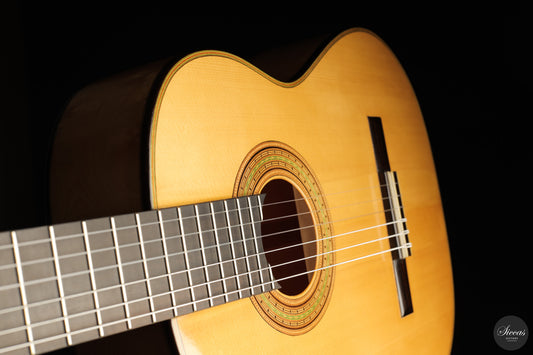
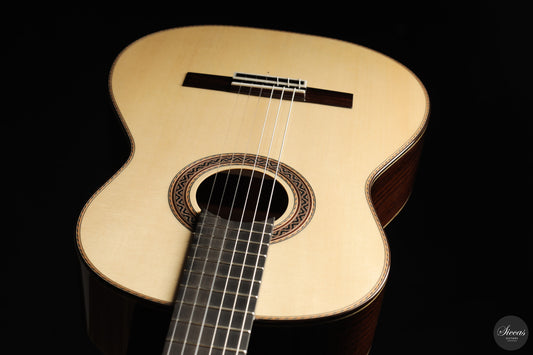
Owning a fine guitar is only half of it; playing and looking after it is the rest. This hub collects practical guidance on technique, the right hand, music reading, and the care that keeps a guitar healthy for life.
Posture and Setup
Classical technique starts before the first note. Posture determines how freely the arms can move, and poor habits at the beginning become very difficult to undo later.
The traditional position uses a footstool under the left foot, raising the guitar so the neck sits at roughly 45 degrees. The guitar body rests on the raised left thigh. Many modern players prefer a guitar support — a cushioned device that clamps to the side of the instrument — which keeps both feet flat on the floor and avoids asymmetric strain on the lower back over time. Neither approach is definitively superior; both achieve the same geometry of arms, wrists, and strings.
The right arm rests on the upper bout so that the hand falls naturally over the sound hole, slightly toward the bridge. The wrist sits slightly forward of the strings, not pressed against the top. The left hand thumb rests lightly behind the neck, roughly opposite the second finger, and never grips. A clenched left thumb is one of the most common causes of tension injuries in classical guitarists.
Right-Hand Technique: Rest Stroke and Free Stroke
The two fundamental right-hand strokes produce different sounds and serve different musical purposes. Understanding when to use each is one of the core decisions a player makes, phrase by phrase.
Rest Stroke (Apoyando)
After the fingertip plucks through a string, the finger comes to rest on the adjacent lower string. Rest stroke produces a fuller, more focused tone with more volume. It is the natural choice for melodic lines that need to project above accompanying voices. Scales played rest stroke carry well even in a large room without amplification.
The finger moves from the knuckle joint, not from the tip. The nail makes first contact, angled slightly so it releases cleanly. The flesh of the fingertip should engage just before the nail does — this combination of flesh and nail is what gives the classical guitar its characteristic warmth.
Free Stroke (Tirando)
The finger plucks through the string and clears the adjacent string without resting on it. Free stroke is used for arpeggios, chords, and any passage where multiple strings need to sound simultaneously or the finger must move immediately to another string. The tone is slightly lighter and more transparent than rest stroke, which suits accompaniment figures and inner voices.
In free stroke, keeping the fingers curved — not flat — at the knuckle joint allows cleaner string clearance and a more consistent point of contact on each nail.
The Thumb
The right-hand thumb (p, from the Spanish pulgar) handles the bass strings. It generally moves in free stroke, sweeping outward away from the soundboard. A common error is letting the thumb collapse inward toward the fingers after each stroke; it should remain extended, ready for the next note. In slow, expressive passages, a thumb rest stroke on the bass delivers noticeably more weight and projection.
Nail Care and Tone Production
Nail shape is not an aesthetic choice — it directly determines tone. A nail that is too long catches and clicks; one that is too short leaves only flesh contact and loses clarity and projection.
The standard approach is to file each nail so it follows the curve of the fingertip and extends just past the flesh by one to two millimetres. The contact edge should be smooth with no ridges or burrs; any roughness shows up in the sound as a scratchy attack. A fine-grit file (400–600 grit) followed by a polishing board is the typical finishing sequence.
Classical guitarists generally file the nails of the right hand and keep the left-hand nails very short, since any length on fretting fingers prevents clean contact with the fretboard. Left-hand nails that click against the frets produce unintended harmonics and buzzing.
The shape of the nail edge also changes the tone character: a straighter profile across the nail tends toward brightness; a more curved profile produces warmth. Most players settle on a shape through experimentation rather than adopting a fixed template.
Read our full guide on classical guitar nail care for detailed shaping and maintenance techniques.
Left-Hand Technique
The left hand frets notes and executes slurs, shifts, and stretches. Efficiency matters more than strength. The goal is to press just hard enough to produce a clean note with no buzzing, and no harder. Excessive pressure accelerates fatigue and reduces speed.
Each finger should be placed as close to the fret as possible without sitting on top of it — the closer to the fret, the less pressure is needed for a clean sound. The fingertip should contact the string, not the pad of the finger, and each finger should remain curved and independent.
Slurs (also called hammer-ons and pull-offs in other contexts) are a defining left-hand technique in classical playing. An ascending slur drives a finger down onto the string with enough speed and weight to produce a note without the right hand plucking. A descending slur pulls the string slightly to one side as the finger lifts, sounding the note below. Well-executed slurs are an expressive tool, not a shortcut — they produce a legato line that is genuinely different from separately plucked notes.
Tremolo
Tremolo is the illusion of a sustained melody on an instrument where every note decays. The right-hand pattern for the standard classical tremolo is p–a–m–i: the thumb plays the bass note, then the ring finger (a), middle finger (m), and index finger (i) play the same treble string in rapid succession. When the tempo is high enough, the ear fuses the repeated notes into a continuous tone.
The technique demands complete independence between the thumb and fingers — the bass notes must fall in time regardless of what the fingers are doing. Etude No. 1 by Francisco Tárrega and his Recuerdos de la Alhambra are the canonical tremolo studies. Read our dedicated guide on classical guitar tremolo for practice methods and common errors.
Reading Music
Classical guitar repertoire is published in standard notation, not tablature. Tab communicates fingering positions on the string but contains no rhythmic information and no expression marks. A guitarist who reads only tab cannot access the majority of the classical literature as written by composers like Tárrega, Sor, Giuliani, or Villa-Lobos.
Learning to read standard notation takes time but is not particularly difficult for guitar compared to instruments like piano, since the guitar is a single-line instrument for most practical purposes. The treble clef, note durations, and basic dynamic markings are enough to start working through beginner repertoire. Read our comparison of reading music vs tab for a practical guide on where to start.
The Repertoire
The classical guitar has a core repertoire spanning roughly three centuries. The Renaissance and Baroque periods produced lute and vihuela music now transcribed for modern guitar — works by Luis de Milán, John Dowland, and J.S. Bach. The Classical and Romantic periods brought guitar-specific composition by Fernando Sor, Mauro Giuliani, and above all Francisco Tárrega, whose arrangements and original works defined the instrument's solo voice. The twentieth century added Villa-Lobos, Rodrigo (for guitar and orchestra), and Leo Brouwer.
Explore famous classical guitar pieces for an annotated guide to the essential repertoire, and free classical guitar sheet music for places to find scores.
How Long Does It Take to Learn?
Classical guitar rewards patience. The instrument is physically demanding in ways that steel-string and electric guitar are not: the nylon strings require a specific right-hand technique, the nail maintenance is ongoing, and the posture is unusual for anyone without prior classical training. Most players reach a functional level of basic pieces within one to two years of consistent daily practice, typically 30–60 minutes per day. Intermediate repertoire — Tárrega, Bach transcriptions, early Villa-Lobos — realistically requires three to five years of focused study.
The honest answer is that there is no ceiling. Players who have studied for twenty years still find new technical problems in advanced repertoire. That is not a discouragement; it is what makes the instrument worth playing for life. Read our full piece on how long it takes to learn classical guitar for a realistic timeline by level.
Caring for Your Classical Guitar
A classical guitar is a thin-walled wooden instrument under constant string tension. The top on a quality instrument may be as thin as 2.5 mm. The bracing pattern is designed for structural integrity at normal conditions — push the humidity, temperature, or mechanical stress outside those conditions and the guitar can warp, crack, or separate at the joints.
Humidity
The target range is 45–55% relative humidity. Below 45%, the wood dries and shrinks. The top can sink, the action drops and buzzes, and in severe or prolonged dryness, cracks appear along the grain of the top, back, or sides. A crack from low humidity is not always repairable to the original condition, and even when it is, the repair leaves a trace.
Above 65–70%, the wood swells. The top may rise, increasing the action until the guitar becomes uncomfortable to play. Sustained high humidity can soften hide glue joints, causing braces to come loose from the inside of the top — a repair that requires opening the instrument.
The practical solution in most climates is a calibrated digital hygrometer in the room where the guitar is stored, and a guitar humidifier in the case during dry seasons. Sound-hole humidifiers that release moisture slowly are the most common type.
Temperature
Stability matters more than absolute temperature. A guitar that lives in a room at 20°C is fine. A guitar taken from a cold car into a warm room and immediately opened can experience condensation inside the case, rapid wood expansion, and stress on glue joints. Cold also makes hide glue brittle, increasing the risk of joint failure under tension. Always allow the case to reach room temperature before opening it.
Direct sunlight and proximity to heating vents are the two most common causes of heat damage. UV exposure fades finish and can cause the surface of french polish to cloud or craze over time. French polish — the traditional shellac finish used on high-quality classical guitars — is more delicate than a catalyzed lacquer finish and more sensitive to heat, moisture, and alcohol. Wipe it only with a dry or very lightly damp cloth; avoid commercial polishes unless they are specifically rated safe for shellac.
Strings
Wipe the strings with a dry cloth after every playing session. Perspiration, oils, and skin debris accelerate corrosion on the wound bass strings and reduce the clarity of treble strings. Classical guitar strings — nylon trebles and nylon-core wound basses — do not last indefinitely; the basses in particular lose tonal quality before they break. Most players change strings every four to eight weeks depending on playing frequency, sweat acidity, and the quality of the string. A set of strings that sounds dull or intonates inconsistently above the fifth fret should be replaced rather than cleaned.
Storage
Store the guitar in its case when not in use. A case is not just protective padding — it is a humidity microenvironment. A humidifier in the case maintains moisture levels independently of the room. If the guitar is on a stand in a dry room, it is exposed to whatever the room humidity is doing, with no buffer. Stands are convenient but not a substitute for case storage in dry climates or during heating season.
Cleaning
The body can be wiped with a soft, dry cloth. For fingerboard grime, a cloth lightly dampened with water is usually sufficient — avoid alcohol or household cleaners, which can strip finish or dry out unfinished ebony and rosewood fingerboards. The fingerboard can be conditioned occasionally with a small amount of lemon oil if it becomes visibly dry. French polish surfaces should not be cleaned with anything other than a dry cloth.
Great Classical Guitarists
Understanding the instrument's technical possibilities is easier with reference to players who have defined them. Andrés Segovia established the modern solo classical guitar as a concert instrument in the early twentieth century. Julian Bream and John Williams extended the repertoire substantially in the postwar decades, both through direct commissions and through recordings. Newer generations — David Russell, Ana Vidovic, Xuefei Yang, Sanel Redžić — have expanded both the technical level and the stylistic range of the instrument. Browse our profiles of great classical guitarists for more detail on these players and others.
Further Reading
Each of the areas above is covered in more depth in its own guide:
- Classical guitar techniques — a comprehensive guide
- Scales and arpeggios — the complete technical guide
- Nail care — Alexandra Whittingham’s guide
- Music theory you actually need — a practical guide
- Classical guitar sheet music — your complete guide
- Sheet music for intermediate players
- A beginner’s guide to classical guitar music
Choosing a Guitar
Technique and care are easier on an instrument that is properly set up for classical playing. A high action makes left-hand technique unnecessarily hard; a poorly cut nut causes open strings to buzz or go sharp. The guitar does not need to be expensive to be well set up, but it does need to be a genuine classical guitar — nylon-strung, with a traditional fan or lattice bracing pattern, and a neck wide enough for the right-hand position.
Browse our collection of classical guitars or, if flamenco technique and repertoire are your focus, our flamenco guitars. Both collections include instruments at student, intermediate, and concert levels.