How Classical Guitar Shaped Modern Music
Few instruments have traveled as far — across genres, continents, and centuries — as the classical guitar. What began as a parlour instrument in nineteenth-century Europe now turns up in pop recordings, jazz clubs, film scores, and bossa nova bars in Rio de Janeiro. The nylon-string guitar did not simply survive the rise of the electric guitar; it quietly colonised modern music from the inside, carried by a handful of pivotal moments and musicians who refused to keep it in a concert hall.
This article traces that journey with verifiable facts, showing exactly where classical guitar left its fingerprints on the music you listen to today.
The Flamenco Fusion That Changed Jazz and Pop
The single most documented collision between classical guitar tradition and modern popular music happened on the stage of the Montreux Jazz Festival in 1987, when Paco de Lucía and John McLaughlin performed together as part of the trio they shared with Al Di Meola. De Lucía had spent years absorbing flamenco's technical vocabulary — rasgueado, picado, golpe — and then applied it to jazz harmony and improvisation. The result was a genre that critics began calling flamenco fusion, and it demonstrated something important: the right-hand technique cultivated over centuries by classical and flamenco players was so precise and so flexible that it could be dropped into virtually any harmonic context.
Paco de Lucía's recordings with McLaughlin, particularly the album Friday Night in San Francisco (1981) and later Guitar Trio (1996), are among the best-documented examples of classical-adjacent guitar vocabulary entering mainstream jazz and world music. De Lucía never claimed to be a classical guitarist, but the technical lineage is direct: flamenco and classical guitar share the same instrument, the same right-hand position, and for much of their history the same luthiers.
If you want to understand what the nylon-string guitar sounds like in a high-performance contemporary context, browse the classical guitars at Siccas Guitars — many of the instruments there are equally at home in flamenco repertoire.
Bossa Nova: When the Nylon String Entered Jazz-Pop
In the late 1950s, João Gilberto developed a guitar style in Rio de Janeiro that would eventually be heard in living rooms across the world. Bossa nova — literally "new trend" — fused samba rhythms with cool jazz harmony, and Gilberto's nylon-string guitar was central to its sound. His 1958 recordings, including "Chega de Saudade," established a template: the guitar simultaneously carried the bass line, the chord voicings, and a syncopated rhythmic pattern, all played fingerstyle on a classical guitar.
Bossa nova's global breakthrough came when Stan Getz and João Gilberto recorded Getz/Gilberto in 1963. The album won four Grammy Awards, including Album of the Year — the first non-English-language album to do so. Astrud Gilberto's vocal on "The Girl from Ipanema" became one of the most-played songs in radio history. The instrument at the centre of all of this was a nylon-string guitar played with classical right-hand technique.
Bossa nova's influence on pop and jazz has been sustained and measurable. Arrangements by Antonio Carlos Jobim, who often wrote with classical voicings in mind, have been recorded by Frank Sinatra, Ella Fitzgerald, and hundreds of subsequent artists. The nylon string did not disappear when electric guitars dominated — it simply moved into a different register of popular music.
The Beatles and the Nylon String in Pop
It is a well-documented fact that the Beatles used nylon-string guitars on their recordings. Paul McCartney's fingerpicked nylon-string guitar on "Blackbird" (1968, The White Album) is perhaps the most listened-to example of classical guitar technique in pop history. McCartney has confirmed in interviews that the piece is based in part on Johann Sebastian Bach's Bourée in E minor (BWV 996), which he learned as a teenager. The picking pattern is a direct application of classical alternating-finger technique to a pop song.
"Blackbird" was recorded on a Martin D-28, but the technique McCartney used — alternating index and middle fingers, thumb on bass strings — comes directly from classical guitar pedagogy. The song has been taught in guitar schools worldwide as an introduction to fingerstyle, and its existence in the Beatles catalogue did more to introduce classical technique to a mass audience than most concert tours managed.
The Beatles also used nylon-string guitars on other tracks. George Harrison's interest in Indian music led him toward fingerstyle nylon-string work, and several studio recordings from the mid-to-late 1960s feature the instrument. The classical guitar was, in that period, a marker of seriousness and craftsmanship in a pop studio context.
Film Scores: Rodrigo, John Williams, and the Guitar in Cinema
The relationship between classical guitar and film scoring is older than most people assume. Joaquín Rodrigo's Concierto de Aranjuez (1939) — composed for guitar and orchestra — was not written for film, but it has appeared in or influenced film scores so many times that it functions as shorthand for Iberian atmosphere and longing. Miles Davis famously based his Sketches of Spain (1960) on the second movement of the Concierto, which brought Rodrigo's guitar writing into the jazz canon.
John Williams — the guitarist, not the film composer, though they share a name — recorded definitive versions of the Concierto and made the classical guitar visible to a mainstream audience through his recordings and television appearances in the 1970s and 1980s. His recordings on CBS Masterworks sold in numbers unusual for classical music, and his technique influenced a generation of players who then carried that vocabulary into pop, film, and session work.
On the film side, the score for The Deer Hunter (1978) featured John Williams's performance of Stanley Myers's "Cavatina" as its central theme. The piece became so associated with the film that it won an Ivor Novello Award and was subsequently released as a single. For millions of cinema-goers who had never attended a classical concert, "Cavatina" was their introduction to what a solo classical guitar could do emotionally.
Ennio Morricone used classical and acoustic guitar extensively in his spaghetti western scores — the opening of "The Good, the Bad and the Ugly" (1966) features a whistled melody over fingerpicked guitar. Morricone's scores demonstrated that the timbral vocabulary of classical guitar — harmonics, sul ponticello, sul tasto — could function as a cinematic language in its own right.
For an overview of the repertoire that formed the foundation of these players' technique, see our guide to famous classical guitar pieces.
Willie Nelson's Trigger: Nylon Strings in Country Music
Willie Nelson's guitar, a 1969 Martin N-20 named Trigger, is a nylon-string classical guitar — specifically a gut-string instrument from the classical/folk crossover range that Martin produced in the late 1960s. Nelson has used Trigger as his primary guitar for more than fifty years, and it is now one of the most recognisable instruments in American music, identifiable by the large hole worn through its top from decades of fingerpicking.
Nelson's right-hand technique — a loose, jazz-inflected fingerpicking style influenced by Django Reinhardt and Wes Montgomery — is applied to a nylon-string instrument in a genre, country music, where steel-string acoustics and electrics are the norm. The result is a sound that is immediately distinctive: warmer, rounder, and less percussive than a steel-string, with a sustain profile that suits Nelson's behind-the-beat phrasing.
The fact that one of country music's most canonical figures plays a nylon-string guitar is rarely noted in discussions of classical guitar's influence, but it belongs in any honest accounting of where nylon strings appear in modern popular music.
Andy Summers and the Nylon String in Post-Punk
Andy Summers, guitarist for The Police, has documented his use of classical guitar on several recordings and in his autobiography. The Police's sound was built primarily around a Telecaster and effects pedals, but Summers's classical training — he studied with the Spanish classical guitarist Andrés Segovia's student in London — is audible in his chord voicings and right-hand articulation throughout the band's catalogue.
More directly, Summers used nylon-string guitars on specific Police and solo recordings. His chord melody approach on pieces like "Spirits in the Material World" owes a debt to the way classical guitarists voice chords across the fingerboard rather than relying on bar chord shapes. Summers has said in interviews that his classical training gave him a harmonic vocabulary that was unusual in rock, and that this contributed to The Police's distinctive sound.
The Tonal Foundation: Why the Nylon String Works Across Genres
A question worth asking is why the classical guitar, an instrument with a relatively quiet acoustic projection and a specific tonal character, keeps appearing in genres that have no obvious connection to classical music. The answer lies in the physics of the instrument and the technique built around it.
A nylon-string guitar produces a sound with a fast attack and a warm, sustained decay. The fundamental frequency is strong relative to the upper harmonics, which gives the instrument a focused, vocal quality. This makes it easier to record cleanly — less high-frequency content means less interaction with room acoustics, and the instrument sits in a mix without masking vocals or other melodic instruments.
Classical right-hand technique, which uses the fleshy pad and nail of each finger alternately, allows very fine control over tone colour, dynamics, and articulation. A player trained in classical technique can produce a sound that ranges from a near-whisper to a bright, projecting fortissimo on the same string, simply by adjusting the angle of attack and the balance between nail and flesh. This range of colour is what made the instrument useful to composers like Rodrigo and to recording artists like Paul McCartney.
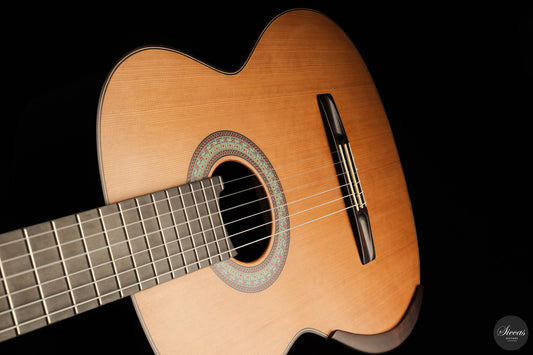
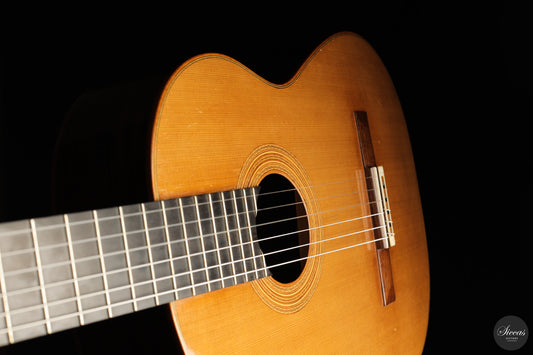
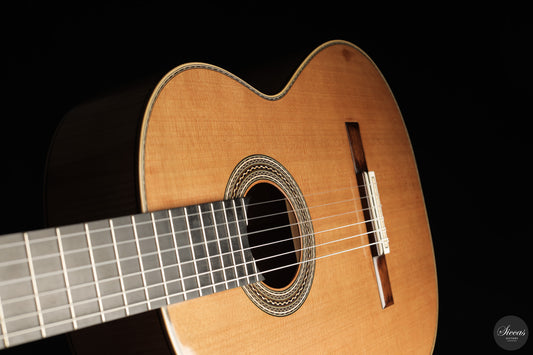
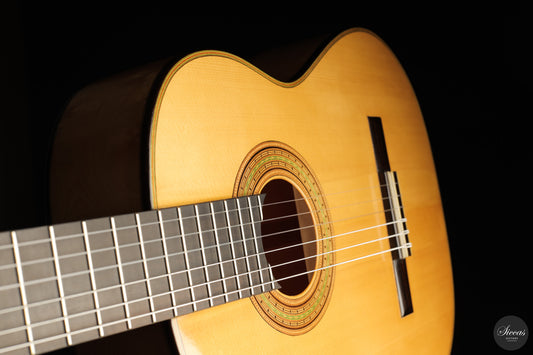
The relationship between spruce and cedar tops also matters here: spruce tops tend to produce a brighter, more projecting sound that records well in pop and film contexts, while cedar tops offer the warmth that suits bossa nova and intimate jazz recordings. You can explore both options in the spruce guitar collection and the cedar guitar collection at Siccas Guitars.
Classical Guitar's Role in Music Education and Its Downstream Effects
One of the less-discussed but most consequential channels of classical guitar's influence is music education. In many European and Latin American countries, classical guitar is the standard instrument through which children learn to read music, develop left-hand technique, and understand harmony. Guitarists who later move into pop, jazz, or rock carry this training with them.
The pedagogy established by Fernando Sor in the nineteenth century and systematised by Francisco Tárrega, Emilio Pujol, and later Andrés Segovia created a body of technique — scales, arpeggios, slurs, position shifts — that is as rigorous as the training given to violinists or pianists. Musicians who pass through this system and then work in commercial music bring its precision and harmonic understanding with them.
Mark Knopfler, whose fingerpicking style on Dire Straits recordings like "Sultans of Swing" (1978) introduced a generation of rock listeners to fingerstyle guitar, has described his technique as influenced by both country guitar and classical playing. Lindsey Buckingham's work on Fleetwood Mac recordings, particularly on Tusk (1979), uses a fingerstyle attack that is closer to classical technique than to standard rock picking.
If you are interested in how long it takes to develop this technique, our article on how long it takes to learn classical guitar covers the realistic timeline for different levels of commitment.
Contemporary Classical Crossover and the Current Landscape
The crossover between classical guitar and contemporary popular music continues to develop. Artists such as Miloš Karadaglić have recorded albums that place classical repertoire alongside arrangements of popular songs, reaching audiences that would not ordinarily attend classical concerts. His recording for Deutsche Grammophon sold well by classical standards and introduced performers like Astor Piazzolla and Manuel de Falla to a younger audience.
In contemporary recording, the nylon-string guitar appears regularly in ambient music, singer-songwriter contexts, and film and television scores. Composers working in television often reach for nylon strings when they want warmth and intimacy — the instrument's tonal character reads as human and acoustic in a way that synthesised sounds do not replicate convincingly.
The double-top guitar — an innovation of the late twentieth century that uses a sandwich construction of carbon fibre and spruce or cedar to produce an instrument with greater projection and tonal complexity — is beginning to appear in recording contexts where a traditional classical guitar would previously have been used. Siccas Guitars carries a selection of double-top guitars from leading luthiers; their combination of classical tonal character and increased volume makes them well suited to studio and live crossover applications.
The legacy of makers like Daniel Friederich, one of the most important French luthiers of the twentieth century, also continues to shape what players and composers expect from the instrument. Friederich guitars are known for their clarity and balance — qualities that transfer directly into recording and film contexts.
Conclusion: A Quiet Revolution
The influence of classical guitar on modern music is not primarily a story of concerts and conservatoires. It is a story of technique and timbre traveling through musicians who absorbed the instrument's possibilities and carried them into new contexts. João Gilberto took nylon strings to jazz-pop and won a Grammy. Paul McCartney took a Bach bourée and put it on the most successful pop album of its decade. Paco de Lucía took flamenco technique into jazz improvisation and changed what both genres thought was possible. Willie Nelson put a nylon-string guitar at the centre of country music and kept it there for fifty years.
None of these were accidents. They were the result of an instrument with a specific, irreplaceable tonal character and a technical tradition rigorous enough to survive transplantation into any genre it encountered.
For more on the broader classical guitar world — its players, its repertoire, and its instruments — see our guide to great classical guitarists and our overview of the differences between acoustic and classical guitar.