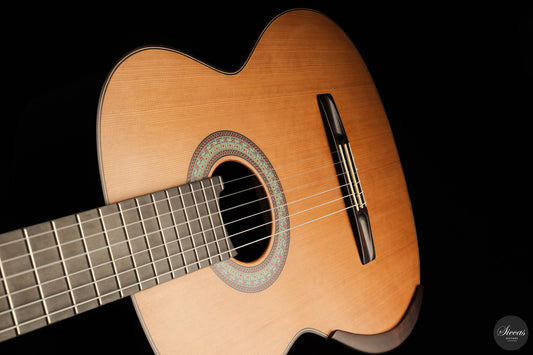
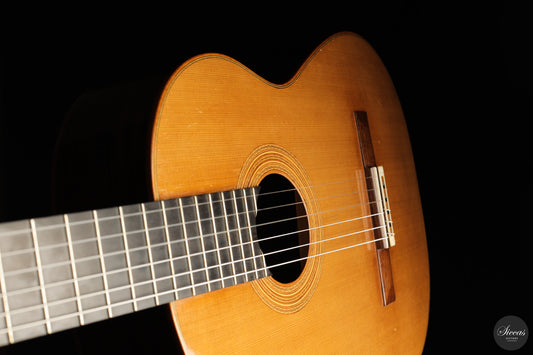
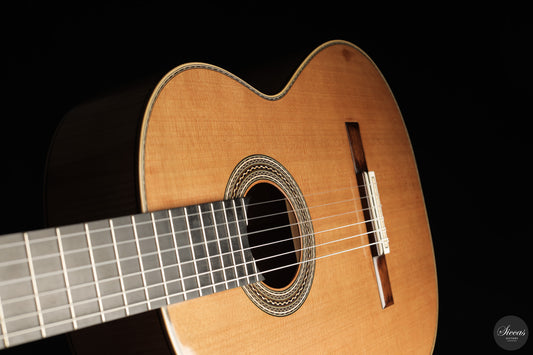
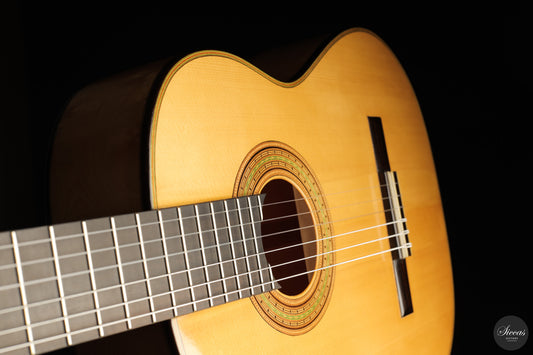
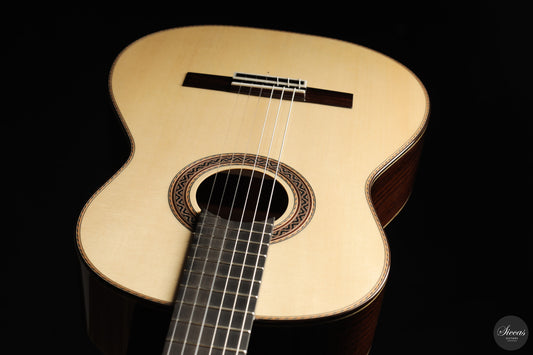
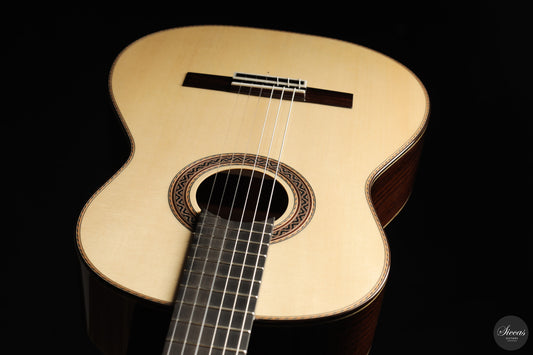
When players in the United States look for a handmade classical guitar that sits between the factory floor and the high-end European workshop, the name Kenny Hill comes up with striking regularity. Hill has been building guitars in the Santa Cruz Mountains of California — specifically around Ben Lomond — since 1981, quietly establishing a reputation for instruments that deliver genuine hand-crafted quality at prices that remain within reach for serious students and advancing players alike. His work draws on the Spanish guitar-making tradition while adapting it to the realities of a North American workshop: efficient construction methods, thoughtful model lines, and a commitment to consistency that larger makers often struggle to match at comparable price points.
This article looks at what defines a Kenny Hill guitar, which models are available, how Hill's construction philosophy developed, and why his instruments have found a loyal following among classical guitarists, teachers, and conservatory students across the United States and beyond.
A California Workshop Rooted in Spanish Tradition
Kenny Hill began making guitars in 1981, a period when the North American luthier community was deeply engaged in absorbing and reinterpreting the Spanish classical guitar tradition that had been codified over generations by makers in Madrid, Granada, and Almería. Hill studied that tradition seriously, grounding his work in the methods and aesthetics associated with the Spanish school — fan bracing, traditional internal construction, and the tonal priorities that Spanish makers refined over the course of the twentieth century.
His base in Ben Lomond, in the Santa Cruz area of California, placed him in a region that has long supported independent craft workshops. The surrounding environment — Northern California's redwood country, not far from the Pacific coast — is a long way, geographically and culturally, from Andalusia. But Hill's commitment was always to the music and the instrument rather than to geographic identity, and the Spanish construction vocabulary remained the foundation of his work even as he adapted it to his own workshop practice.
What distinguishes Hill's approach from many American luthiers of his generation is the emphasis on producing a coherent model range rather than building primarily one-off commissions for individual clients. This decision shaped his workshop into something more akin to a small production house — though "production" here always meant handmade instruments built in controlled batches, not factory output. The result is a degree of consistency across instruments that players and teachers find genuinely useful when recommending guitars to students or when ordering without the ability to play the specific instrument in advance.
The Model Range: Performance, New World, and Student Instruments
The Performance Series
The Performance series represents Hill's professional-level instruments — guitars built to the standards a conservatory student or working performer would require. These instruments draw directly on Spanish construction methods, with fan-braced spruce or cedar tops, traditional proportions, and the kind of tonal balance that rewards classical technique: a clear, focused treble register, a warm but well-defined bass, and the sustain required for legato phrasing in the concert repertoire.
The Performance series is where Hill's accumulated experience shows most clearly. Decades of building in a consistent tradition means that the maker knows exactly how the materials will behave, which graduations produce the response he is looking for, and how to manage the details — the fit of the neck joint, the stability of the finish, the evenness of the action — that determine whether a handmade guitar feels like a refined instrument or merely an ambitious one. For players exploring the famous classical guitar pieces at an advanced level, the Performance series provides a credible tool without the waiting lists and expense associated with top-tier European makers.
The New World Series
The New World series is perhaps the most discussed part of Hill's output, in part because it includes an option for lattice bracing — a structural approach quite different from the traditional fan-brace system that defines Spanish-school construction. Lattice bracing, which arranges thin carbon fibre or wooden struts in a grid pattern across the underside of the soundboard, allows for a thinner, lighter top that can vibrate more freely. The result, in skilled hands, is an instrument with a pronounced projection and a modern tonal character that suits amplified performance and larger halls.
The availability of a lattice-braced option within the New World range gives Hill's workshop an unusual versatility. Players who prefer the warmth and complexity of a traditional fan-braced instrument can choose accordingly; those who need maximum projection — for concerto work, for teaching in large rooms, or simply because they prefer the sound — have a genuine alternative from the same maker. This kind of flexibility within a single workshop's output is relatively rare, and it reflects Hill's willingness to engage with the full range of contemporary classical guitar construction rather than positioning himself as a guardian of any single approach.
If you are comparing tonal character between traditional Spanish-school construction and more modern approaches, the articles on spruce vs. cedar classical guitars and the history of the romantic guitar offer useful context for understanding how construction choices shape the sound of an instrument.
Student Instruments
Hill's workshop also produces instruments aimed at the student market. These guitars are built to a standard that is consistent with the overall workshop philosophy — careful construction, stable action, reliable tuning — while using materials and a level of finish appropriate to the price point. For teachers recommending first or second serious instruments to students who are committed enough to need a genuine classical guitar but not yet ready to invest in a Performance-level instrument, Hill's student range offers a trustworthy option.
The student instruments benefit from the same construction knowledge that informs the professional range. This matters more than it might appear: a student instrument built with a poorly fitted neck joint, uneven frets, or a top that does not respond cleanly will actively impede development. Hill's reputation in the US teaching community rests in significant part on the reliability of his student instruments as functional pedagogical tools.
If you are still deciding whether a classical guitar is the right choice at all, the comparison of acoustic vs. classical guitar covers the key differences, and the guide on how long it takes to learn classical guitar gives a realistic picture of the commitment involved.
Accessible Prices and Handmade Craftsmanship
One of the recurring themes in any discussion of Kenny Hill's work is the relationship between price and quality. Hill has consistently positioned his instruments as handmade guitars that serious players can afford — not as entry-level products that sacrifice quality for cost, but as genuinely handcrafted instruments that are priced to be accessible because of the workshop's efficient methods and the maker's decision not to operate in the prestige segment of the market.
This positioning is meaningful in the classical guitar world, where the gap between factory instruments and the guitars of internationally recognised Spanish or European luthiers can be very wide indeed. In that gap, Hill occupies a specific and valuable position: instruments with real handmade quality, built by a luthier with over four decades of experience, available at prices that a committed student or advancing amateur can realistically consider.
The consistency that comes from building a defined model range — rather than building entirely bespoke instruments — also contributes to the accessible pricing. Hill and his workshop have refined the construction process for each model to the point where the work can be done efficiently without compromising the quality of the result. This is a different philosophy from the single-instrument-at-a-time approach of the highest-tier luthiers, but it produces instruments that serve a larger portion of the guitar-playing community.
Kenny Hill in the Context of Classical Guitar Making
To understand the significance of Hill's work, it helps to place it in the broader context of the classical guitar's history. The instrument's modern form was largely defined by makers in nineteenth and early twentieth century Spain — most significantly by Antonio de Torres, whose designs established the template that most subsequent luthiers have followed. The Spanish tradition of fan bracing, cedar or spruce tops, and traditional construction methods was brought to a global audience in large part through the advocacy of Andrés Segovia, who championed the instrument throughout the twentieth century and established the classical guitar as a legitimate concert instrument.
American luthiers of Hill's generation inherited this tradition as practitioners from outside the Spanish workshop lineage, and they faced the question of how to engage with it honestly and productively. Hill's answer — serious study of the tradition, rigorous application of its methods, adaptation to the realities of a California workshop — produced a body of work that has proved durable. His guitars are not attempts to replicate the specific sound of any one Spanish maker; they are the products of a craftsman who absorbed the tradition and built his own coherent practice from it.
For players interested in exploring the full range of classical guitar, the collections of classical guitars and double-top guitars at Siccas Guitars include instruments from a range of traditions and construction philosophies, providing a useful point of comparison for understanding where Hill's work sits in the broader landscape.
Who Are Kenny Hill Guitars For?
Kenny Hill's instruments are particularly well suited to three groups of players. The first is the serious student — someone working through the classical guitar repertoire with a teacher, preparing for examinations or auditions, and needing an instrument that will not be a limiting factor in their development. The Performance and New World series both meet this requirement comfortably, and the student instruments provide a credible option for those at an earlier stage.
The second group is the advancing amateur — a player who has moved beyond the beginner stage, plays regularly, and values the tonal and technical qualities of a handmade instrument without being in a position to spend the sums required for a top-tier European guitar. Hill's pricing makes this group a realistic customer in a way that the prestige segment of the market does not.
The third group is teachers who are equipping studio libraries or recommending instruments to multiple students simultaneously. The consistency and reliability of Hill's workshop output makes it easier to recommend his instruments with confidence, knowing that the next guitar ordered will perform to the same standard as the last.
Explore the full range of instruments available from Siccas Guitars' classical guitar collection to see how Kenny Hill's work fits alongside guitars from other traditions.
Summary
Kenny Hill has spent more than four decades building classical guitars in California, applying the lessons of the Spanish guitar-making tradition to a North American workshop and producing instruments that balance handmade quality with accessible pricing. His model range — Performance, New World (with lattice bracing option), and student instruments — covers a broad spectrum of player needs, and the consistency of his output has made him a trusted name in the US classical guitar community. For players who want a genuine handmade instrument without the waiting lists and expense of the highest-tier European makers, Hill's workshop offers a compelling and well-established alternative.
The instruments. For Kenny Hill himself and his path as a maker, see Kenny Hill.