Piazzolla: Oblivion on the Classical Guitar

Piazzolla: Oblivion on the Classical Guitar

← All works

Oblivion is Piazzolla's most quietly devastating melody — a slow tango of such tenderness that it has become one of the best-loved pieces on any instrument. Since its breakthrough performance in 1984, it has been recorded by cellists, violinists, oboeists, jazz ensembles, string orchestras and classical guitarists worldwide.

The Work

Piazzolla composed Oblivion in 1982 while living in the United States. It was written for the soundtrack of Marco Bellocchio's Italian film Enrico IV (1984), an adaptation of Luigi Pirandello's play about a man who permanently assumes the identity of the Holy Roman Emperor Henry IV. The film was commercially unsuccessful, and the piece lay largely unnoticed until 29 September 1984, when Italian singer Milva performed it live at the Théâtre des Bouffes du Nord in Paris — with French lyrics by David McNeil (son of Marc Chagall) — with Piazzolla on bandoneón. That recording gave Oblivion a European audience and launched it into the standard repertoire.

The music is built on a slow milonga rhythm — a dance predating the tango, lighter and more contemplative — rather than the urgent compás of most nuevo tango. In C minor, ABA ternary form, 64 bars, it moves with the quality of a long-held breath. The harmonic language is jazz-inflected (major 7ths, sus4 chords, blue notes) but restrained: Oblivion is, by Piazzolla's own standards, unusually lyrical and "traditional."

On the Guitar

The most celebrated guitar arrangement is by Roland Dyens, published in a posthumous collection of his tango arrangements. Dyens worked on this collection in hospital right up until his death in 2016; the arrangement uses dropped-C tuning and reaches virtuosic levels, with jazz chord extensions, artificial harmonics and near-orchestral polyphony. More accessible versions by Ryuji Kunimatsu (standard tuning, free download) and others exist for intermediate players who want to work on the essential melody and bass.

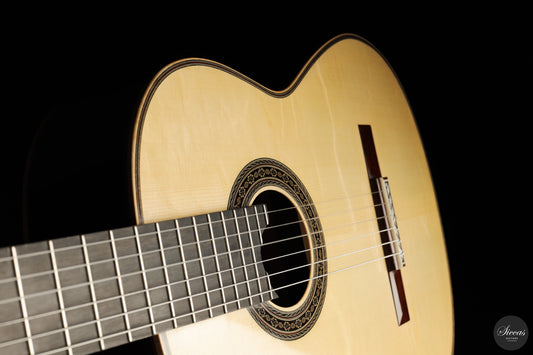
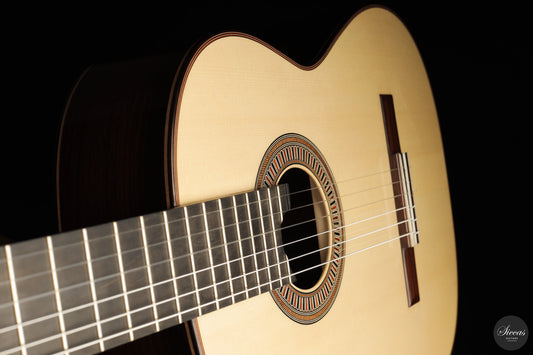
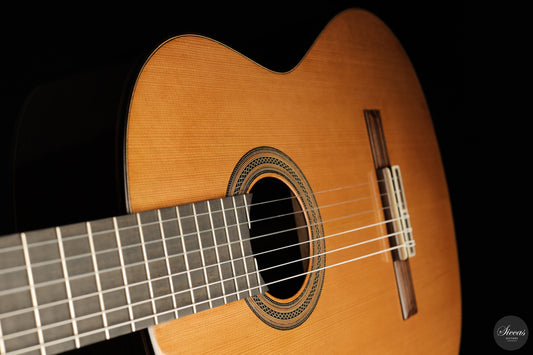
Performed at Siccas Guitars

Julia Trintschuk — Oblivion · 2020 Mario Sicca
Duo Mayr-Celis Catalán — Oblivion · 2015 Walter Verreydt
Edith Pageaud — Oblivion

Playing it

The challenge of Oblivion on guitar is sustain. The melody needs to float over the bass heartbeat — unhurried, inevitable. In simpler arrangements, the right hand carries both melody and accompaniment simultaneously, which requires clarity of voicing. In the Dyens version, the dropped-C tuning gives the bass an orchestral depth. Whichever arrangement you choose, the music rewards a patient, unhurried approach.

See the full Piazzolla guide and the companion piece Las Cuatro Estaciones Porteñas. Explore our guitar collection.

The Library
  • Classical Guitars

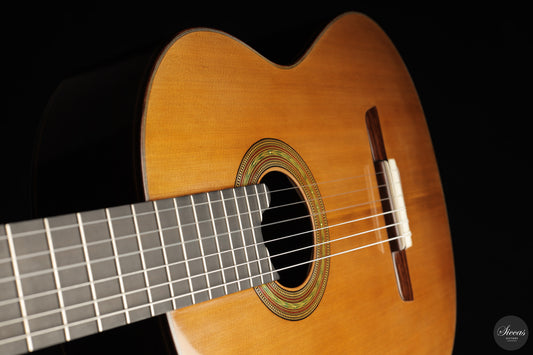
    The classical guitar, with its soft nylon strings and characteristic timbre, has become a symbol of chamber music, Spanish tradition, and concert repertoire. Its modern form was shaped by Antonio de Torres in the 19th century, setting the standard for the body, fan bracing, and the 65-centimeter scale length that are still used today. Instruments in this category open up a rich palette from the refined Romantic miniatures of Tárrega to the majestic concertos of Rodrigo. Here you will find guitars that preserve historical continuity and at the same time inspire new interpretations.
    Explore all classical guitars
  • Luthier: Antonius Müller
    Construction Year: 2013
    Construction Type: Double-Top Guitars
    Top: Cedar
    Back and Sides: Brazilian rosewood (CITES certified)
    Soundboard Finish: Lacquer
    Body Finish: Lacquer
    Weight (g): 1615
    Tuner: Rodgers
    Condition: Very good
  • Luthier: Jakob Lebisch
    Construction Year: 2022
    Construction Type: Double-Top Guitars
    Top: Cedar
    Back and Sides: Indian rosewood
    Soundboard Finish: French polish
    Body Finish: French polish
    Air Body Frequency: E / F
    Weight (g): 1240
    Tuner: Klaus Scheller
    Condition: Excellent
  • Luthier: Daniele Marrabello
    Construction Year: 2026
    Construction Type: Traditional
    Top: Spruce
    Back and Sides: Indian rosewood
    Soundboard Finish: French polish
    Body Finish: French polish
    Air Body Frequency: F / F sharp
    Weight (g): 1395
    Tuner: Kris Barnett
    Condition: New
  • Construction Year: 2026
    Construction Type: Double-Top Guitars
    Top: Cedar
    Back and Sides: Indian rosewood
    Soundboard Finish: French polish
    Body Finish: French polish
    Air Body Frequency: A
    Weight (g): 1705
    Tuner: Gotoh
    Condition: New
  • Luthier: Adrien Savary-Freestone
    Construction Year: 2020
    Construction Type: Traditional
    Top: Spruce
    Back and Sides: Indian rosewood
    Soundboard Finish: French polish
    Body Finish: French polish
    Air Body Frequency: G sharp / A
    Weight (g): 1230
    Tuner: Perona
    Condition: Excellent
  • Luthier: Jose Marques
    Construction Year: 2026
    Construction Type: Lattice
    Top: Spruce
    Back and Sides: Indian rosewood
    Soundboard Finish: Nitrocellulose
    Body Finish: Polyurethane
    Air Body Frequency: F / F sharp
    Weight (g): 1730
    Tuner: Kris Barnett
    Condition: New

Discounts and Early Access

Subscribe to our weekkly Siccas Guitars newsletter for immediate access to subscriber-exclusive discounts and early bird specials.